RBAC for AI Agents: An Audit-Ready Compliance Framework
RBAC for AI Agents: An Audit-Ready Compliance Framework

Yes, you can produce audit-ready RBAC-style evidence for AI agents without touching customer data. Metadata-driven inventories, identity graphs, and cryptographically signed evidence packs give auditors what they actually need: proof of who or what an agent is, what it's permitted to do, and who signed off on it. Regulators expect identity attributes, role and permission mapping, signed action provenance, and clear governance ownership. None of that requires reading a single customer record.
TL;DR:
- Most firms can produce tamper-evident, publish-ready RBAC evidence for AI agents using metadata, identity graphs, and cryptographically signed logs without accessing customer data.
- Key evidence categories include agent identity, role and permission mappings, deployment approvals, signed action logs, risk metrics, and governance ownership details.
- Implementing this requires a structured process: define scope and materiality, perform read-only discovery, build an agent identity graph, reconcile permissions, and verify without touching data.
- Regularly update and validate permissions, assign clear ownership, and produce cryptographically signed reports aligned with regulatory frameworks like IOSCO, EU AI Act, and FCA standards.
- Using agentless tools simplifies compliance, reduces data exposure risks, and accelerates audit readiness by providing verifiable, self-contained evidence packages.
Table of Contents
- What Audit-Ready RBAC for AI Agents Actually Looks Like
- How to Implement Agentless RBAC Evidence Without Touching Live Data
- Packaging Tamper-Evident Evidence for Regulators
- A Short Operational Checklist for Proving RBAC Compliance
- Why Agentless, Tamper-Evident RBAC Evidence Matters Now
- How Aetherpulse Delivers Audit-Ready RBAC Evidence Without Touching Your Data
- Sources
What Audit-Ready RBAC for AI Agents Actually Looks Like
Auditors don't want a narrative about your AI governance philosophy. They want artifacts. RBAC for AI agents, in the audit-ready sense, means a specific, repeatable set of evidence categories that map directly to supervisory questions.
Start with canonical agent identity. Every agent needs a stable ID, a record of its deployment context (which system it runs in, which business line owns it), and a named accountable owner. Without this, an examiner can't even begin to ask "who approved this?"
From there, you need RBAC-style attributes attached to that identity: the roles assigned to the agent, the specific actions it's allowed to take, and the scope of permissions within those actions. This is different from traditional human RBAC because agents often act across systems, so scope metadata matters as much as the role label itself. What systems can the agent call? What data classes can it reference? Are its actions reversible, or does it commit irreversible transactions?
Risk attributes come next. Materiality, financial blast-radius, and concentration indicators tell you whether ten low-risk agents are quietly clustering into one high-risk exposure. The Sound Practices consultation report flags exactly this pattern as a distinct risk of agentic AI: unauthorized actions and complex system interactions that don't show up when you evaluate agents one at a time.
Two more categories close the loop:
- Immutable provenance indicators, including signed timestamps and cryptographic signatures such as HMAC-SHA256, so no one can quietly alter a record after the fact.
- Governance ownership documentation, showing approvals, certification dates, and where oversight sits across the three lines of defense.
IOSCO's supervisory toolkit states plainly that senior management must designate responsibility for AI oversight and that firms must maintain inventories and audit trails enabling supervisory review. That's not a suggestion for large firms with big compliance budgets. It's the baseline expectation.
Pro Tip: Treat "who owns this agent" as a required field, not a nice-to-have column. Examiners ask this question first, and an unassigned owner is a worse answer than a wrong one.
How to Implement Agentless RBAC Evidence Without Touching Live Data
Building this evidence layer is a sequencing problem, not a technology problem. Get the order wrong and you end up with a partial inventory that satisfies no one.
- Define scope and materiality first. Identify which agentic use cases carry real risk (trading support, client communications, transaction processing) and assign a named owner in senior management before you build anything technical.
- Run read-only discovery. Connect to OAuth connectors, orchestration manifests, and orchestration endpoints to pull metadata only. No payload ingestion, no customer data exposure. This is the same principle behind agentless discovery workflows that compliance teams use to build inventories without touching production data.
- Build the identity graph. Canonicalize agent IDs across environments, link every deployment back to a single record, and map the chain from agent to role to business owner. Duplicate or orphaned agent records are the single most common gap examiners find.
- Reconcile permissions. Extract declared permissions directly from orchestration platforms and compare them against your intended RBAC policy. Gaps here (an agent with broader access than its role card claims) are exactly what an examiner is trained to look for.
- Validate without touching data. Simulate permitted actions, run policy simulations, and generate verifiable provenance traces that prove the control works, not just that it exists on paper.
Pro Tip: Run permission reconciliation on a quarterly cycle, not annually. Agent permissions drift faster than human role assignments because deployment pipelines change orchestration configs without anyone filing a change ticket.
The FSB's Sound Practices guidance recommends tracking agent-level identifiers across the full lifecycle, which is exactly what this sequence produces: a defensible, timestamped record from deployment to decommission.
Packaging Tamper-Evident Evidence for Regulators
An evidence pack is only useful if an auditor can trust it wasn't edited after the fact. That's the entire point of cryptographic signing.
A complete pack should contain a canonical inventory export, role and permission mappings, signed action logs, an approvals and change history record, and risk metrics covering materiality and concentration. Each of those maps to a specific question an examiner is likely to ask.
Cryptographic signing, typically using HMAC-SHA256, matters because it lets an auditor verify that a record hasn't been altered since it was generated. This is a well-established mechanism in security architecture generally, and it does the same job here: any tampering breaks the signature, which means the pack either verifies cleanly or it doesn't. There's no partial credit and no ambiguity.
| Regulator question | Evidence pack item |
|---|---|
| Who approved this agent's deployment? | Approvals and change history |
| Can you prove this action wasn't altered after the fact? | Signed action logs (HMAC-SHA256) |
| Where is your risk concentrated? | Risk metrics and materiality scoring |
| Who is accountable for this agent? | Canonical inventory with ownership field |
SEC and FINRA guidance treats existing supervisory and recordkeeping rules as technologically neutral, meaning firms are expected to adapt current recordkeeping obligations to AI agents rather than wait for AI-specific rules. That's a meaningful point: you're not waiting on new regulation to start producing this evidence.
Delivery matters too. Secure export formats, controlled viewer sessions, and reproducible indexes let you hand an auditor a self-contained package rather than a live walkthrough of production systems, which is exactly the kind of packaged oversight evidence examiners increasingly expect to see on request.
A Short Operational Checklist for Proving RBAC Compliance
Turning the above into a working program comes down to five sequenced moves:
- Define scope, name a senior owner, and document materiality for every agentic use case in production.
- Run agent discovery to build canonical IDs and a full inventory, including agents outside your immediate visibility.
- Map roles and permissions, capture approval records, and certify each agent with a recorded date and named owner.
- Turn on signed evidence exports and have internal audit independently validate that verification actually works.
- Set a re-certification cadence and build regular reporting to senior management into the calendar, not just the initial rollout.
| Checklist stage | Primary output |
|---|---|
| Scope and ownership | Documented materiality and named owner |
| Discovery | Canonical agent inventory |
| Role mapping and certification | Approved role/permission record per agent |
| Signed evidence | Verified export tested by internal audit |
| Ongoing governance | Re-certification schedule and reporting cadence |
Training matters here too. Compliance and audit staff need enough role-specific familiarity with agent behavior to actually challenge what the evidence shows them, a point FCA-aligned guidance makes explicitly about the three lines of defense. A perfect evidence pack reviewed by an untrained team is still a governance gap. High-risk agentic contexts, like those emerging in prediction market applications, make this discipline even more pressing, since the permission surface for autonomous decision-making expands quickly once agents start acting on live market signals.
Why Agentless, Tamper-Evident RBAC Evidence Matters Now
Non-invasive evidence collection isn't a compromise. It's a better answer to a real problem: audit friction and data exposure risk compound each other, and most governance tooling makes both worse by inserting itself into production. Tamper-evident, signed packs cut through supervisory back-and-forth because the proof doesn't depend on trusting a live walkthrough. The next priority for most firms isn't more tooling. It's naming an executive owner, setting a certification cadence, and asking harder questions in vendor due diligence.
— Eleye
How Aetherpulse Delivers Audit-Ready RBAC Evidence Without Touching Your Data
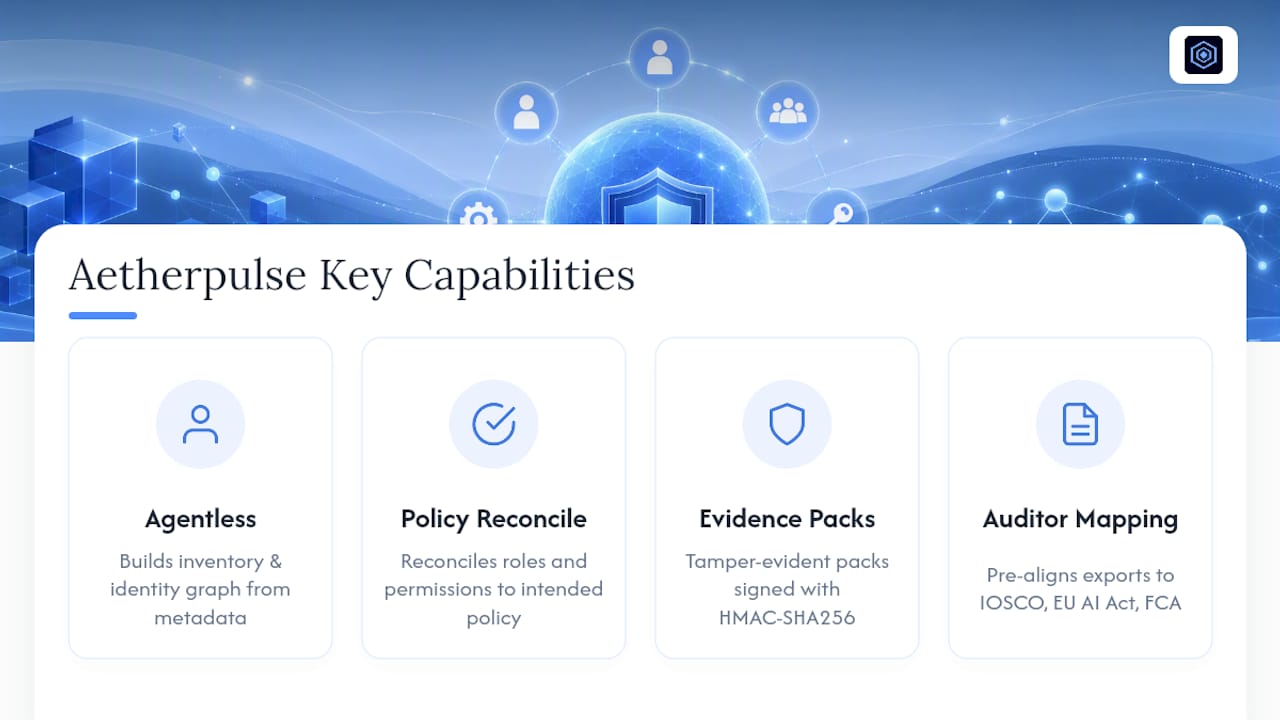
Aetherpulse is the practical answer to everything covered above: an agentless governance layer that builds your agent inventory and identity graph from metadata alone, never customer data. It reconciles roles and permissions against your intended policy, then produces tamper-evident evidence packs signed with HMAC-SHA256 so nothing in the record can be quietly altered after the fact.
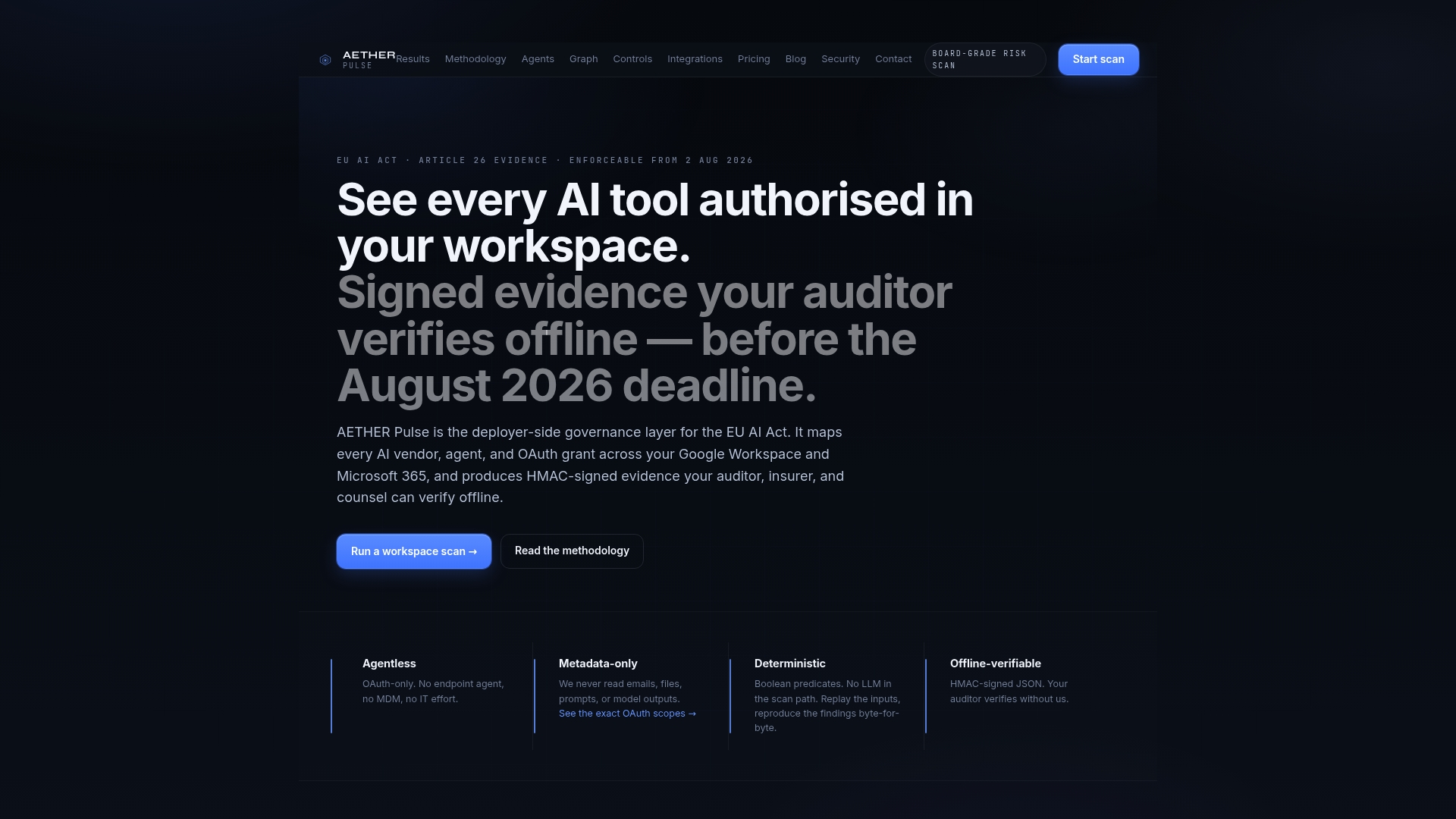
The platform maps its evidence directly to the frameworks your examiners already reference, including IOSCO's supervisory toolkit, EU AI Act Article 26, and FCA SYSC and Consumer Duty requirements, so your exports arrive pre-aligned to the questions auditors actually ask. That mapping is what turns a documentation exercise into an exam-response time saved.
If you're currently assembling this evidence manually, or not at all, it's worth seeing how the inventory and identity graph works against your own agent population. Check current pricing and plans or request a demo to see a signed evidence pack generated against a real deployment before your next exam cycle starts.
This article is general information, not a substitute for advice from a qualified financial advisor. Consult a qualified financial professional about your own circumstances before acting on anything here.
Sources
- FR/02/2026 Supervisory Toolkit for AI Use in Capital Markets
- Sound Practices for Financial Institutions' Responsible AI Adoption: Consultation Report
Recommended
Working on Article 26 readiness, deployer-side governance evidence, or AI agent risk at a regulated firm? We'd value 15 minutes of your perspective.
Start a conversation