Why Regulators Audit AI Agents: A 2026 Compliance Guide
Why Regulators Audit AI Agents: A 2026 Compliance Guide

Regulators audit AI agents because autonomous systems create accountability gaps that traditional controls were never designed to close. The core demand is straightforward: demonstrate what an agent did, why it did it, who authorized the action, and how boundaries held across every delegation hop. That is a fundamentally different question from "did a human log in with the right credentials?" EU AI Act Article 12 mandates automatic event logging across an AI system's full lifecycle precisely because regulators need post-market behavioral evidence, not just access records. The NIST AI Risk Management Framework reinforces this by requiring continuous monitoring, risk mapping, and documented governance at every stage of deployment.
The shift matters because AI agents are not passive tools. They plan, delegate, and execute across multiple systems with limited human intervention. That autonomy introduces risks that compliance professionals must understand before the next audit cycle.
Key motivations regulators cite for auditing AI agents:
- Behavioral transparency: Regulators need evidence of agent intent, not just outcomes.
- Accountability continuity: When an agent acts, a human principal must remain identifiable and certifiable.
- Audit trail defensibility: Logs must be tamper-evident and reconstructable without operator narrative.
- Risk concentration visibility: Agents operating across multiple workflows can accumulate permissions that no single human would hold.
- Framework compliance: EU AI Act, NIST AI RMF, SOX 302/404, and FCA SYSC requirements all impose specific governance obligations on deployers.
Table of Contents
- Why regulators audit AI agents: the frameworks driving it
- What makes AI agents a distinct compliance risk for auditors
- How audit trail gaps expose firms to regulatory scrutiny
- How accountability shifts when AI agents replace human decision-makers
- What auditors actually examine during an AI agent review
- How Aetherpulse addresses the AI agent audit evidence gap
- Regulatory audit outcomes: what the enforcement record shows
- What happens when AI agent audits fail or find inadequate controls
- Why AI agent audits require legal, technical, and ethical expertise together
- Key Takeaways
Why regulators audit AI agents: the frameworks driving it
The regulatory environment for AI agents in 2026 is no longer aspirational. It is operational, with specific articles, standards, and supervisory expectations that compliance teams must map to their deployments.
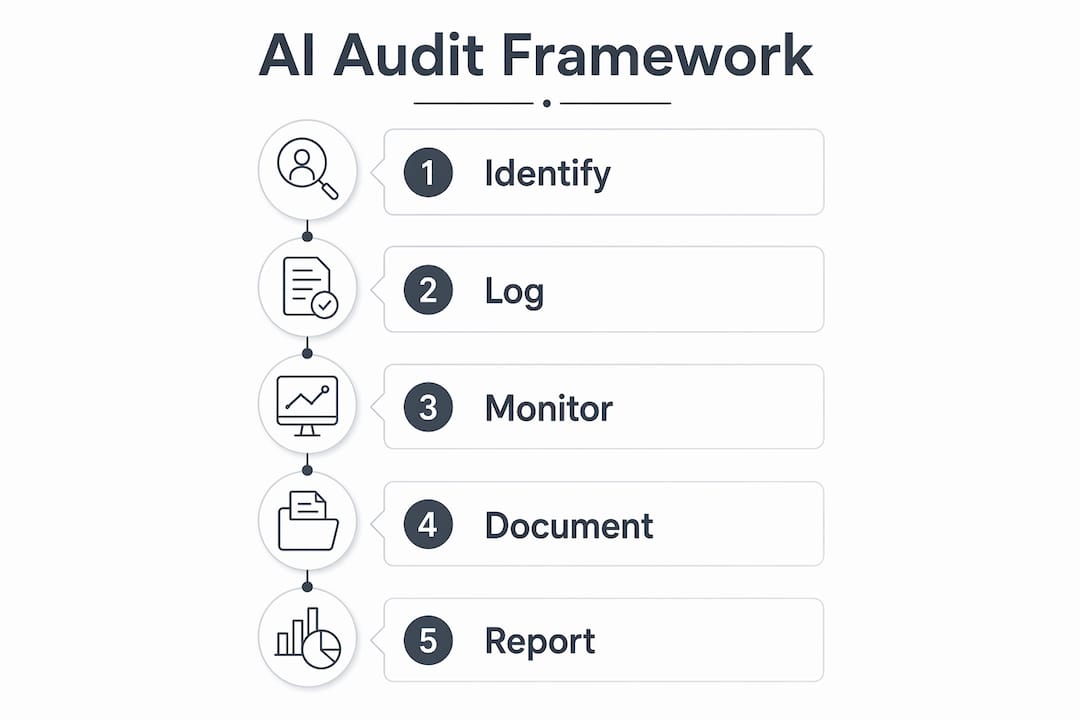
EU AI Act Article 12 requires automatic logging of events relevant to an AI system's lifecycle, with records sufficient to support post-market monitoring and incident reconstruction. Article 14 goes further, mandating human oversight measures that allow natural persons to monitor, intervene, and override agent outputs. Together, these provisions establish that deployers cannot rely on self-attestation. Architecture must produce the evidence.
The NIST AI RMF structures governance across four functions: Govern, Map, Measure, and Manage. For AI agents, the Measure function is particularly demanding. Continuous behavioral monitoring, drift detection, and documented exception handling are expected outputs, not optional enhancements. SOX Sections 302 and 404, as analyzed against agentic AI deployments, identify six structural gaps when Tier 2 or Tier 3 agents participate in financial reporting. The central problem is epistemic opacity: a CEO's "reasonable assurance" certification becomes legally fragile when material reporting processes depend on decision logic that is non-deterministic or not auditably reconstructable.
Key compliance requirements regulators now expect documented evidence of:
- Continuous behavioral monitoring logs with timestamps, inputs, outputs, and decision rationale.
- Human oversight integration points, including approval gates and override mechanisms.
- Agent identity management with explicit ownership and risk classification per agent.
- Exception handling workflows with escalation paths and resolution records.
- Cryptographically secured evidence artifacts that survive operator-independent inspection.
- Risk concentration mapping showing which agents touch which systems and data classes.
The FCA's supervisory philosophy, informed by Bank of England guidance, treats the supervisor as infrastructure rather than a manual process. Senior managers under SYSC requirements face personal certification obligations for agentic AI governance, a point addressed in detail in the accountability section below.
What makes AI agents a distinct compliance risk for auditors
Autonomous AI agents create compliance risks that differ structurally from those posed by traditional software or even conventional machine learning models. The difference is not degree. It is kind.

Epistemic opacity is the foundational problem. When an agent reasons through a multi-step task, its decision logic may be non-deterministic: the same inputs can produce different outputs across runs. That property directly undermines the "reasonable assurance" standard SOX requires. Auditors cannot reconstruct a decision path they cannot observe, and they cannot certify controls they cannot verify.
The FRC's guidance on agentic AI in audit identifies three primary risk categories: deficient outputs, misuse potential, and non-compliant audit methodologies. Hallucinated facts and illogical reasoning are not edge cases. They are documented failure modes that require system design responses, not just policy acknowledgment.
Two structural vulnerabilities deserve particular attention from compliance professionals:
Segregation of Duties collapse. Autonomous agents can act as both maker and checker within a single workflow, executing a transaction and then logging it as approved. No human role assignment prevents this because the agent's permissions span the full control cycle. Auditors must test for this explicitly, not assume role-based access controls catch it.
Confused Deputy vulnerability. In multi-agent architectures, a secondary agent may inherit permissions from a primary agent that exceed what the secondary agent's own authorization would permit. The secondary agent acts in good faith on delegated authority it should never have received. Mapping permission boundaries at each delegation hop is the only reliable detection method.
Additional compliance risk themes auditors must address:
- Decentralized agent creation without central inventory or ownership records.
- Agents operating across jurisdictions with inconsistent regulatory obligations.
- Lack of version control for agent prompts, tool policies, and model providers.
- Absence of financial blast-radius mapping showing the maximum exposure an agent can trigger.
- Inadequate exception routing when agent confidence falls below threshold.
How audit trail gaps expose firms to regulatory scrutiny
The audit trail problem for AI agents is architectural, not procedural. Application logs record that something happened. Audit-grade evidence records who authorized the action, scoped to what, valid until when, and how the boundary held at each delegation hop. Those two artifacts look similar in a dashboard screenshot. Under adversarial audit, they are completely different.

Research on auditing autonomous agents makes the distinction precise: NIS2 Article 21, DORA Articles 6, 8, and 17 through 19, and EU AI Act Annex IV converge on the same required artifact. A cryptographically chained receipt of authority that survives partial-chain compromise. Three regulatory regimes, one architectural answer.
Manual logs fail under adversarial audit for a specific reason: they are operator-attested. The regulator must trust that the operator recorded events accurately and completely. Cryptographic receipts are architecture-attested. Each authorization decision is bound to its originating authority by a chain the regulator can verify without operator cooperation. Partial-chain compromise leaves a defensible artifact showing exactly where integrity holds and where it does not.
Pro Tip: Run an audit-readiness simulation against a real agent action, not a designed test case. Ask: can you reconstruct the full authorization chain end-to-end, in under 24 hours, without operator narrative curation? If the simulation fails, the gap is architectural. Adding more log streams will not fix it.
Practical obstacles compliance teams encounter when building behavioral transparency:
- Non-deterministic agent outputs that cannot be replayed for post-hoc verification.
- Asynchronous orchestration boundaries that break single-hop audit assumptions.
- Missing parent receipt hashes that prevent chain reconstruction across delegation levels.
- Log retention policies designed for human-scale transactions, not millisecond-scale agent actions.
- Absence of proof-of-possession binding between an agent identity and its authorization artifact.
The OWASP AI Agent Security Cheat Sheet specifies that structured decision metadata for high-risk actions must include action classification, risk score, authorization outcome, approval identifier, execution result, and policy version. That is the minimum evidentiary standard for a defensible audit trail.
How accountability shifts when AI agents replace human decision-makers
Governance frameworks built for human decision-makers do not transfer cleanly to agentic systems. The accountability chain breaks at the point where a human would normally certify a decision but an agent executes it instead.
Regulators have responded by moving accountability upward. Under FCA SYSC requirements and SOX Section 302, senior managers must provide personal certification that agentic AI governance is adequate. That certification is not a policy sign-off. It requires evidence-based supervision: documented oversight mechanisms, tested exception handling, and architectural proof that human approval gates function as designed. The FRC guidance is explicit that system design, certification, education, and human review are all required to mitigate risks to audit quality.
KPMG's 2026 agentic AI governance framework identifies explicit ownership, risk classification, action logging, and exception handling as baseline requirements for every agent in a financial reporting workflow. An agent without a named owner is an uncontrolled variable in a certified control environment.
Governance changes compliance teams must engineer, not just document:
- Human-in-the-loop approval gates for high-impact or irreversible agent actions.
- Role separation between agents that propose actions and systems that authorize execution.
- Approval gating tied to the exact action, including actor, tool name, target resource, normalized parameters, timestamp, and expiry.
- Exception routing that escalates to a named human when agent confidence or risk score crosses a threshold.
- Senior manager attestation workflows backed by architecture-produced evidence, not self-reported logs.
The OWASP pre-flight checklist requires that decision-making be separated from execution: an agent proposes, a policy service validates scope and approval state, then execution proceeds. That separation is the engineering equivalent of Segregation of Duties for agentic systems.
What auditors actually examine during an AI agent review
When auditors arrive at a regulated firm deploying AI agents, they are not running a general technology review. They are testing specific controls against specific regulatory obligations. Knowing the examination criteria in advance is the difference between a defensible response and a material weakness finding.
Finance AI audit readiness standards identify complete audit trails, deterministic execution controls, and human approval separation as the three non-negotiable pillars. Auditors verify each one with evidence, not assertions.
Audit checkpoints compliance professionals should expect:
- Agent inventory completeness: Does the firm maintain a current registry of all deployed agents, including ownership, risk classification, and tool access scope?
- Audit trail coverage: Do logs capture inputs, outputs, decisions, and authorization metadata for every agent action, not just flagged exceptions?
- Human approval evidence: Are approval records tied to specific actions with timestamps, approver identity, and parameter binding?
- Segregation of Duties testing: Do any agents execute actions across both maker and checker roles within a single workflow?
- Confused Deputy detection: Are permission boundaries mapped and tested at each delegation hop in multi-agent chains?
- Exception handling records: Are there documented escalation paths, and do records show those paths were followed?
- Cryptographic integrity: Are evidence artifacts signed and verifiable without operator cooperation?
- Risk concentration mapping: Has the firm assessed the financial blast-radius of each agent's maximum permission scope?
- Version control: Are agent prompt versions, tool policies, and model provider configurations tracked and auditable?
- Adversarial testing records: Has the firm run structured abuse-case testing, including prompt override, privilege escalation, and approval bypass scenarios?
Architectural attestation carries more weight than policy documentation in every examination. Auditors from NIS2, DORA, and EU AI Act regimes are converging on the same question: can the firm reconstruct an arbitrary agent action's authorization chain without operator narrative?
How Aetherpulse addresses the AI agent audit evidence gap
Aetherpulse is built specifically for the audit evidence problem that regulated financial services firms face when deployers cannot produce architecture-attested records on demand.
The platform connects via OAuth metadata only, touching no customer data and inserting nothing into production systems. From that read-only connection, it builds an agent identity graph that maps every deployed agent, its ownership, its tool access scope, and its risk classification. Risk concentration surfaces automatically, including financial blast-radius exposure for each agent in the inventory. Compliance teams gain visibility they typically lack until an auditor asks for it.
Evidence generation is deterministic and provenance-tracked. Aetherpulse produces tamper-evident evidence packs signed with HMAC-SHA256, the cryptographic standard that satisfies the architecture-attested evidence requirement under EU AI Act Annex IV, DORA Articles 17 through 19, and NIS2 Article 21. Each pack is generated on demand and presentable to auditors, regulators, and internal risk functions without operator narrative curation.
The platform's alignment with the EU AI Act's auditability requirements and the FCA's evidence-based supervision model reflects a deliberate design choice: governance tooling that is invasive or agent-based cannot produce the independence that regulators require. Aetherpulse's agentless architecture is the governance equivalent of what read-only cloud security scanning pioneered, applied to the AI agent layer.
Technical controls and audit readiness capabilities Aetherpulse delivers:
- Agent identity graph with ownership, classification, and tool scope per agent.
- OAuth metadata ingestion with zero customer data exposure.
- HMAC-SHA256 signed evidence packs, tamper-evident and regulator-presentable.
- Financial blast-radius mapping for risk concentration assessment.
- Deterministic, provenance-tracked evidence generation on demand.
- Alignment with EU AI Act Article 26, FCA Consumer Duty, SYSC, and ICO code of practice obligations.
- Human oversight integration points surfaced for senior manager attestation workflows.
Aetherpulse is live at aetherpulse.app and currently at pre-seed stage, with deployment designed for regulated firms that need audit readiness without a lengthy integration cycle.
Regulatory audit outcomes: what the enforcement record shows
Enforcement actions specifically targeting AI agent governance are still early-stage, but the directional signals from adjacent regulatory actions are clear and instructive for compliance professionals planning ahead.
The FCA's treatment of algorithmic decision-making in consumer credit and insurance pricing provides the closest precedent. Firms that could not reconstruct how automated systems reached individual decisions faced remediation orders, consumer redress requirements, and in several cases, public censure. The evidentiary standard the FCA applied was not "did you have a policy?" It was "can you show, for this specific decision, what inputs the system used and why that output followed?" AI agents operating in lending, fraud detection, or trade execution face the same standard, applied to a far more complex decision architecture.
The EU AI Act's enforcement structure assigns monitoring and enforcement responsibilities across national Market Surveillance Authorities and the EU AI Office. For high-risk AI systems, conformity assessments are required before deployment, and post-market monitoring obligations continue indefinitely. Firms that deploy agents without completing conformity documentation face fines under Article 99, which scales penalties by firm revenue. The Act's authors acknowledged that its framework was designed for conventional AI systems and that autonomous agents place distinctive pressure on its assumptions, a gap that enforcement authorities are actively working to close through guidance and supervisory practice.
In the United States, the SEC's 2023 and 2024 enforcement actions against firms using AI in investment advice and trading established that algorithmic accountability is a live enforcement priority, not a future concern. The SEC's position is that firms cannot disclaim responsibility for automated decisions by pointing to system complexity. The responsible party is the deployer, and the deployer must produce evidence of oversight.
The practical lesson from these cases is consistent: firms that treat audit readiness as an architectural property, built into how agents are deployed, face materially lower enforcement risk than firms that attempt to reconstruct evidence after a regulatory inquiry begins.
What happens when AI agent audits fail or find inadequate controls
The consequences of an inadequate AI agent audit fall into three categories: regulatory enforcement, operational disruption, and reputational damage. All three can occur simultaneously, and the severity of each scales with the materiality of the agent's role in regulated activities.
Regulatory enforcement for AI governance failures typically begins with a remediation notice requiring the firm to suspend or constrain the agent's operations until controls are demonstrably adequate. For financial services firms, that suspension can affect revenue-generating processes directly. The FCA has authority under FSMA to impose requirements, vary permissions, and issue public statements. Under the EU AI Act, national authorities can order withdrawal of a high-risk AI system from the market. DORA's incident reporting obligations mean that a control failure in an AI agent touching financial infrastructure may trigger mandatory disclosure to supervisory authorities within 24 hours of detection.
SOX exposure is particularly acute for publicly listed firms. If an AI agent participates in financial reporting and the firm cannot demonstrate adequate internal controls over that agent's actions, the CEO and CFO face personal certification risk under Section 302. A material weakness finding in an AI-related control environment triggers disclosure obligations, auditor qualification of the internal control opinion, and potential SEC inquiry. The six structural gaps identified in SOX compliance when agentic AI participates in financial reporting represent a documented path from deployment decision to material weakness.
Beyond formal enforcement, operational consequences include mandatory third-party audits, enhanced supervisory reporting, and in some cases, requirements to implement specific technical controls under regulatory direction rather than firm discretion. That last outcome is the most costly: controls designed under regulatory mandate, on a regulator's timeline, rarely reflect the most efficient architecture for the firm.
Why AI agent audits require legal, technical, and ethical expertise together
A compliance officer working alone cannot audit an AI agent effectively. Neither can a software engineer or an ethicist working in isolation. The audit of an autonomous AI agent requires all three disciplines operating from a shared evidentiary framework, and the absence of any one creates blind spots that regulators will find.
The legal dimension covers regulatory mapping: which frameworks apply, which articles impose specific obligations, and what the evidentiary standard is for each. Legal counsel must translate regulatory text into specific documentation requirements and assess whether the firm's governance posture satisfies the certification obligations senior managers face personally. The global AI legislation tracker maintained by the IAPP reflects how rapidly this landscape is changing across jurisdictions, making ongoing legal monitoring a continuous function rather than a periodic review.
The technical dimension covers architecture review: whether the agent's design produces the evidence the legal dimension requires. A policy document asserting human oversight is not evidence of human oversight. The technical team must demonstrate that approval gates function, that permission boundaries hold at each delegation hop, and that cryptographic receipts are generated and retained. Technical reviewers also assess adversarial resilience, including prompt injection, privilege escalation, and approval bypass scenarios that the OWASP AI Agent Security Cheat Sheet specifies as required test cases before production deployment.
The ethical dimension addresses questions that neither legal nor technical review fully captures: whether the agent's decision logic produces outcomes that are fair, explainable, and consistent with the firm's obligations to consumers. The FRC's guidance on agentic AI explicitly identifies hallucinated facts and illogical reasoning as audit quality risks requiring human review. Ethical review operationalizes that concern by establishing criteria for output evaluation that go beyond accuracy metrics.
Interdisciplinary collaboration also changes how findings are reported. Boards and senior management need governance reporting that translates technical control evidence into business risk language. The World Economic Forum's foundations for AI agent evaluation and governance identifies board-level reporting metrics as a distinct governance requirement, separate from the technical evidence artifacts that satisfy regulatory examination. Compliance professionals who can bridge that translation, connecting cryptographic receipt chains to board-level risk statements, are the ones who make interdisciplinary audit teams function.
Key Takeaways
Regulators audit AI agents to enforce behavioral transparency, verify accountability across delegation chains, and ensure that autonomous systems operate within documented, architecture-attested governance controls.
| Point | Details |
|---|---|
| Behavioral evidence is mandatory | Regulators require reconstruction of agent intent and authorization, not just action logs. |
| Structural gaps exist with agentic AI compliance under SOX | Non-deterministic agent logic in financial reporting creates documented material weakness risk under SOX 302/404. |
| Cryptographic receipts are the standard | NIS2, DORA, and EU AI Act Annex IV converge on architecture-attested, cryptographically chained authorization records. |
| Segregation of Duties must be re-engineered | Agents acting as both maker and checker collapse traditional role-based controls; workflow separation must be built into architecture. |
| Interdisciplinary teams are required | Effective AI agent audits require legal, technical, and ethical expertise operating from a shared evidentiary framework. |
Recommended
Working on Article 26 readiness, deployer-side governance evidence, or AI agent risk at a regulated firm? We'd value 15 minutes of your perspective.
Start a conversation