AI Compliance Gap Assessment Guide for Regulated Firms
AI Compliance Gap Assessment Guide for Regulated Firms

A successful AI compliance gap assessment must produce five concrete deliverables: an auditable inventory, a risk-tiered classification, a controls mapping crosswalk, a defensible evidence pack, and a prioritized remediation plan. Start there. The single immediate action: assign an owner today to verify or build the AI inventory within seven days, covering every system the firm develops, deploys, imports, or distributes.
- Auditable inventory: catalog all AI agents, including those embedded in SaaS tools accessed via APIs
- Risk classification: apply regulatory tier criteria (EU AI Act tiers, SR 11-7 model risk analogues) to each system
- Controls mapping: link each obligation to a named control owner and an evidence artifact
- Evidence pack: tamper-evident, provenance-tracked documentation an examiner can read without your help
- Remediation plan: prioritized by regulatory urgency, exposure, and cross-system dependency
Pro Tip: Assign the inventory task to a named owner with a seven-day deadline before any other assessment work begins. Without a complete inventory, risk classification cannot begin — every subsequent step depends on knowing what AI you actually operate.
Table of Contents
- What does a rapid AI compliance checklist cover?
- How to run the gap assessment step by step
- What governance maturity dimensions should you target?
- How do you prioritize remediation findings?
- What evidence do auditors and examiners actually expect?
- How does an agentless, metadata-only evidence layer work?
- What tools and templates should you produce?
- How long does a baseline gap assessment take?
- What should you hand to senior stakeholders and regulators?
- Key Takeaways
- The gap most compliance teams don't see until it's too late
- Audit readiness without the invasive tooling
- Authoritative sources and standards to consult
What does a rapid AI compliance checklist cover?
A rapid AI regulatory gap analysis produces two artifact classes: an executive one-pager and a per-system evidence file.
Executive one-page summary fields: firm name, assessment date, total AI systems inventoried, count by risk tier, top three control gaps, remediation budget ask, and sign-off authority.
Minimum per-system artifacts:
| Artifact | Description | Owner |
|---|---|---|
| System description | Purpose, inputs, outputs, decision scope | Product lead |
| Risk tier | Regulatory classification with rationale | Compliance officer |
| Data sources | All data reachable by the model, including third-party feeds | Data governance |
| Model card | Training data, performance benchmarks, known limitations | ML lead |
| Human-oversight log | Timestamps, operator ID, action taken for each intervention | Operations |
| Monitoring snapshot | Drift rate, accuracy threshold, alert history | ML/Infra |
| Vendor contract pointer | SLA, liability, audit-right clauses | Legal |
Rapid readiness checklist (compliance lead sign-off):
- Inventory complete and version-controlled
- Every system assigned a risk tier with documented rationale
- Control gaps scored against at least one framework (NIST AI RMF or EU AI Act)
- Evidence artifacts linked to specific regulatory obligations
- Remediation plan with named owners and target dates
- Executive summary drafted and reviewed by CCO
How to run the gap assessment step by step
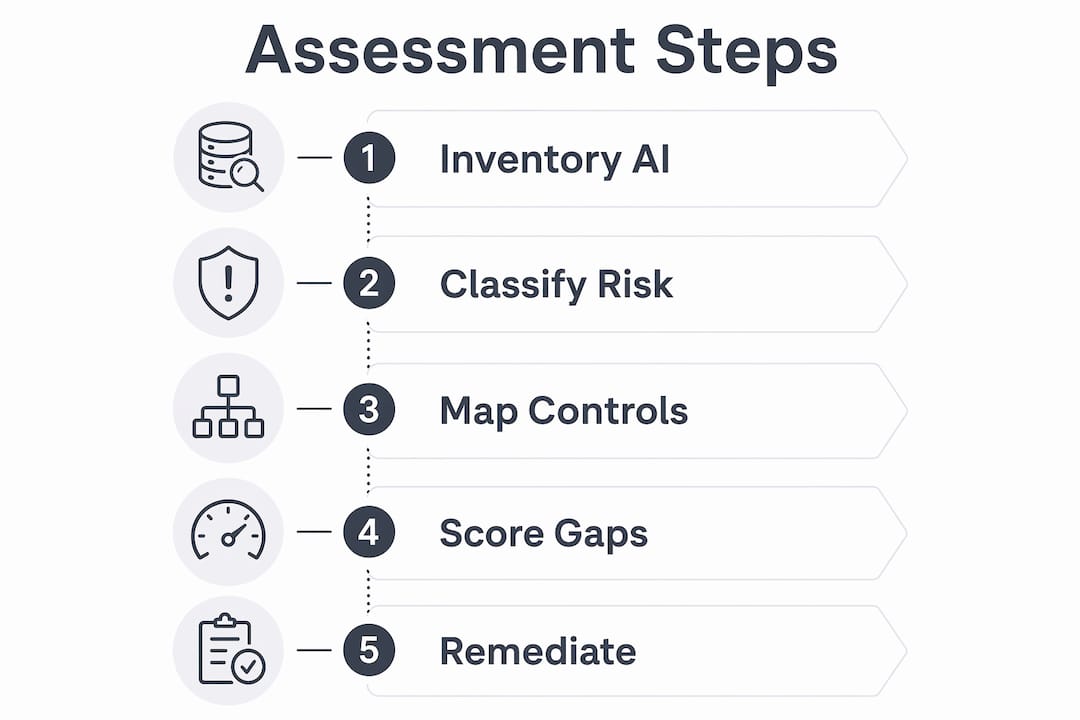
A workable assessment runs in four phases: scope and inventory, obligation-to-control mapping, evidence collection and testing, and reporting with remediation. Skipping the scoping phase wastes effort and produces incomplete findings.
- Plan: Define the legal perimeter (EU AI Act, SR 11-7, FCA SYSC), name the assessment sponsor, identify quick wins (systems already documented), and set the scope boundary.
- Inventory: Use three discovery methods in parallel: query the managed system register, scan OAuth authorization logs for third-party AI connectors, and review SaaS app integrations. Shadow AI — agents embedded in vendor tools and accessed via APIs — is a frequent audit failure point.
- Classification: Apply risk-tier rules to each inventoried system. Map each tier to its applicable obligations using a controls crosswalk.
- Controls mapping: For each obligation, record the control owner, the evidence artifact, and the current gap score (0–5 scale, where 3 = defined/documented but not yet validated).
- Evidence collection: Gather logs, human-intervention records, bias test results, and provenance metadata. Policy documents alone will not satisfy an examiner.
- Prioritize and schedule remediation: Rank findings by regulatory urgency, consumer impact, and technical dependency. Fix foundational gaps first.
- Monitoring: Define drift detection thresholds, alerting cadence, and evidence retention periods before closing the assessment.
Controls crosswalk template:
| Obligation | NIST AI RMF | EU AI Act Article | ISO/IEC 42001 | Control owner | Gap score |
|---|---|---|---|---|---|
| Risk management system | GOVERN | Art. | 6.1 | CRO | 2 |
| Data governance | MAP | Art. | — | Data governance | 1 |
| Technical documentation | MANAGE | Art. 11 | — | Product lead | 3 |
| Human oversight | GOVERN 4.1 | Art. 14 | 8.6 | Operations | 2 |
| Post-market monitoring | MEASURE | Art. | — | ML lead | 1 |
What governance maturity dimensions should you target?
The MITRE AI Maturity Model frames governance across three interdependent dimensions: data, process, and people. Each dimension has observable evidence that distinguishes genuine maturity from policy theater.
| Dimension | Level 2 (Developing) | Level 3 Target (Defined) | Observable evidence |
|---|---|---|---|
| Data | Ad hoc data quality checks | Documented data governance with bias examination | Data quality policy, bias test logs, dataset cards |
| Process | Informal risk reviews | Structured lifecycle reviews with sign-off gates | Risk register, change management records, audit trail |
| People | Awareness only | Named roles, training records, accountability matrix | RACI, training completion logs, escalation records |
Reach Level 3 in inventory and classification before investing in automation or advanced monitoring. Practitioners consistently advise that foundational maturity in these two areas unlocks every downstream control. Most organizations should target a defined maturity baseline across all dimensions within the first year, with a plan to advance towards higher maturity over the next two years.
Pro Tip: Do not apply conventional software QA to non-deterministic AI. A model that passed testing at deployment can drift into non-compliance within weeks. Governance maturity means continuous monitoring and drift detection, not a one-time launch review.
How do you prioritize remediation findings?
Triage findings on three axes: regulatory urgency (binding deadline or active examination), impact on consumers or fundamental rights, and technical dependency (a gap that blocks other controls from functioning).
- Score each finding: Regulatory urgency (0–3) + consumer impact (0–3) + dependency count (0–2) = priority score (max 8). Scores of 7–8 are blockers; 5–6 are high; 3–4 are medium; below 3 are low.
- Blocker (Days 1–30): Missing inventory, unclassified high-risk systems, no human-oversight logs. Owner: CCO and ML lead. Acceptance criteria: inventory signed off, logs active, risk tier documented.
- High (Days 31–60): Incomplete technical documentation, no bias testing history, vendor contracts lacking audit rights. Owner: Product lead and Legal. Acceptance criteria: model cards complete, bias test run and recorded, contracts amended.
- Medium (Days 61–90): Monitoring thresholds not defined, drift alerting not configured, evidence retention policy missing. Owner: ML/Infra. Acceptance criteria: thresholds set, alerts tested, retention schedule approved.
- Low findings (documentation formatting, minor policy gaps) are scheduled after the 90-day sprint closes.
- Dependency mapping matters: fixing the inventory gap first unlocks classification, which unlocks controls mapping. The sequence is not arbitrary.
What evidence do auditors and examiners actually expect?
Auditors require business-readable documentation that links technical logs to governance claims. Technical logs alone are insufficient. Build a two-column artifact for each control: technical evidence on the left, business narrative on the right.

Evidence index template:
| Artifact | Control | Framework claim | Metadata required |
|---|---|---|---|
| Human-oversight log | Human oversight active | EU AI Act Art. 14 / NIST GOVERN 4.1 | Timestamp, operator ID, action taken, system version |
| Bias test report | Non-discrimination | EU AI Act Art. / ISO 42001 — | Test date, dataset version, methodology, outcome |
| Drift monitoring snapshot | Ongoing accuracy | NIST MEASURE / Art. | Metric name, threshold, current value, alert history |
| Model card | Technical documentation | EU AI Act Art. 11 / ISO 42001 — | Version, training data hash, known limitations |
Tamper-evidence requirements:
- Apply HMAC-SHA256 signatures to each evidence artifact at the point of generation
- Record the hash, signing key reference, and generation timestamp in the evidence index
- Store signed packs in write-once storage with access logs
- Map controls across frameworks so a single evidence artifact satisfies multiple examiners simultaneously
Human-in-the-loop logs must show timestamps, operator ID, and the action taken. Policy-only oversight will be flagged in any examination.
How does an agentless, metadata-only evidence layer work?
An agentless approach ingests OAuth metadata and connector logs without touching customer data or inserting agents into production systems. The result is an inventory and identity graph built from what the firm's authorization layer already knows.
Evidence pack schema (metadata-only):
- Inventory snapshot: system name, OAuth client ID, scopes granted, last-active timestamp
- Identity graph: agent-to-agent and agent-to-data-source relationships derived from authorization metadata
- Event timestamps: authorization grants, scope changes, connector activations
- Signed hashes: HMAC-SHA256 applied to each snapshot at generation, stored with key reference
Integration checklist:
- OAuth provider access (read-only scopes only)
- SaaS connector inventory (list of authorized third-party apps)
- Network metadata feed or API gateway logs (for shadow AI discovery)
- Typical deployment timeline for a baseline pilot: two to four weeks
Limitations: Metadata-only approaches cannot prove what a model computed, only that it was authorized and active. For high-risk systems requiring evidence of model outputs, bias test results, or human-intervention records, full-data evidence collection remains necessary. Agentless layers are most defensible for inventory completeness, authorization provenance, and access-scope audits.
Pro Tip: Aetherpulse connects via OAuth metadata only, building an AI agent inventory and identity graph without accessing customer data. For firms that need audit-ready evidence fast, this is the lowest-friction starting point.
What tools and templates should you produce?
Inventory CSV schema (example header row):
Dashboard metrics to track during assessment:
- Percentage of AI systems inventoried
- Percentage classified by risk tier
- Model drift rate (per system, rolling 30-day)
- Time-to-remediation for blocker and high findings
- Evidence artifact completion rate (artifacts filed vs. required)
Useful tool categories: discovery (OAuth log analyzers, SaaS connector scanners), monitoring (model performance dashboards, drift detection pipelines), and evidence packaging (document management with version control and hash generation). The mechanics of cataloging AI tools across a portfolio apply across regulated domains, not only financial services.
Adapt any template to the firm's existing change management process so artifacts slot into the governance workflow rather than creating a parallel paper trail.
How long does a baseline gap assessment take?
A single high-risk system assessment runs 8–12 weeks. A full portfolio assessment for an enterprise with a large AI estate can require 16 weeks or more. For high-risk systems under binding frameworks, conformity assessment and technical documentation can take 12–24 months; starting early is the only mitigation.
Staffing table:
| Role | Tasks | Estimated FTE-days |
|---|---|---|
| Chief Compliance Officer | Scope sign-off, regulator liaison, executive reporting | 5–8 |
| Product lead | System descriptions, model cards, vendor contracts | — |
| ML lead | Bias testing, drift monitoring, technical documentation | — |
| Infrastructure lead | Log access, evidence storage, hash generation | 5– |
| External reviewer | Independent gap scoring, notified body liaison (if required) | 8– |
Cost factors that increase scope: number of high-risk systems, cross-jurisdictional evidence requirements (EU AI Act plus SR 11-7 analogues), and whether a notified body or external auditor is required. Firms with ISO/IEC 42001 certification can reuse a significant portion of existing documentation, compressing both timeline and cost.
What should you hand to senior stakeholders and regulators?
The minimal handoff package contains five items: inventory snapshot, risk register, prioritized remediation plan, evidence index, and a one-page executive summary with a clear budget and authority ask.
Handoff checklist:
| Document | Purpose | Audience |
|---|---|---|
| Inventory snapshot | Proves scope and completeness | Regulator, CRO |
| Risk register | Shows classification rationale and residual exposure | Board, CRO |
| Remediation plan | Named owners, dates, acceptance criteria | CCO, CRO, Board |
| Evidence index | Links artifacts to obligations | Examiner, auditor |
| Executive summary | One page: gaps, ask, timeline | Board, CEO |
Sample executive slide outline:
- Slide 1: Assessment scope and methodology (systems covered, frameworks applied)
- Slide 2: Inventory summary (total systems, risk tier breakdown)
- Slide 3: Top five control gaps with gap scores
- Slide 4: Remediation roadmap (30/60/90-day sprint plan)
- Slide 5: Budget and authority ask with sign-off request
Request three governance decisions from the board or CRO: remediation budget approval, authority for the CCO to mandate control changes across business units, and a formal timeline aligned to regulatory deadlines.
Key Takeaways
A complete AI compliance gap assessment requires an auditable inventory, risk classification, controls mapping, tamper-evident evidence, and a prioritized remediation plan before any examiner conversation.
| Point | Details |
|---|---|
| Inventory first | Without a complete AI inventory, risk classification cannot begin — assign an owner with a seven-day deadline. |
| Level 3 maturity as baseline | Reach defined/structured maturity in inventory and classification before investing in monitoring automation. |
| Evidence must be business-readable | Link every technical log to a governance claim; auditors reject technical artifacts without a narrative. |
| High-risk timelines are long | Conformity assessment and technical documentation for high-risk systems can take 12–24 months; start immediately. |
| Aetherpulse for fast inventory | Aetherpulse builds an AI agent inventory and identity graph via OAuth metadata only, producing HMAC-SHA256 signed evidence packs without accessing customer data. |
The gap most compliance teams don't see until it's too late
The conventional wisdom on AI compliance is that the hard part is the frameworks: NIST AI RMF, EU AI Act, ISO/IEC 42001. Learn the frameworks, map your controls, done. That framing is wrong, and it leads teams to spend weeks on crosswalk spreadsheets while the actual gap widens underneath them.
The real problem is almost always the inventory. Not the classification, not the evidence packaging. The inventory. Firms routinely discover AI agents they did not know they were operating, embedded in SaaS tools authorized years ago via OAuth grants that nobody reviewed. Those systems are making decisions, touching customer data, and generating no oversight logs. When an examiner asks for the inventory, the honest answer is often "we don't have one."
The second mistake is treating governance maturity as a documentation project. Policies and model cards matter, but they are not governance. Governance is the continuous practice of monitoring, detecting drift, logging human interventions, and closing findings. A firm that produces a beautiful evidence pack at assessment time and then does nothing for 11 months is not governed. It is performing governance for the camera.
The teams that come out of examinations well are the ones that built the inventory first, assigned real owners to real controls, and produced evidence that existed before the examiner asked for it. That evidence is not impressive because it is comprehensive. It is impressive because it is contemporaneous, signed, and traceable.
Audit readiness without the invasive tooling
Regulated firms deploying autonomous AI agents face a specific problem: the governance tooling that exists is either too invasive (inserting agents into production) or too slow (manual evidence assembly). Aetherpulse is built for exactly this gap.

Aetherpulse connects via OAuth metadata only, building an AI agent inventory and identity graph without touching customer data or inserting itself into production systems. It surfaces risk concentration, including financial blast-radius exposure, and generates tamper-evident, HMAC-SHA256 signed evidence packs on demand. For compliance officers who need to demonstrate oversight of autonomous agents to the FCA, EU AI Act examiners, or internal audit, this is the fastest route from zero to audit-ready. Deployment for a baseline pilot typically runs two to four weeks.
Request a readiness pilot or demo at aetherpulse.app with your inventory scope and target framework, and the team will confirm what a baseline evidence pack covers for your specific regulatory context.
Authoritative sources and standards to consult
The frameworks and guidance documents below are the primary references for any AI compliance evaluation strategy. Map them into a single crosswalk so evidence artifacts satisfy multiple frameworks simultaneously, reducing duplication across examinations.
- EU AI Act (Regulation 2024/1689): The binding EU framework. Use the official Compliance Checker to identify which obligations apply to each system. Prohibited practices enforceable since February 2025; high-risk requirements due August 2026.
- NIST AI RMF (AI 100-1): The primary US reference for AI risk management. Organizes obligations across GOVERN, MAP, MEASURE, and MANAGE functions. Use as the spine of your controls crosswalk.
- ISO/IEC 42001: AI management system standard. Firms with existing certification can reuse substantial documentation for EU AI Act evidence packs.
- MITRE AI Maturity Model: Frames governance maturity across data, process, and people dimensions on a five-level continuum. Use to set baseline targets and sequence remediation.
- SR 11-7 / Model Risk Management guidance: The Federal Reserve and OCC's model risk framework remains the baseline for US financial services. Map AI-specific obligations onto its validation and governance requirements.
- FCA Consumer Duty and SYSC: For UK-regulated activities, these set the human oversight and fair-outcomes expectations that AI governance must satisfy.
Crosswalk approach: Build a single master matrix with one row per obligation and columns for each framework. A control that satisfies NIST AI RMF GOVERN 4.1 typically also satisfies EU AI Act Article 14 and ISO/IEC 42001 clause 8.6. Reusing evidence across frameworks is the most efficient path to multi-examiner readiness.
This article is general information, not legal or regulatory advice. Confirm current obligations with the relevant primary sources or a qualified compliance professional for your specific situation.
Recommended
Working on Article 26 readiness, deployer-side governance evidence, or AI agent risk at a regulated firm? We'd value 15 minutes of your perspective.
Start a conversation