AI Agent Discovery Enterprise Workflow: A Compliance Guide
AI Agent Discovery Enterprise Workflow: A Compliance Guide

Regulated financial firms need an evidence-first AI agent discovery enterprise workflow now. Implement it by running a full-surface scan, correlating agent identities, mapping execution modes, and packaging cryptographically signed evidence packs for OCC and SEC supervisory review.
Immediate next steps:
- Run parallel detection across metadata, network telemetry, and eBPF runtime hooks to surface every active agent, including those with no deployment record.
- Correlate agent identities across machines to build a living AIBOM (AI Bill of Materials) that separates distinct agents from multiple instances of the same agent.
- Map each automated process step to one of three execution modes: deterministic, AI-assisted, or human-gate, before any agent reaches production.
- Package findings into a tamper-evident evidence pack using HMAC-SHA256 signing for auditor and regulator delivery.
- Register every discovered agent in an AgentOps governance registry with owner attribution, risk score, and lifecycle status.
Pro Tip: Start with your highest-frequency runbooks, such as phishing triage or access request routing. These carry the most regulatory exposure and produce the most defensible evidence quickly.
Table of Contents
- What does AI agent discovery mean for regulated financial firms?
- Which technical methods actually find all your agents?
- How should your team run the operational discovery workflow?
- What does audit-ready evidence actually look like?
- How do you integrate discovery with existing RPA and BPM without replacing them?
- Which KPIs prove your discovery program is working?
- What does a realistic pilot-to-scale timeline look like?
- What do US regulators and internal auditors expect to see?
- Why an agentless, read-only evidence layer is the right operational pattern
- Key Takeaways
- The accountability gap is wider than most firms realize
- Aetherpulse gives you signed evidence before your next examination
- Useful sources and further reading
What does AI agent discovery mean for regulated financial firms?
Enterprise AI agent discovery is the systematic process of inventorying every autonomous agent, runtime process, and associated metadata operating across an organization's environment. It is not a one-time audit. It is a continuous operational discipline that feeds two governance primitives: the AIBOM and AgentOps.
An AIBOM is a structured, versioned record of every AI agent in the enterprise, analogous to a software bill of materials but scoped to autonomous decision-making components. AgentOps is the governance framework that uses that living inventory to enforce lifecycle controls, detect behavioral drift, and generate traceable evidence on demand. Neither works without a reliable, continuously updated discovery layer beneath them.
Regulated firms face a specific accountability gap: agents can be deployed by business units, third-party vendors, or developers without appearing in any change-control record. An accountability gap in AI governance means that when an OCC examiner or SEC reviewer asks "show me every automated decision-maker touching client accounts," most firms cannot answer with confidence. Discovery closes that gap.
For US financial regulators, the stakes are concrete. Supervisory requests require audit trails, owner assignments, and incident histories. Blast-radius assessments require knowing which agents have access to financial systems and what exposure they carry. An intelligent workflow that integrates analytics, AI reasoning, and automation increases visibility across complex activities, but only when the underlying agent inventory is accurate and current.
Which technical methods actually find all your agents?
No single detection method is sufficient. Effective enterprise scanners correlate five simultaneous detection layers to create accurate inventories and detect drift.

| Detection Layer | What It Finds | Regulated-Environment Tradeoff |
|---|---|---|
| Static analysis | Declared agents in source code and config files | Misses runtime-only or dynamically loaded agents |
| Network telemetry | Agents making external AI API calls | Requires traffic visibility; may need proxy configuration |
| eBPF runtime hooks | Process-level syscalls and API interactions | Read-only; minimal footprint; requires kernel access |
| Endpoint / package scans | Installed SDKs and agent libraries | Covers endpoints; misses cloud-native deployments |
| Cloud audit logs | Every AI API call with caller identity, source IP, model ID, and SDK user-agent | Near-real-time; depends on log retention policy |
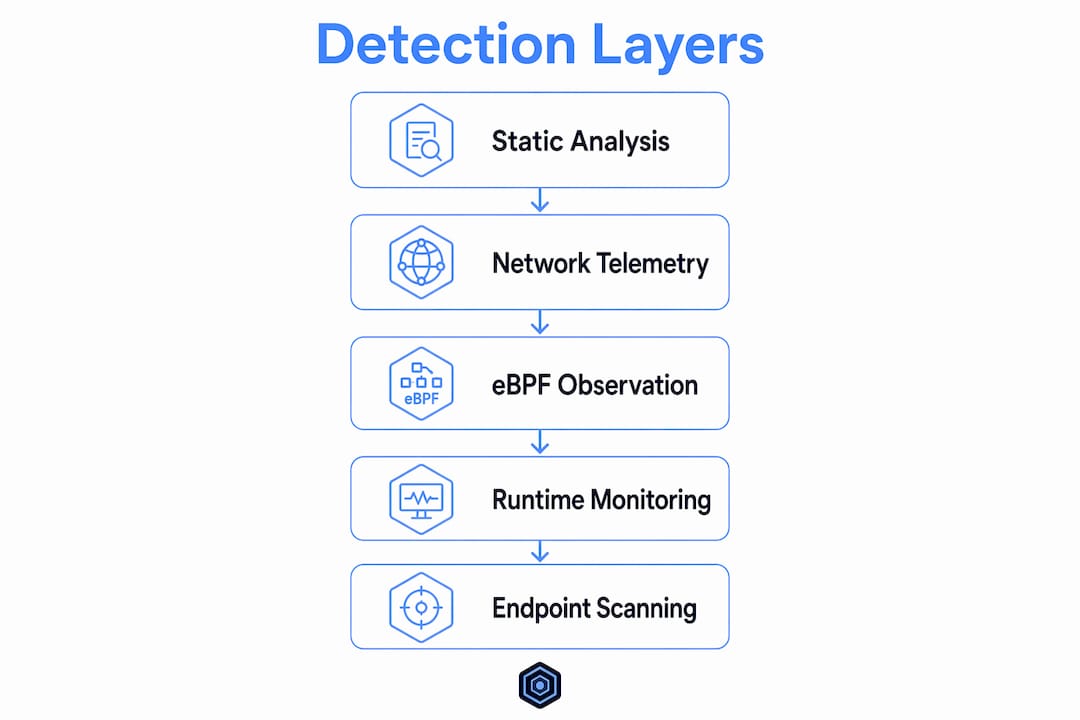
Runtime observation is particularly critical. eBPF and network telemetry can identify agents making external AI API calls with no corresponding source code or deployment record in under 60 seconds. These "ghost" agents, present in many financial environments after rapid AI adoption, are invisible to static analysis alone.
Combining all five layers into a correlation pass yields an identity graph: a structured map that distinguishes distinct agents from multiple instances of the same agent and tracks behavioral changes over time. Cloud audit logs supply near-real-time attribution for AI API usage, filling gaps that static analysis consistently misses. For regulated environments, the practical constraint is observation window length: longer windows improve drift detection accuracy but increase data retention obligations under applicable privacy frameworks.
Pro Tip: Deploy eBPF-based observation in read-only mode first. It adds no agent to the production environment and produces syscall-level evidence that satisfies technical audit requirements without touching customer data.
How should your team run the operational discovery workflow?
A repeatable workflow requires defined steps and clear role ownership. The pattern below maps to a standard governance operating model for regulated financial services.
Workflow steps:
- Scope and map. Define the discovery perimeter: business units, cloud accounts, endpoint groups, and third-party integrations in scope.
- Run parallel scans. Execute all five detection layers simultaneously. Prioritize high-frequency runbooks and systems with financial data access.
- Correlate and resolve identity. Merge layer outputs into a single identity graph. Flag agents with no owner, no deployment record, or cross-environment presence.
- Score risk. Assign a risk score based on data access, exposure level, and lifecycle status (dev, staging, production).
- Triage. Route findings to the appropriate queue: immediate remediation for unauthorized production agents, review for unowned agents, and documentation for compliant agents.
- Remediate and document. Execute remediation playbooks. Generate a signed evidence pack for each resolved finding.
Role matrix:
- Risk owner: Approves scope, reviews blast-radius findings, signs off on evidence packs for regulatory submission.
- Automation owner: Maintains execution-mode mappings and runbook documentation.
- SOC / IR team: Responds to drift alerts and unauthorized environment transitions.
- Platform engineer: Operates detection tooling and manages observation window configuration.
- Audit liaison: Packages evidence for internal audit and external examiner requests.
Execution mode assignment is a governance decision, not a technical one. Workflows that mix deterministic steps, AI proposals, and human checkpoints produce auditable chains where AI handles ambiguous tasks and humans approve consequential actions. Any step that triggers a financial transaction, a client communication, or a regulatory filing requires a mandatory human gate with full decision context captured.
What does audit-ready evidence actually look like?
Evidence packs must be structured, signed, and self-contained. The minimum fields for each agent record are:
- Agent identity: Unique identifier, name, version, and owner attribution.
- Source metadata: Deployment record, repository reference, and OAuth grant scope.
- Runtime telemetry summary: API call counts, model IDs accessed, and environment markers (dev, staging, production).
- Timestamps: Discovery time, last-seen time, and any drift events with delta description.
- Risk score: Calculated score with blast-radius exposure and data access classification.
- Lifecycle status: Current state and change history.
Cryptographic signing using HMAC-SHA256 converts a structured evidence record into a tamper-evident bundle. The signing process hashes the full evidence payload and appends the signature, so any post-generation modification invalidates the bundle. This satisfies the technical audit requirement that evidence has not been altered between collection and review.
Auditors and examiners do not read raw telemetry. A signed evidence pack should include a one-page summary in plain language, a machine-readable JSON payload, and the HMAC-SHA256 signature block. The summary tells the examiner what was found; the payload lets technical reviewers verify it; the signature proves neither has been changed. See the compliance playbook for regulators for evidence templates.
For non-technical auditors, redaction patterns matter. Strip raw API keys, internal IP addresses, and any field that constitutes personal data under applicable privacy frameworks before packaging. The goal is a digestible, defensible record, not a raw data dump.
Pro Tip: Generate evidence packs on a fixed schedule, not only in response to incidents. A dated, signed pack produced before an examiner request demonstrates proactive oversight, which carries more weight than reactive documentation.
How do you integrate discovery with existing RPA and BPM without replacing them?
Agentic platforms extend existing RPA and BPM systems using pre-built connectors to add AI reasoning without replacing legacy investments. The same principle applies to discovery governance.
Non-invasive integration options:
- OAuth metadata-only connectors: Read grant scopes and token issuance logs without accessing underlying data.
- CI/CD SARIF hooks: Reusable CI/CD actions upload SARIF from static analysis and trigger platform correlation, making agent findings visible in code scanning and change-control systems.
- Endpoint osquery scans: Query installed packages and running processes without deploying a persistent agent.
- Cloud audit log ingestion: Pull structured log exports from AWS CloudTrail, Azure Monitor, or GCP Audit Logs on a scheduled basis.
Integration deployment sequence:
- Deploy in shadow mode against existing manual processes. Collect findings without triggering alerts or remediation.
- Validate the identity graph against known agent inventory. Measure false-positive rate and coverage gaps.
- Enable alerting for unauthorized environment transitions (dev-to-production without change-control approval).
- Connect evidence pack generation to existing ticketing and change-control workflows.
- Gate production promotion on a signed discovery clearance from the governance layer.
Developer-first orchestration provides unified traces, step inspection, and explainability built into runtime, reducing governance gaps when shipping agentic workflows. Connecting that orchestration layer to a read-only discovery governance layer preserves the existing automation estate while adding the evidential layer regulators expect.
Which KPIs prove your discovery program is working?
| KPI | Definition | Audit Relevance |
|---|---|---|
| Discovered agent count | Total agents in current AIBOM | Baseline for supervisory inventory requests |
| Owner attribution rate | % of agents with assigned owner | Directly maps to accountability requirements |
| Drift events | Behavioral changes detected per unit of runtime | Demonstrates active monitoring |
| Time-to-evidence-pack | Hours from discovery trigger to signed pack delivery | SLA evidence for incident response |
| Mean time to remediate (MTTR) | Average hours from triage to resolved status | Operational control effectiveness |
| SaaS blast-radius exposure | Count and financial value of systems accessible by unowned agents | Risk concentration reporting |
For audit audiences, thresholds matter as much as the metrics themselves. An owner attribution rate below a high threshold is a material finding in most supervisory frameworks. Drift events with no corresponding remediation record within a defined SLA window indicate a control gap. Combining automated detection, AI triage, and human approvals reduces escape rate and speeds SLA compliance, but the KPI record is what proves it to an examiner.
What does a realistic pilot-to-scale timeline look like?
Pilot phase (4–8 weeks): Run discovery in shadow mode. Success criteria: identity graph covers all known agents, at least one ghost agent identified, and one signed evidence pack produced for a high-frequency runbook.
Validation phase (4–6 weeks): Enable drift detection and environment-transition alerting. Brief internal audit on findings. Update execution-mode mappings for all in-scope runbooks.
Phased rollout (3–9 months): Expand scope by business unit. Connect evidence packs to supervisory reporting cycles. Maintain AIBOM as a living registry updated on each deployment.
Major cost and effort drivers:
- Scope: endpoint-only discovery is faster and cheaper than full cloud-plus-endpoint coverage.
- Integration complexity: firms with fragmented cloud accounts or legacy RPA estates require more connector configuration.
- Observation window: longer windows improve drift detection but increase storage and retention costs.
- Remediation staffing: unowned agent remediation requires business-unit engagement, which is often the longest lead-time item.
Pro Tip: Use an AI compliance gap assessment before scoping the pilot. It identifies which runbooks carry the highest regulatory exposure and lets you sequence discovery work by risk priority rather than technical convenience.
What do US regulators and internal auditors expect to see?
US financial regulators, including the OCC and SEC, approach AI governance through existing supervisory frameworks: model risk management (SR 11-7), operational resilience, and change-control requirements. Discovery evidence maps directly to these expectations.
Regulatory mapping:
- Audit trail: Signed evidence packs with timestamps and change history satisfy SR 11-7 documentation requirements for automated decision-making.
- Owner assignment: Every agent in the AIBOM must have a named owner accountable for its behavior and outputs.
- Change control: CI/CD SARIF integration connects agent deployment to existing change-control records, closing the gap examiners most frequently cite.
- Incident history: Drift event logs with remediation records demonstrate that the firm detects and responds to agent behavioral changes.
- Blast-radius analysis: Financial exposure scoring answers the supervisory question of what systemic risk an uncontrolled agent could create.
Examiners increasingly ask firms to demonstrate, not just describe, their AI oversight. A signed identity graph with timestamped drift events and a blast-radius report is a concrete answer. Firms that can produce this on demand, rather than reconstructing it after a request, consistently receive more favorable examination outcomes. See why regulators audit AI agents for the current supervisory expectations.
Pro Tip: Prepare a one-page executive summary of your AIBOM for board and audit committee reporting. Regulators view board-level visibility into AI agent risk as a governance maturity indicator.
Data minimization applies throughout. Collect only the telemetry fields necessary for governance purposes, and confirm that your collection practices align with applicable privacy frameworks before expanding observation scope. This article is general information, not legal or compliance advice; confirm current regulatory requirements with qualified counsel for your specific situation.
Why an agentless, read-only evidence layer is the right operational pattern
The practical choice for risk and compliance teams is a governance layer that produces evidence without inserting itself into production systems. Aetherpulse implements this pattern through AETHER Pulse: a read-only, agentless platform that connects via OAuth metadata only, builds an agent inventory and identity graph, surfaces financial blast-radius exposure, and generates HMAC-SHA256 signed evidence packs on demand.
Key capabilities that matter for regulated firms:
- Read-only OAuth metadata integration: No customer data is accessed; the platform reads grant scopes and token metadata only.
- Tamper-evident evidence packs: HMAC-SHA256 signing produces cryptographically verifiable bundles that satisfy technical audit requirements.
- Agent inventory and identity graph: Continuously updated AIBOM with owner attribution, lifecycle status, and cross-machine identity resolution.
- Financial blast-radius scoring: Risk concentration mapped to financial system access, giving compliance teams a quantified exposure view.
- Audit export on demand: Evidence packs formatted for regulatory submission, with plain-language summaries for non-technical reviewers.
An agentless approach limits sensitive-data exposure by design. Because AETHER Pulse never deploys a runtime component into the production environment, it cannot become a vector for data exfiltration or introduce new operational risk. For firms subject to OCC, SEC, or FINRA oversight, this architecture removes a significant objection that invasive governance tooling typically faces during security review.
Pro Tip: Request a shadow AI risk assessment for any Microsoft Copilot or similar productivity AI rollout before expanding AIBOM scope. These deployments frequently surface unowned agents with broad data access that static discovery misses.
Key Takeaways
An evidence-first AI agent discovery enterprise workflow requires parallel detection layers, execution-mode mapping, and HMAC-SHA256 signed evidence packs to satisfy OCC and SEC supervisory expectations.
| Point | Details |
|---|---|
| Run five detection layers | Combine static analysis, network telemetry, eBPF, endpoint scans, and cloud audit logs to avoid ghost-agent blind spots. |
| Map execution modes before deployment | Assign deterministic, AI-assisted, or human-gate status to every process step before any agent reaches production. |
| Sign all evidence with HMAC-SHA256 | Cryptographically signed packs are the minimum standard for tamper-evident audit submission to US financial regulators. |
| Track owner attribution rate | Monitor the percentage of agents with assigned owners as a primary KPI; a low attribution rate is a material control gap in most supervisory frameworks. |
| Aetherpulse for agentless governance | AETHER Pulse delivers read-only OAuth metadata integration, identity graphing, and signed evidence packs without touching production systems. |
The accountability gap is wider than most firms realize
The conventional view is that AI governance is a documentation problem: write the policy, log the outputs, and the audit passes. That framing misses the actual risk. The agents that create the most supervisory exposure are the ones nobody documented in the first place, deployed by a business analyst using a no-code tool, or inherited from a vendor integration that predates the current governance framework.
Evidence-first discovery inverts the usual approach. Instead of starting with policy and hoping the agents comply, you start with what is actually running, build the inventory from observed behavior, and then map policy controls onto a verified reality. That sequence is what makes the evidence defensible. A signed evidence pack produced from observed telemetry is categorically different from a self-reported inventory, and examiners know the difference.
The read-only, agentless pattern matters for a second reason: it removes the internal objection that governance tooling creates new risk. When a platform touches no customer data and deploys no runtime component, the security review is straightforward and the business-unit resistance is lower. Faster deployment means earlier evidence, which means the firm is audit-ready before the examiner arrives rather than after.
Aetherpulse gives you signed evidence before your next examination
Compliance teams that have mapped their agent inventory and execution modes still face one practical gap: converting that work into evidence a regulator will accept. Aetherpulse fills that gap directly. AETHER Pulse connects to your environment via read-only OAuth metadata, builds a continuously updated identity graph, scores financial blast-radius exposure, and produces HMAC-SHA256 signed evidence packs formatted for OCC, SEC, and internal audit submission.
A scoped pilot typically takes weeks in shadow mode and produces a signed evidence pack for at least one high-frequency runbook, giving your audit liaison something concrete before the next examination cycle. The demo covers the full workflow: identity graph construction, drift detection, blast-radius report, and evidence pack export. Review pricing and pilot options or visit aetherpulse.app to request a scoped discovery demonstration for your firm.
Useful sources and further reading
Technical and compliance teams can verify the methods and claims in this article using the following primary references.
| Resource | Type | Relevance |
|---|---|---|
| agent-discover-scanner (Defend-AI-Tech-Inc) | Open-source scanner | Five-layer detection, eBPF hooks, SARIF CI/CD integration, and identity correlation |
| Intelligent workflow automation (Tines) | Technical blog | Execution-mode mapping, deterministic-first design, and human-gate auditability |
| Agentic Process Automation Platform (Automation Anywhere) | Product documentation | Non-destructive RPA/BPM integration patterns and connector architecture |
| Maestro Flow (UiPath) | Product documentation | Unified traces, step inspection, and explainability for orchestrated workflows |
| Intelligent workflow definition (TechTarget) | Reference definition | Accepted definition of intelligent workflow integrating analytics, AI, and automation |
| AETHER Pulse evidence library | Compliance guides | Practical templates, evidence examples, and governance operating model guidance |
Preserve source artifacts, including SARIF outputs, cloud audit log exports, and eBPF observation summaries, as primary evidence within your AIBOM and AgentOps registry. Regulators may request the underlying collection artifacts, not only the signed summary pack, during a detailed examination.
Recommended
Working on Article 26 readiness, deployer-side governance evidence, or AI agent risk at a regulated firm? We'd value 15 minutes of your perspective.
Start a conversation