Metadata Only AI Kill Switch: Audit Ready Evidence for Regulated Firms
Metadata Only AI Kill Switch: Audit Ready Evidence for Regulated Firms

For a regulated financial services firm, an AI kill switch is not a power button. It is an audit-ready, metadata-only governance capability that produces tamper-evident evidence and a live AI system inventory, so a firm can demonstrate oversight before, during, and after any AI-related incident. The recommended posture pairs accountable invocation authority with cryptographically signed evidence packs, an approach such platforms are built to deliver.
TL;DR:
- An AI kill switch for regulated firms is primarily a metadata-based governance tool that produces tamper-evident evidence and maintains a live inventory of AI models.
- Core components include an AI system inventory, decision logs, cryptographically signed evidence packs, a clear authority model, and contractual audit rights.
- Proper invocation involves assessing severity, preserving evidence, authorizing actions, and documenting rationale before containment and escalation.
- Regulators expect firms to demonstrate ability to reconstruct decision chains, with evidence packs answering what happened, who decided, when, and how the record was verified.
- Implementing and testing metadata-only controls through tabletop exercises and continuous monitoring minimizes legal, ethical, and operational risks during AI incidents.
Table of Contents
- What Does "AI Kill Switch" Mean in a Compliance Context?
- What Are the Core Components of an Audit-Ready Kill Switch?
- How Do You Invoke a Metadata-Only Kill Switch?
- What Will Regulators and Auditors Expect to See?
- How Does This Fit Into Existing GRC Frameworks?
- How Should Firms Test and Maintain These Controls?
- What Are the Ethical Considerations of Deploying AI Kill Switches?
- What Technical Architectures Support AI Kill Switch Implementation?
- What Are the Risks and Failure Modes of AI Kill Switches?
- Where Are AI Kill Switches Most Critical?
- What Legal and Compliance Challenges Arise During Activation?
- Why Metadata-Only Governance Deserves Priority Now
- How AETHER Pulse Builds Your Audit-Ready Evidence Layer
- Sources
What Does "AI Kill Switch" Mean in a Compliance Context?
Search the term generically and you will find articles about emergency shutdown buttons for autonomous systems. That framing does not match what supervisors actually ask regulated firms to produce. Financial services regulators care less about whether you can physically halt a model in half a second and far more about whether you can prove, after the fact, who was running what, why, and under what oversight.
The IOSCO supervisory toolkit makes this explicit: firms need AI inventories, recordkeeping of AI-generated outcomes, and audit trails covering inputs, outputs, and system logic. That is a governance and evidence problem, not a wiring problem.
Metadata-only governance fits this scope precisely when:
- You run autonomous or semi-autonomous AI agents across trading, underwriting, client service, or back-office operations
- Regulators or internal audit expect demonstrable human oversight, not just policy documents
- You need to reconstruct a decision chain months after the fact without touching underlying customer data
Read this article with that scope in mind. It covers governance evidence, not emergency circuit-breaking hardware.
What Are the Core Components of an Audit-Ready Kill Switch?
An invocation only holds up under regulatory scrutiny if the underlying architecture was built for it in advance. Five components form the backbone of a defensible metadata-only kill switch.
- AI system inventory and identity graph. Also called know-your-agent (KYA), this catalogs every deployed model or agent, its owner, its permissions, and its blast-radius exposure across the firm. Projects like the open-source AI-System-Inventory framework show what this deliverable looks like in practice: risk-tier classification mapped directly to NIST AI RMF categories.
- Decision and event logging. Every material action needs a timestamped record of inputs, outputs, and the policy version in force at the time.
- Tamper-evident evidence packs. Logs are cryptographically signed, commonly with HMAC-SHA256, so an auditor can verify nothing was altered after the fact.
- Authority and escalation model. A named role, not a vague committee, holds invocation authority, with documented criteria for when that authority gets used.
- Contractual audit rights. Vendor agreements need explicit rights to data access and third-party audit so evidence gaps do not appear at the exact moment a regulator asks for them.
A modular governance architecture for agentic AI reinforces the point that every intervention must land in immutable audit logs, since reconstructability is the entire point of the exercise.
Pro Tip: Build your identity graph before you need it. Firms that try to inventory agents retroactively, after a regulator asks, typically find the gaps are worse than they assumed.
How Do You Invoke a Metadata-Only Kill Switch?
Invocation is a sequence, not a single click. Skip a step and the evidence pack you produce afterward will have holes an auditor finds immediately.
- Assess severity against pre-defined trigger criteria. Not every anomaly warrants invocation; know the thresholds in advance.
- Preserve evidence before making any change. Snapshot the inventory state, isolate the affected agent from new inputs, and sign the current logs.
- Document authorization and rationale. Record who approved the action, the specific policy or risk basis, and the timestamp.
- Apply containment. Restrict or suspend the agent's permissions at the metadata layer rather than altering production systems.
- Escalate and remediate. Notify the board, and where required, the regulator, then begin corrective action with the evidence pack as the paper trail.
Before closing out the incident, confirm you have captured:
- The full inventory snapshot at the moment of invocation
- Signed logs covering the period immediately before and after the trigger
- A written rationale tying the action to a specific policy or risk threshold
- Escalation records showing who was notified and when
The IOSCO standalone toolkit specifically flags circuit-breaker policies, incident reporting templates, and test plans as things supervisors expect to see documented, not improvised. A structured incident response workflow built for financial services gives you the reporting scaffolding before the first real incident forces you to build it under pressure.
What Will Regulators and Auditors Expect to See?
An evidence pack is only useful if it answers the questions a supervisor or internal auditor is actually going to ask. Those questions tend to cluster around four things: what happened, who decided, when, and can you prove the record wasn't altered.
A defensible evidence pack typically contains:
- An inventory snapshot showing every agent and its permission state at the time of the event
- Signed logs of inputs, outputs, and policy versions covering the relevant window
- A written decision rationale tied to a named authority
- Precise timestamps that align across every system referenced
Retention matters as much as content. Evidence that cannot be independently verified as unaltered months later is not evidence, it is a claim. Cryptographic signing solves this by letting an auditor check the hash rather than take your word for it.
Firms that can map their evidence packs directly to supervisory questions, rather than translating on the fly during an exam, tend to move through regulatory reviews faster and with fewer follow-up requests.
The IOSCO supervisory toolkit frames recordkeeping expectations around exactly this kind of reconstructability. A useful internal exercise is drafting a one-page governance narrative for your board or audit committee that walks through a hypothetical invocation start to finish, using your actual evidence pack format. If the narrative has gaps, your evidence pack does too. Guidance on regulatory disclosure obligations for finance firms offers a useful template for the language boards and regulators expect.
How Does This Fit Into Existing GRC Frameworks?
Building a parallel governance process for AI, separate from your existing model-risk and third-party risk functions, creates duplication and blind spots. Legal and compliance specialists advising on bridging the AI governance gap recommend mapping AI controls into frameworks you already run, including DORA-style operational resilience structures, rather than standing up something new.
Practical integration points include:
- Map kill-switch triggers and evidence requirements to your existing NIST AI RMF control set
- Extend third-party contracts to include explicit right-to-audit and evidence-availability clauses for any vendor-supplied AI agent
- Assign first-line ownership (the business unit running the agent), second-line oversight (risk and compliance), and third-line assurance (internal audit) with clear board reporting cadence
This also solves a vendor due-diligence problem. When an AI vendor cannot commit contractually to evidence availability, that gap surfaces during procurement rather than during a regulatory exam. A model change management guide built for banks shows how version control and change logs slot into this same structure without requiring a separate system.
How Should Firms Test and Maintain These Controls?
A kill switch that has never been exercised is a theory, not a control. Tabletop exercises using synthetic or metadata-only scenarios let compliance teams walk through invocation without touching live customer data or production systems.
- Run a tabletop exercise simulating a specific trigger, such as an agent exceeding its authorized transaction limit.
- Have the designated authority actually document the rationale and escalation, not just describe how they would.
- Pull the resulting evidence pack and attempt to independently verify the cryptographic signature.
- Time each stage and log it against KPIs like time-to-evidence and time-to-decision.
- Feed gaps back into a change-management process that updates trigger thresholds and escalation rules.
Pro Tip: Track time-to-evidence as a standing KPI, not a one-time exercise metric. A control that takes four hours to produce an evidence pack today needs to be faster before your next regulatory exam, not after it.
Inventory automation tools referenced in projects like the AI-System-Inventory framework illustrate how reproducibility checks can run on a schedule rather than only when someone remembers to do it.
What Are the Ethical Considerations of Deploying AI Kill Switches?
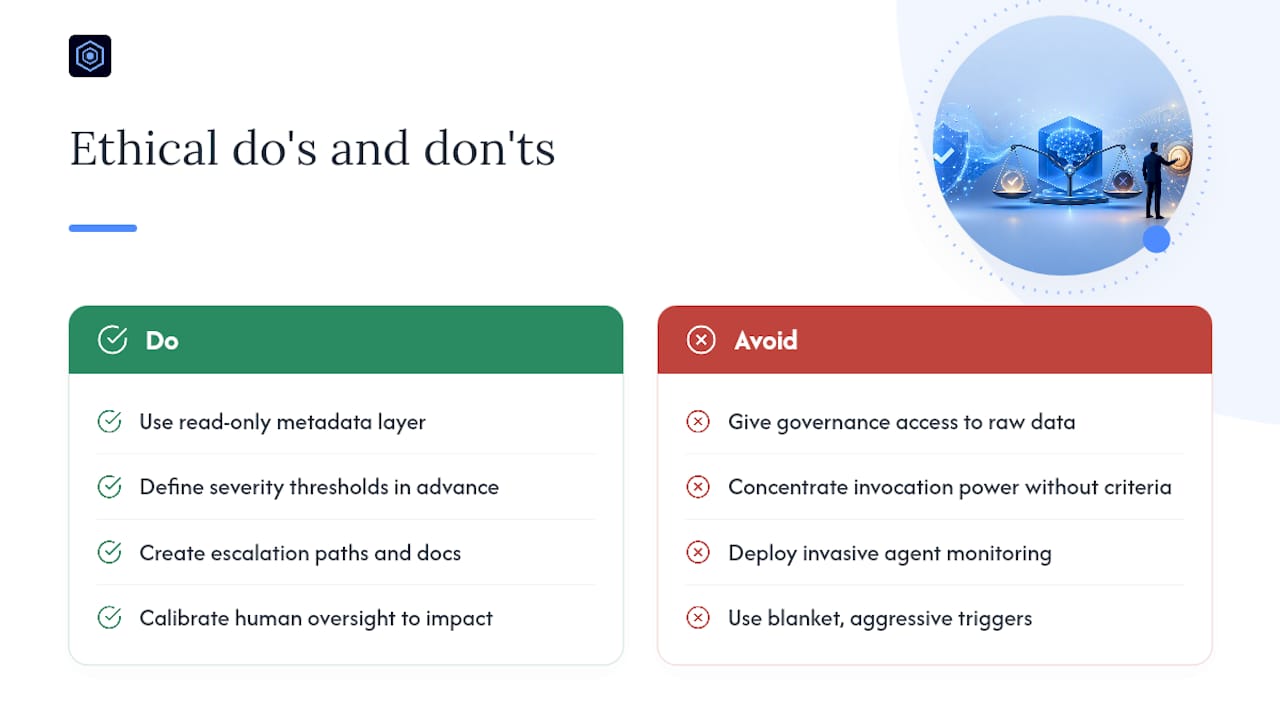
The metadata-only model sidesteps one ethical problem inherent to invasive kill switches: it does not require the governance layer to see customer data to do its job. That distinction matters more than it might first appear.
An invasive agent-based monitoring tool that sits inside your AI pipeline creates its own risk surface. It becomes another system with access to sensitive data, another target for breach, and another vendor whose own governance you now have to audit. A read-only, metadata-only layer avoids compounding the very risk it is meant to control.
There is a fairness dimension too. Invocation authority concentrated in a single individual without documented criteria creates the appearance, and sometimes the reality, of arbitrary shutdowns that disadvantage customers mid-transaction or mid-process. Building severity thresholds and escalation paths in advance is as much an ethical safeguard as a procedural one, since it removes discretion from the moment of maximum pressure.
Firms also need to think about false positives. An overly aggressive trigger that suspends a customer-facing agent unnecessarily has real consequences for the people on the other end of that interaction, not just an internal inconvenience. Human oversight calibrated to the system's actual autonomy and impact, rather than a blanket policy applied uniformly, tends to produce fairer outcomes across use cases.
What Technical Architectures Support AI Kill Switch Implementation?
The architecture that works best for regulated firms sits outside the AI agent's own execution path rather than inside it. That distinction is what separates a metadata-only governance layer from an invasive monitoring agent.
Ingestion typically happens through OAuth grants that pull metadata, permission states, and activity logs without ever touching the underlying customer data those agents process. This keeps the governance layer's own risk footprint small while still giving compliance teams a complete picture of what every agent is doing.
Layered governance architecture helps here. A modular structure that separates firm-level governance blocks from independent audit blocks means telemetry aggregated at the firm level can detect correlated failures across multiple agents, something no single agent's own logs would reveal. Firm-level modules that aggregate signals across a fleet of agents can catch a pattern, several agents drifting toward the same risky behavior, that would look like noise if examined one agent at a time. The kind of telemetry aggregation described in analyses of FinOps AI agent monitoring illustrates why post-deployment monitoring alone, without this kind of firm-level correlation, tends to miss exactly the failures that matter most.
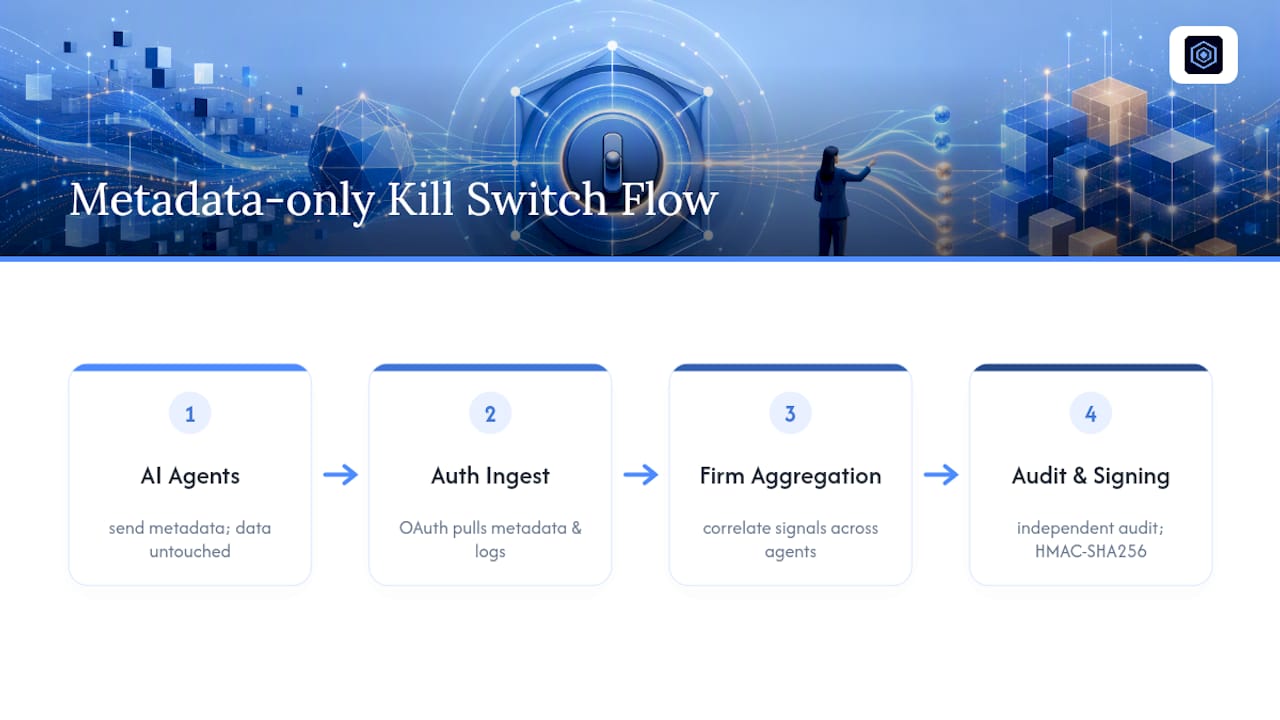
Signing infrastructure, usually HMAC-SHA256 or an equivalent cryptographic standard, needs to sit at the point where logs are generated, not bolted on afterward. Retrofitted signing creates a gap between when an event happened and when it became tamper-evident, and that gap is exactly what a skeptical auditor will probe.
What Are the Risks and Failure Modes of AI Kill Switches?
The most common failure mode is not a technical one. It is an inventory gap: an agent nobody registered, running in a business unit that adopted an AI tool without going through procurement. You cannot invoke a control over a system you do not know exists, and shadow AI deployments are the single biggest blind spot regulated firms report.
A second failure mode is evidence that looks complete but is not verifiable. Logs without cryptographic signing can be edited after the fact, and even if nobody ever tampers with them, an auditor cannot prove that to a skeptical regulator. Unsigned evidence is functionally worse than no evidence, because it creates false confidence.
Authority ambiguity is a third risk. When invocation authority is not clearly assigned, incidents get slower, not faster, as multiple people wait for someone else to make the call. Firms that have documented, tested authority chains resolve incidents materially faster than firms relying on ad hoc committee decisions made under pressure.
Finally, there is the risk of over-triggering. A kill switch calibrated too sensitively generates so many false alarms that teams start ignoring them, which defeats the entire purpose of the control. Calibration needs regular review against real operating patterns, not a one-time setting left untouched for years.
Where Are AI Kill Switches Most Critical?
Not every AI deployment needs the same intensity of governance. The use cases where metadata-only kill-switch controls matter most share a common trait: autonomy paired with financial or customer impact.
Algorithmic trading agents that execute without human sign-off on each trade sit at the top of this list, since a malfunctioning agent can generate losses or market impact within seconds. Underwriting and credit-decisioning agents come next, where an unmonitored drift in decision logic can produce discriminatory outcomes at scale before anyone notices. Client-facing agents handling account changes, payments, or advice carry direct Consumer Duty implications under FCA rules, making documented oversight a regulatory expectation rather than a nice-to-have.
Back-office agents processing high volumes of transactions, reconciliations, or regulatory filings represent a quieter but equally serious case. Their failures are less dramatic than a trading incident but can compound silently across thousands of transactions before detection. In each of these scenarios, the value of the kill switch is not the shutdown itself but the evidence trail that lets a firm show, credibly, exactly when oversight kicked in and why.
What Legal and Compliance Challenges Arise During Activation?
Invoking a kill switch triggers its own compliance obligations, separate from whatever incident caused the invocation in the first place. Getting this sequence wrong compounds one problem into two.
Disclosure timing is the first challenge. Depending on the incident's materiality, firms may face reporting obligations to regulators within specific windows, and the clock often starts at detection, not at resolution. Firms unclear on their own disclosure triggers risk missing deadlines while still investigating.
Cross-border firms face a second layer of complexity: an agent flagged under EU AI Act Article 26 obligations may trigger different documentation requirements than the same incident viewed purely through FCA SYSC rules. A guide to EU AI Act obligations for regulated firms is a useful reference point for mapping which regime applies to which deployment.
Contractual exposure is the third challenge. If the AI agent in question is vendor-supplied, invocation may intersect with service-level agreements, liability clauses, and data-processing terms that were never written with a governance shutdown scenario in mind. Firms that negotiated right-to-audit and evidence-availability clauses up front resolve these situations far faster than firms discovering the contract is silent on the issue mid-incident.
Why Metadata-Only Governance Deserves Priority Now
Compliance leaders often treat AI governance as a project to finish rather than a capability to maintain, and that framing undersells what is actually at stake. The firms that handle regulator conversations well are not the ones with the most policies on paper. They are the ones that can produce a signed evidence pack within minutes of being asked.
Privacy-preserving oversight is not a compromise here, it is the advantage. A metadata-only approach gives you the audit trail without expanding your own attack surface or requiring you to justify why a governance tool has access to customer data it does not need. Speed-to-evidence follows naturally once the inventory and signing infrastructure exist ahead of the incident rather than being assembled during one.
Platforms built specifically around this model show that audit-readiness and non-invasiveness are not in tension. They are the same design decision.
— Eleye
How AETHER Pulse Builds Your Audit-Ready Evidence Layer
This platform gives regulated firms the capability described: an inventory of every AI agent in the organization, built without ever touching customer data. It connects through OAuth metadata ingestion, so deployment is fast and non-invasive, unlike governance tools that insert themselves into production systems.
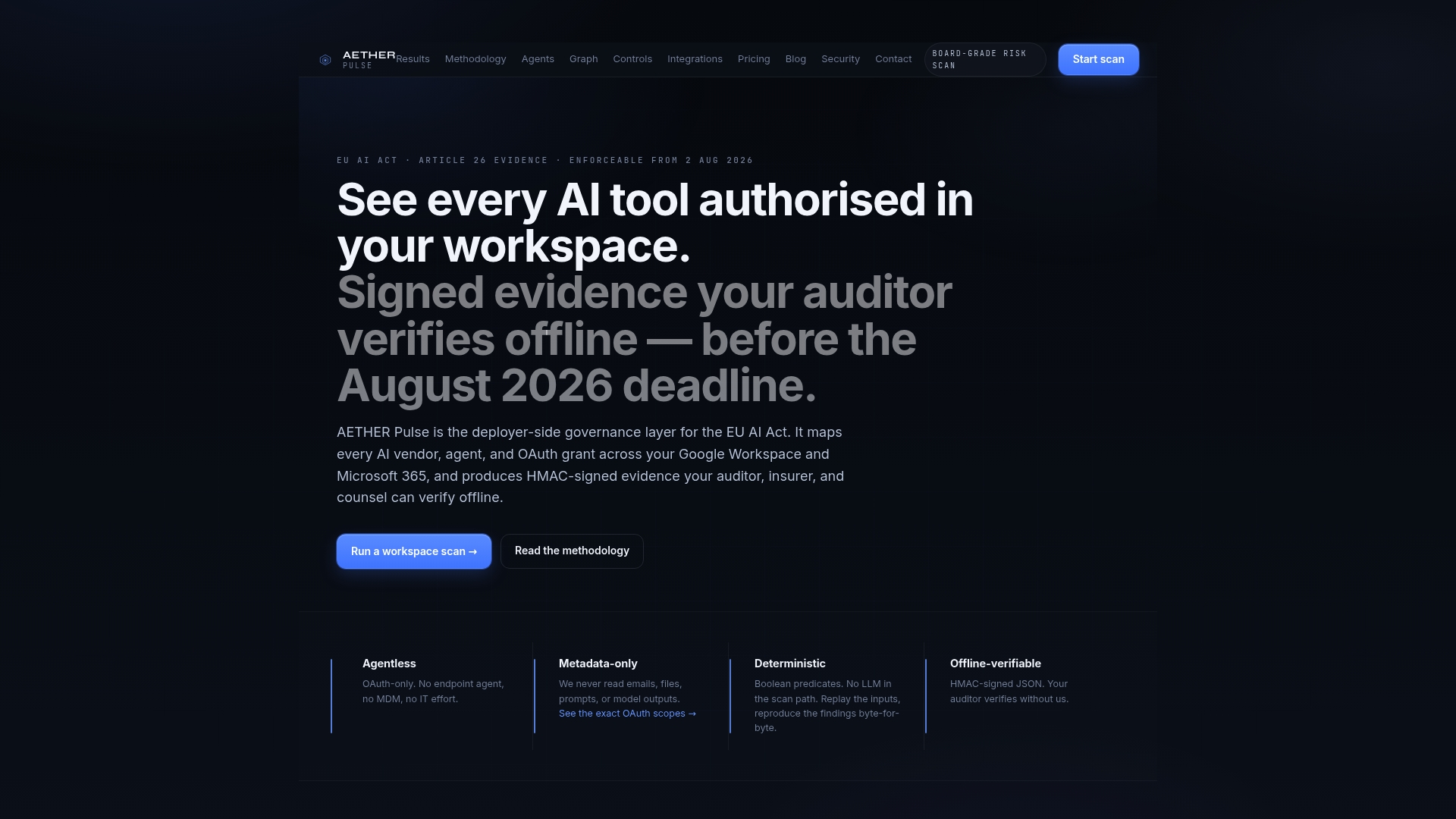
The platform builds an AI identity graph, surfaces financial blast-radius exposure across the agent fleet, and generates tamper-evident, cryptographically signed evidence packs on demand, the same artifacts auditors and regulators ask for when reviewing oversight of autonomous decision-making. It maps directly to the frameworks this article covers, including EU AI Act Article 26, FCA SYSC and Consumer Duty, and the ICO's emerging guidance on automated decision-making.
If your firm is still assembling evidence manually when a regulator asks, that gap is worth closing before the next exam, not after it. Visit AETHER Pulse to see the platform, or review the security architecture behind its non-invasive, metadata-only design and request a demo.
Sources
- Supervisory Toolkit for AI Use in Capital Markets (IOSCO)
- Bridging the AI governance gap in financial institutions (Bird & Bird)
Recommended
Working on Article 26 readiness, deployer-side governance evidence, or AI agent risk at a regulated firm? We'd value 15 minutes of your perspective.
Start a conversation