AI Incident Response Compliance Workflow for Financial Services
AI Incident Response Compliance Workflow for Financial Services

A non-invasive, deterministic, API-driven AI incident response compliance workflow is the fastest path to audit-ready evidence for U.S.-regulated financial firms. The approach maps to NIST AI RMF and NIST SP 800-61, satisfies emerging state mandates such as the NY RAISE Act and California's TFAIA, and produces cryptographically signed metadata logs, prompt telemetry, and decision-gate records that auditors can verify without touching production customer data.
What this workflow delivers:
- Tamper-evident evidence packs signed with HMAC-SHA256, covering every lifecycle stage
- Prompt and tool-execution telemetry captured at runtime, not reconstructed after the fact
- Decision-gate records with timestamps and chain-of-custody metadata
- Mapping to NIST AI RMF MANAGE function and applicable state reporting rules
- Audit execution can be accelerated by 24× compared to manual, screenshot-driven processes when shifting to API-based evidence collection, as demonstrated by engineering case studies.
Table of Contents
- What does an AI incident response compliance workflow actually cover?
- How do decision gates and cross-functional roles work?
- What architecture principles make evidence defensible?
- How do you implement this in practice?
- What does an audit-ready evidence pack look like?
- How do you keep compliance current as regulations shift?
- How do you stay non-invasive while gathering defensible evidence?
- What KPIs and timelines should you expect?
- What are the known limitations and next steps?
- Key Takeaways
- Why deterministic evidence changes the audit conversation
- Aetherpulse gives you audit-ready evidence without touching production data
- Useful sources
What does an AI incident response compliance workflow actually cover?
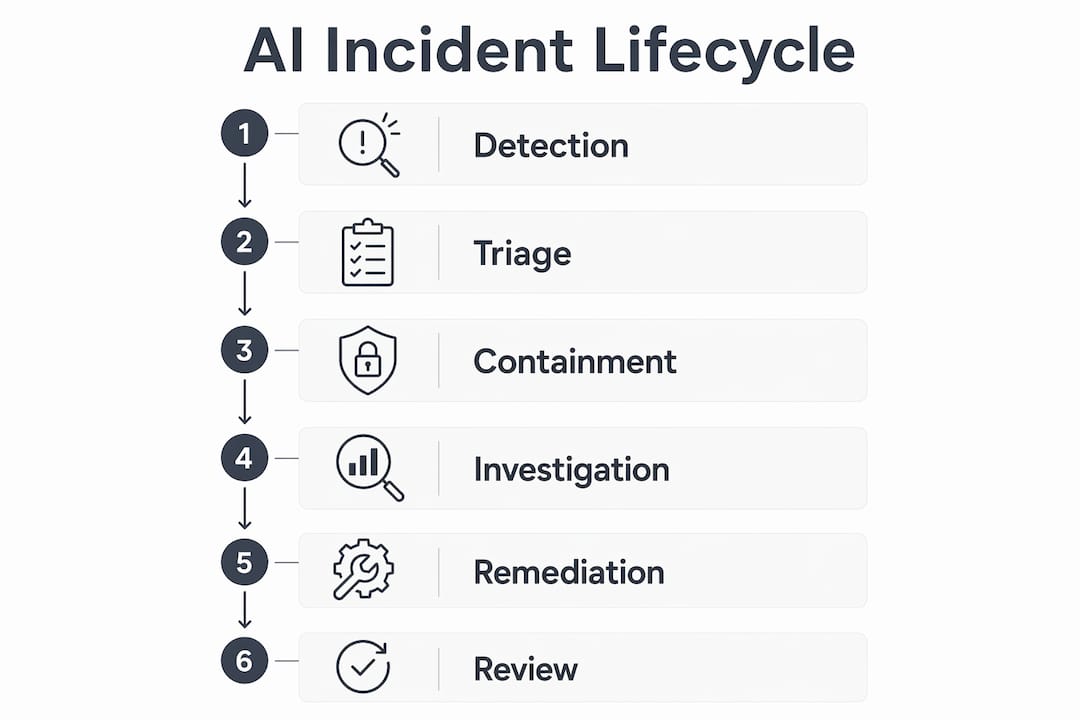
The six-stage lifecycle adapted for AI systems runs: detection, triage/enrichment, containment, investigation/root cause, remediation, and post-incident review. Each stage generates distinct artifacts that auditors expect to see.
| Stage | Core Artifacts | Typical SLA / Trigger |
|---|---|---|
| Detection | Signed alert records, anomaly telemetry | MTTD target: under 1 hour |
| Triage/Enrichment | Enriched incident ticket, severity classification | MTTI target: under 4 hours |
| Containment | Containment approval record, isolation logs | Regulator notification threshold check |
| Investigation | Root-cause analysis, prompt/response logs | MTTR clock starts |
| Remediation | Signed remediation record, patch/config diff | Regulatory reporting trigger |
| Post-Incident Review | Lessons-learned report, governance update | Feeds policy-as-code update |
AI incidents differ from traditional IT events. Root causes span model drift, adversarial prompts, and RAG pipeline misuse, not only code vulnerabilities. Each stage must therefore capture model-layer evidence, not just network or endpoint telemetry.
How do decision gates and cross-functional roles work?
Decision gates with clear hand-offs between SecOps, Forensics, and Legal reduce cognitive load during incidents and produce auditable checkpoints that map back to regulatory controls.
Gate-to-role mapping:
- Acknowledge/Triage — SecOps: confirm alert is AI-specific, assign severity tier, open incident ticket
- Escalate to Legal — Compliance lead: assess regulatory notification obligation, set notification clock
- Approve Containment — SecOps + Business Owner: authorize isolation action, log approval with timestamp
- Sign-Off Remediation — Engineering + Compliance: verify fix, sign remediation record
- Regulator Notification — Legal: file required notice with evidence package attached
- Post-Incident Sign-Off — CISO + AI Governance Lead: approve lessons-learned, update policy-as-code
Pro Tip: Pre-authorize decision thresholds as policy-as-code. A containment action below a defined blast-radius threshold can auto-approve, cutting hand-off latency without removing human oversight from high-impact decisions.
What architecture principles make evidence defensible?

Deterministic execution is the foundation. When policy-as-code or a neurosymbolic runtime governs AI decisions, every output traces to a written rule, a source document, and an approver. That traceability is what survives an auditor's scrutiny.
API-driven evidence collection replaces fragile screenshot audits with repeatable, verifiable queries that log exact parameters and source data references. Cryptographic signing with HMAC-SHA256 makes each evidence record tamper-evident. Integrating prompt telemetry at runtime, and embedding evidence capture into CI/CD pipelines, prevents the retrospective data gap that makes AI forensics impossible after the fact.
Technical implementation checklist:
- OAuth read-only connectors for metadata ingestion (no customer data in scope)
- Immutable append-only logs with cryptographic signing at write time
- Prompt and tool-execution telemetry fields: timestamp, agent ID, model version, input hash, output hash, source query ID
- Rate-limited read-only API connectors to avoid production impact
- Chain-of-custody metadata on every evidence record (who collected, when, from which endpoint)
Stat: Engineering case studies report 24× faster audit execution when moving from manual screenshots to API-driven evidence collection.
How do you implement this in practice?
Phased rollout:
- Inventory and risk scoring — catalog all AI agents, score by regulatory exposure and financial blast radius
- Policy-as-code authoring — encode decision thresholds, escalation triggers, and notification rules
- Telemetry onboarding — connect metadata-only OAuth feeds; validate field completeness
- Playbook automation — wire playbooks into CI/CD and ML governance pipelines
- Tabletop exercises — run Legal, Forensics, and SecOps through both playbooks below
- Pilot to scale — single high-risk workflow in 4–8 weeks; enterprise rollout across the AI estate in 6–12 months
Sample Playbook A: Prompt injection / jailbreak
| Step | Action | Evidence to Preserve |
|---|---|---|
| Trigger | Anomalous output distribution or policy-override attempt detected | Alert record, input/output hashes |
| Containment | Suspend agent session; rate-limit endpoint | Isolation log with timestamp |
| Investigation | Pull prompt telemetry; compare against known injection patterns | Signed prompt/response log |
| Notification | Assess NY RAISE / TFAIA reporting threshold | Legal sign-off record |
Sample Playbook B: RAG data-source leakage
| Step | Action | Evidence to Preserve |
|---|---|---|
| Trigger | Source-data query returns out-of-scope records | Query ID log, source reference |
| Containment | Revoke RAG connector access; snapshot query state | Connector revocation record |
| Investigation | Trace source query IDs to affected records | Chain-of-custody metadata |
| Notification | Evaluate state breach-notification threshold | Signed notification record |
Pro Tip: Capture prompt telemetry at runtime and commit evidence-capture hooks to your CI/CD pipeline on day one. Retrofitting telemetry after an incident is the single most common reason AI forensics fail.
What does an audit-ready evidence pack look like?
Auditors reviewing an AI incident expect a structured package, not a folder of screenshots. The package maps each artifact to the regulatory requirement it satisfies.
| Artifact | Format | Why Auditors Care |
|---|---|---|
| Signed metadata logs | JSON + HMAC-SHA256 signature | Chain-of-custody, tamper evidence |
| Prompt/response telemetry | Structured log, field-level redacted | Reproducibility, model-layer traceability |
| Decision-gate approvals | Timestamped records with approver ID | NIST AI RMF MANAGE function mapping |
| Source-data query IDs | Immutable reference log | RAG provenance, data lineage |
| Cryptographic verification proofs | Signature manifest | Independent verifiability |
| Retention metadata | Policy record with retention window | Regulatory retention compliance |
Pre-submission QA checklist:
- All records carry cryptographic signatures verified against the manifest
- Personally identifiable information redacted at field level before packaging
- Retention window documented and consistent with applicable state rules
- Regulatory mapping table included (artifact → rule → article/section)
For privacy-preserving data handling during evidence packaging, GDPR-compliant export patterns offer practical field-level redaction guidance applicable to metadata-only evidence workflows.
How do you keep compliance current as regulations shift?
Static compliance programs are increasingly inadequate as state-level laws change enforcement windows and reporting obligations. Living compliance means that the program adapts automatically when rules change.
Living compliance components:
- Versioned policy-as-code stored in source control with change history
- Automated test suites that validate playbook behavior against current rule mappings
- Governance pipelines that trigger revalidation when a regulatory rule version increments
- Regulatory rule-to-playbook mapping ledger, maintained as a first-class artifact
Proactive investment in compliance automation is a cost-avoidance strategy as state-level regulations create material penalty risk. Firms that wire automation to their regulatory change feed avoid manual rework cycles when TFAIA or RAISE Act enforcement windows shift.
Pro Tip: Maintain a rules-to-playbook mapping ledger and run automated regression tests against it on every policy-as-code commit. A rule change that silently breaks a playbook is a compliance gap waiting to surface in an audit.
How do you stay non-invasive while gathering defensible evidence?
Metadata-only ingestion via OAuth read-only connectors is the practical pattern. No customer data enters the evidence pipeline; only agent identifiers, query hashes, timestamps, and decision outputs are retained.
Non-invasive integration checklist:
- OAuth read-only scope only — no write permissions granted to any evidence connector
- Metadata fields only — strip payload content at ingestion; retain hashes and references
- Field-level redaction applied before any evidence record leaves the collection layer
- Vendor contracts reviewed for telemetry obligations and data-residency requirements
- Rate limits documented and respected to avoid production system impact
When an incident involves potential customer data exposure, escalate to Legal before expanding telemetry scope. Collecting additional fields beyond the pre-approved metadata schema requires legal sign-off and may trigger separate breach-notification obligations under applicable state law.
Operational constraints to plan for:
- Vendor API rate limits can delay evidence collection during high-volume incidents; pre-negotiate elevated read quotas for incident windows
- Some AI platforms do not expose prompt-level telemetry via API; document these gaps in the inventory and flag them as elevated forensic risk
What KPIs and timelines should you expect?
| KPI | Manual Baseline | API-Driven Target |
|---|---|---|
| Mean time to detect (MTTD) | Hours to days | Under 1 hour |
| Mean time to investigate (MTTI) | Days | Under 4 hours |
| Mean time to remediate (MTTR) | Weeks | Days |
| Audit evidence production time | Weeks | Hours |
| % incidents with auditor-grade evidence | Low | High |
Cost and resourcing notes:
- Pilot phase (single workflow, 4–8 weeks): primary cost is engineering time for telemetry onboarding and policy-as-code authoring
- Enterprise rollout (6–12 months): cost shifts to governance pipeline maintenance and tabletop exercise cadence
- Ongoing: automated evidence collection reduces per-audit labor materially versus manual screenshot-driven processes
What are the known limitations and next steps?
Limitations to plan for:
- Vendor API constraints may prevent full prompt-level telemetry for some AI platforms; document gaps explicitly
- Metadata-only retention cannot reconstruct full data payloads if a deeper forensic investigation requires them; host-level forensics may be required
- Policy-as-code covers known incident archetypes; novel attack vectors require human escalation and playbook updates
- Non-destructive containment is the default, but some incidents require full system isolation that metadata-only tooling cannot execute alone
When evidence gaps suggest potential regulatory breach or litigation exposure, escalate immediately to Legal and engage a qualified forensic firm before taking further containment actions.
Next-steps checklist:
- Run an AI agent inventory and score each agent by regulatory exposure
- Select one high-risk workflow as the pilot candidate
- Encode the first policy-as-code rule set covering that workflow's decision thresholds
- Onboard OAuth metadata connectors for the pilot agent
- Schedule a tabletop exercise with Legal, Forensics, and SecOps before go-live
Key Takeaways
A six-stage, deterministic, API-driven AI incident response compliance workflow produces tamper-evident, cryptographically signed evidence that satisfies auditors and maps to NIST AI RMF and applicable U.S. state reporting requirements.
| Point | Details |
|---|---|
| Six-stage lifecycle | Detection through post-incident review generates distinct, auditor-grade artifacts at each hand-off. |
| API-driven evidence | Moving from manual screenshots to API-based evidence collection can accelerate audit execution by 24×. |
| Non-invasive by design | OAuth read-only, metadata-only ingestion preserves customer data privacy while producing defensible evidence. |
| Living compliance | Versioned policy-as-code with automated regression tests keeps the program current as TFAIA and RAISE Act rules evolve. |
| Aetherpulse | Aetherpulse implements these patterns as an agentless, read-only evidence layer for regulated financial firms. |
Why deterministic evidence changes the audit conversation
The compliance advantage of an agentless, deterministic evidence layer is not speed alone. It is the shift from a defensive posture to a provable one. When an auditor asks how a specific AI agent reached a decision on a given date, a signed metadata log with a cryptographic verification proof answers that question without requiring anyone to reconstruct events from memory or screenshots. That artifact reduces enforcement risk in a way that a well-intentioned but undocumented process cannot.
The firms that will struggle with the next wave of U.S. state AI enforcement are not those that lack governance intent. They are those that cannot produce evidence on demand. A deterministic, API-driven workflow closes that gap before the regulator asks.
Aetherpulse gives you audit-ready evidence without touching production data
Regulated financial firms deploying AI agents face a specific problem: governance tooling that either requires invasive access to production systems or cannot produce evidence that survives an audit. Aetherpulse is the agentless alternative. It connects via OAuth metadata only, never touching customer data, and generates tamper-evident evidence packs signed with HMAC-SHA256 on demand.

Every evidence pack carries a plain-English audit trail mapping each artifact to the applicable regulatory control, from NIST AI RMF to applicable U.S. state reporting requirements. The platform builds an identity graph of your AI agents, surfaces financial blast-radius exposure, and produces deterministic, provenance-tracked evidence your auditors can verify independently. No agents installed. No production access required.
Request early access at Aetherpulse and see how the evidence layer maps to your current AI governance gaps.
This article is general information, not legal or compliance advice. Confirm current regulatory requirements with qualified legal counsel and the relevant primary sources for your specific situation.
Useful sources
- Coalition for Secure AI: AI Incident Response Framework V1.0 — canonical guidance on non-destructive containment, chain-of-custody, and prompt telemetry capture for AI-specific incidents
- Deloitte: AI Compliance Automation for the TFAIA Era — living compliance rationale and cost-avoidance framing for U.S. state-level AI regulation
- Salesforce Engineering: Building an AI-Accelerated Compliance Automation Platform — engineering case study on API-driven evidence and the 24× audit acceleration finding
- MDPI: A Practical Incident-Response Framework for Generative AI Systems — peer-reviewed framework mapping GenAI playbook steps to NIST-style controls with RACI matrices and SLA windows
Recommended
Working on Article 26 readiness, deployer-side governance evidence, or AI agent risk at a regulated firm? We'd value 15 minutes of your perspective.
Start a conversation