Audit Ready Service Account Governance for Finance: SMF, Article 26
Audit Ready Service Account Governance for Finance: SMF, Article 26

Service account governance, in the context of autonomous AI agents, means maintaining a complete inventory and identity graph of every agent operating across your firm, mapping the financial risk each one carries, and producing tamper-evident, cryptographically signed evidence that a named senior manager attests to. The outcome is not a dashboard. It is a defensible package you can hand to an auditor or the FCA without scrambling to reconstruct what an agent did, when, and under whose authority. The rest of this article breaks that down into a working checklist and a way to evaluate the tools that claim to deliver it.
TL;DR:
- Effective governance requires maintaining a complete, auditable inventory of all autonomous AI agents, including risk tiers and attestation evidence signed by senior managers.
- Agents must be classified by autonomy and financial impact, with evidence packs cryptographically signed and retained for at least six months as mandated for high-risk AI systems.
- Monitoring involves drift detection and kill-switch procedures tailored to the agent's autonomy tier, combining pre-commitment gates, statistical alerts, and post-action audits.
- Metadata-only governance tools enable fast, non-invasive oversight by ingesting only system information without accessing customer data, but require rigorous verification of evidence signatures.
- Firms often fail by lacking clear ownership and continuous attestation, risking regulator scrutiny; establishing formal roles and persistent signed evidence addresses this compliance gap.
Table of Contents
- What Does Service Account Governance Mean for AI Agents?
- Core Components of an Audit-Ready Governance Program
- How Do You Prepare Defensible Audit Evidence?
- What Is Agent Oversight Architecture?
- How Do You Evaluate Agentless, Metadata-Only Governance Tools?
- Where Compliance Leaders Consistently Get This Wrong
- How AETHER Pulse Supports Audit-Ready Oversight
- Where to Point Auditors for Supporting Documentation
- Sources
- FAQ
What Does Service Account Governance Mean for AI Agents?
Traditional identity and access management treats a service account as a static credential. You create it, assign permissions, rotate the secret, and decommission it when the application retires. That model assumes the account behaves the same way every time it runs. Autonomous AI agents break that assumption, because an agent's behavior changes based on inputs, context, and the tools it decides to invoke. IAM alone cannot govern a system that makes judgment calls.
That gap produces four distinct risk categories worth naming. Autonomous decision drift happens when an agent's outputs shift over time as underlying models update or context windows change, without anyone noticing until a customer complaint surfaces. Tool chain escalation occurs when an agent granted narrow permissions chains multiple tools together to reach an outcome nobody explicitly authorized. Accountability void describes the common scenario where an agent takes a consequential action and no single person can be identified as having approved, monitored, or attested to it. Autonomous concentration is the systemic version: several agents independently making correlated decisions across a portfolio, creating exposure that looks diversified on paper but is not.

The FCA's Mills Review makes clear that firms deploying AI are expected to extend existing governance disciplines, including a maintained AI inventory and continuous monitoring, rather than treat automated systems as exempt from oversight. This is why service account governance for agents has become its own compliance discipline rather than a subset of identity and access management.
Core Components of an Audit-Ready Governance Program
An audit-ready program rests on five components, and skipping any one of them is what creates the accountability void described above.
- Agent inventory and identity graph. Every agent needs a record covering system ID, name, tier, SMF owner, model and version, grounding sources, data classes touched, regulatory perimeter, deployment date, and next review date. Proof of completeness matters as much as the fields themselves; auditors want evidence the inventory is exhaustive, not just populated.
- Risk mapping and financial blast-radius tiering. Each agent gets scored on the maximum financial exposure it could create if it acted incorrectly at scale, then tiered accordingly (Material, Significant, Standard).
- Tamper-evident evidence packs. These need cryptographic signatures, timestamps, and action provenance that trace back to the specific inventory record and attestation.
- Monitoring and kill-switch procedures. Drift detection, anomaly alerting, and incident classification need a defined halt path for Material-tier agents.
- SMF ownership and attestation cadence. A named senior manager attests on a fixed schedule, and outsourcing registers get updated when third-party agents enter the picture.
Building this out yourself starts with discovery. A structured agent discovery workflow gives you the raw inventory before you tier anything.
Pro Tip: Tier by financial blast-radius, not by how "smart" the agent seems. A simple pricing agent with unrestricted trade execution rights is a bigger risk than a sophisticated agent confined to read-only research tasks.
The FCA's approach to AI reiterates that existing accountability regimes, including SM&CR, apply directly here. Ownership isn't optional documentation. It's the mechanism regulators expect you to already have.
How Do You Prepare Defensible Audit Evidence?
Auditors don't want a narrative. They want a package they can verify independently, and building one follows a repeatable sequence.
- Discover every agent operating in production, including shadow deployments that business units stood up outside formal IT channels.
- Classify each agent by autonomy tier and financial blast-radius.
- Collect signed evidence continuously rather than reconstructing it after the fact.
- Attest, with the named SMF owner signing off on a defined cadence.
- Sample audit a subset of agents internally before a regulator asks.
- Produce the package on demand, formatted for supervisory review.
An evidence pack itself needs specific contents: metadata describing the action, exact timestamps, an HMAC-SHA256 or equivalent cryptographic signature, provenance linking the action back to the inventory record, and the grounding sources the agent drew on when making its decision.
On retention, Article 26 requires deployers of high-risk AI systems to keep logs for a period appropriate to the system's purpose, with a floor of at least six months. Many regulated firms build sampling around that floor: retain rolling logs continuously, but keep signed six-month samples ready for immediate production during any supervisory engagement.
What Is Agent Oversight Architecture?
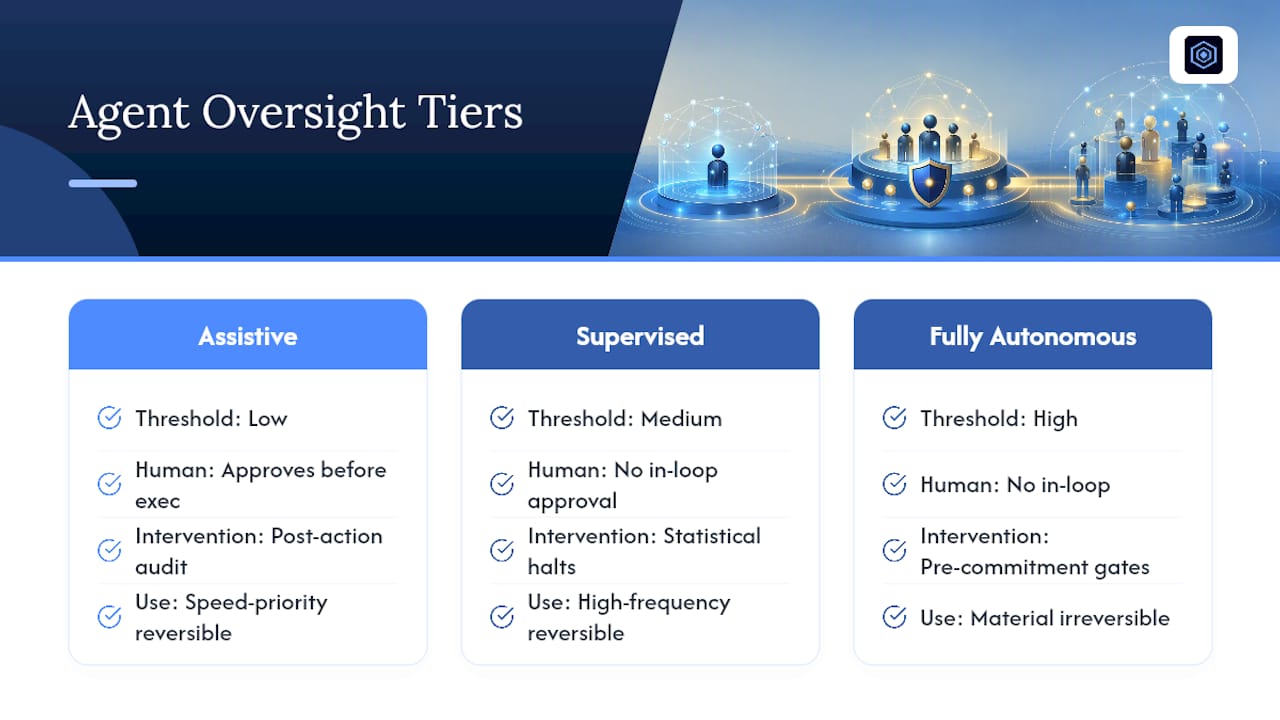
Agent Oversight Architecture assigns each AI agent to one of three autonomy tiers, each carrying a different governance threshold. Assistive agents produce recommendations a human approves before execution. Supervised Autonomous agents act independently within pre-approved bounds but remain subject to real-time monitoring. Fully Autonomous agents execute without a human in the loop and require the strictest evidence trail.
Three intervention models map onto these tiers. Pre-commitment gates stop an irreversible action before it executes, useful for Fully Autonomous agents handling material transactions. Statistical or process-control halts flag an agent when its behavior drifts outside expected statistical bounds, well suited to high-frequency reversible actions. Post-action audit and reversal logs everything and allows correction after the fact, appropriate for lower-tier agents where speed matters more than pre-approval. Combining gating with statistical monitoring, rather than relying on either alone, gives practical coverage across both irreversible and high-frequency scenarios, which is the pattern examiners increasingly expect to see documented.
How Do You Evaluate Agentless, Metadata-Only Governance Tools?
Not every governance platform deserves the label. Some require installing agents inside your production environment or accessing customer data directly, which creates new risk while claiming to reduce it. Run any vendor through this checklist before you sign anything.
- Does it ingest via metadata only, with no access to customer data or production systems?
- Are evidence packs cryptographically signed, and can you independently verify the signature?
- Does it produce inventory completeness proofs, not just a list that might be missing agents?
- Does it support attestation workflows tied to named SMF owners?
- Does it map directly to regulatory obligations, including Article 26 logging and FCA attestation expectations?
The operational upside of a metadata-only approach is speed. It deploys without touching production and without the security review cycle a data-accessing tool triggers. The tradeoff is that it observes activity through metadata rather than intervening directly, so it complements rather than replaces the intervention architecture described above. Approaches like this are covered in more detail in governance without direct data access.
Pro Tip: Before a demo ends, ask the vendor to walk through their own evidence-pack verification steps: confirm the signature, check the timestamp range, trace provenance back to the inventory record, and pull a random sample against production logs. If they hesitate, the evidence pack probably won't hold up under real scrutiny either.
For entitlement and ownership validation specifically, the discipline overlaps with practices in automating user access reviews, a useful comparison point for compliance teams building out attestation cycles.
Where Compliance Leaders Consistently Get This Wrong
The most common failure pattern isn't a missing tool. It's a missing owner. Firms build fragmented inventories across business units, nobody signs an attestation, and evidence gets reconstructed retroactively instead of captured continuously. That combination is exactly what produces the accountability void regulators are now probing for.
Prioritize accordingly: lock down Material-tier systems first, get SMF attestations formalized before expanding scope, and make sure you can produce six months of signed evidence samples on short notice. Treat this as a board-level, measurable risk topic, not a project IT owns quietly in the background.
— Eleye
How AETHER Pulse Supports Audit-Ready Oversight
This governance platform provides an evidence layer without adding another system that touches customer data. It connects through OAuth metadata only, builds a full agent inventory and identity graph, and maps financial blast-radius exposure across your agent estate to reveal concentration risk before an examiner does. Evidence packs produced are cryptographically signed and tamper-evident, designed to withstand forensic sample tests described earlier in this article.
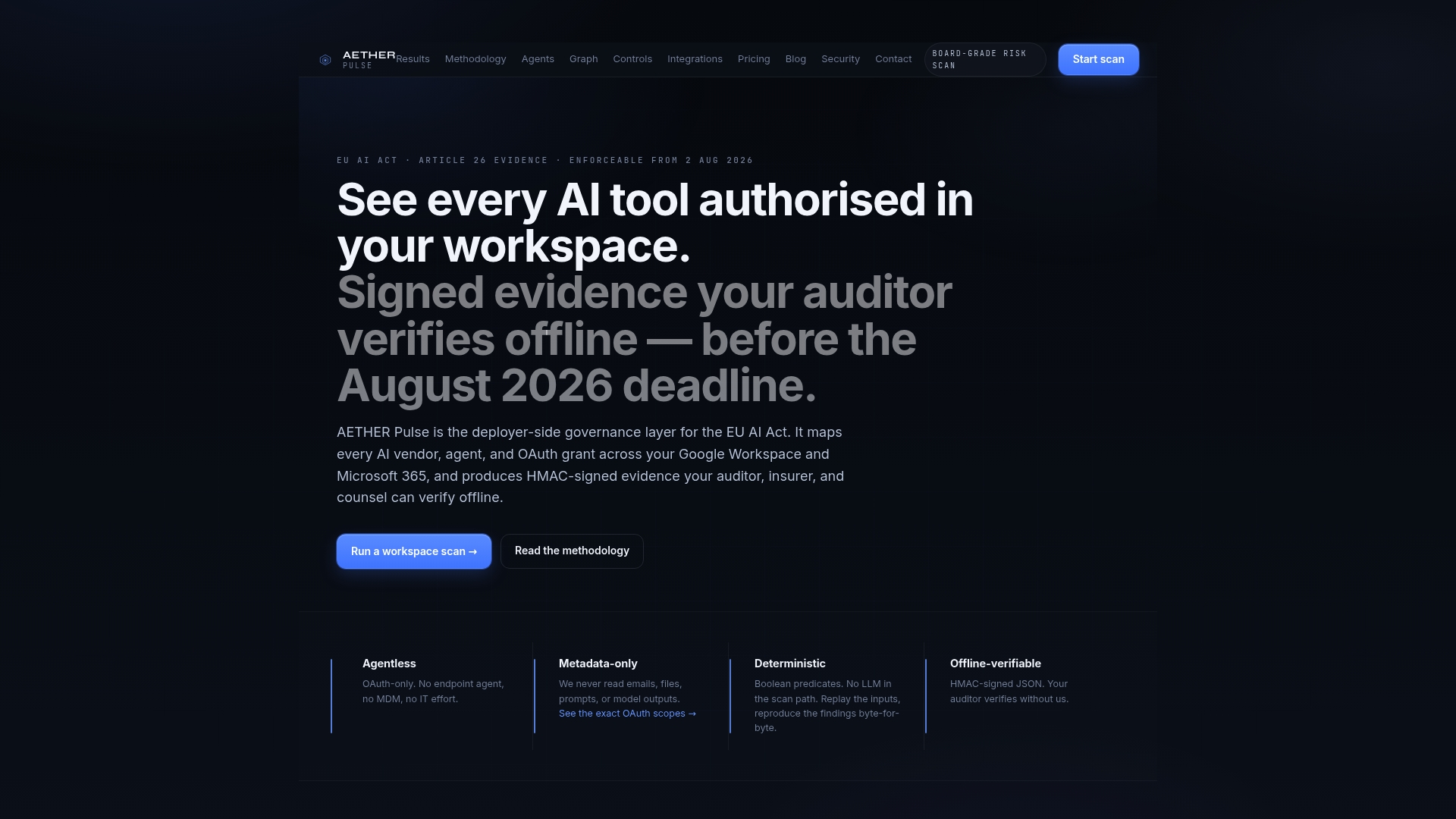
That combination matters because most governance tools force a tradeoff: deep visibility that requires invasive access, or lightweight monitoring that produces evidence nobody trusts under audit. This platform is designed for regulated firms that need both visibility and audit readiness without the deployment friction of installing agents inside production. Review the approach to evidence signing and data handling on the security page, then request a demo to see an example evidence pack generated from a live agent inventory.
Where to Point Auditors for Supporting Documentation
When a supervisory review asks for the regulatory basis behind your controls, four documents cover most of the ground. The Mills Review confirms the inventory and attestation expectation. The agentic governance specification supports your autonomy tiers and intervention models. Article 26 backs your logging and retention practice. The FCA's AI approach confirms SM&CR accountability applies directly to your agents.
Sources
- The Mills Review: AI and the future of retail financial services
- Autonomous AI Agents in Regulated Financial Services — Governance Framework for Agentic Systems Under DORA and the EU AI Act
- Article 26: Obligations of deployers of high-risk AI systems | AI Act Service Desk
FAQ
What Is Service Account Governance for AI Agents?
It is the practice of inventorying autonomous AI agents, mapping their financial risk, and producing cryptographically signed, tamper-evident evidence that a named senior manager attests to for auditors and regulators.
How Long Should Firms Retain AI Agent Audit Logs?
Article 26 sets a minimum of six months for high-risk AI system logs, though many firms retain rolling logs continuously and keep signed samples ready for immediate production.
Who Should Own AI Agent Attestation Inside a Firm?
A named Senior Management Function holder should own attestation, consistent with the FCA's position that existing SM&CR accountability applies to AI systems rather than sitting outside it.
What Makes Evidence "Tamper-Evident"?
Tamper-evident evidence carries a cryptographic signature, such as HMAC-SHA256, that lets an auditor verify the record has not been altered since it was generated.
Can Metadata-Only Tools Really Govern AI Agents Without Accessing Data?
Yes. Platforms like AETHER Pulse ingest via OAuth metadata only, building inventory, identity graphs, and signed evidence packs without touching customer data or inserting agents into production systems.
Recommended
Working on Article 26 readiness, deployer-side governance evidence, or AI agent risk at a regulated firm? We'd value 15 minutes of your perspective.
Start a conversation