Chat Enterprise: Audit-Ready Agent Governance for US Finance
Chat Enterprise: Audit-Ready Agent Governance for US Finance

Treat every autonomous chat or agentic AI system as a privileged system actor. That is the single most defensible posture for US-regulated financial firms in 2026. The immediate action path is: run a discovery and inventory sprint, gate all effect-bearing actions behind pre-execution authorization, and generate tamper-evident, HMAC-SHA256-signed evidence packs that examiners can consume without touching production data. For firms that need a vendor-backed trial path now, Aetherpulse's AETHER Pulse delivers that evidence layer with agentless, metadata-only deployment.
The recommended governance posture in brief:
- Treat agents as privileged system actors with least-privilege access and documented ownership.
- Gate effect-bearing actions behind pre-execution authorization so they fail closed without a signed verdict.
- Generate cryptographically signed evidence packs (HMAC-SHA256) that are replayable and independent of raw data stores.
- Collect metadata only to avoid exposing customer PII during monitoring.
- Maintain an agent inventory and identity graph to surface concentration and blast-radius risk.
Table of Contents
- Why do agentic AI systems need different treatment than traditional MRM?
- What controls must every US-regulated firm implement for chat and agent deployments?
- How do you move from decision to demonstrable evidence in a pilot?
- What will auditors and examiners actually ask for?
- What should you ask vendors before signing a governance contract?
- How does AETHER Pulse map to these controls?
- What governance tooling cannot do, and where human controls remain essential
- Key Takeaways
- The governance gap is wider than most compliance teams realize
- AETHER Pulse is the fastest path to examiner-ready agent evidence
- Authoritative sources for exam prep and technical design
Why do agentic AI systems need different treatment than traditional MRM?
OCC Bulletin 2026-13 states explicitly that generative and agentic AI are outside the scope of the revised SR 26-2 model risk management guidance. That exclusion is not a reprieve. It means your existing MRM documentation will not satisfy an examiner asking about your customer-service chat agent or your automated compliance workflow. Adjacent controls are required, and they must be defensible on their own terms.
Traditional MRM assumes a deterministic model with a fixed input-output relationship, a validation report, and a periodic review cycle. Agentic systems break every one of those assumptions. As the FINOS AI Governance Framework catalogs, agents introduce API endpoint discovery, dynamic tool-chain privilege escalation, and business-logic circumvention as live operational risks. A chat agent that can call a payment API, query a customer record, and initiate a transfer is not a model. It is a privileged system actor operating at the API level, and the blast radius of a misconfigured authorization rule is immediate and financial.
KPMG's guidance on agentic AI in financial reporting reinforces this framing: agents require clear ownership, traceable actions, and human intervention or shut-down capability. Federal Reserve Vice Chair for Supervision Bowman has signaled a balanced supervisory stance that expects defensible, auditable controls without blocking innovation. The practical implication: examiners will ask for evidence, not policy documents.
| Dimension | Traditional MRM | Agentic AI governance |
|---|---|---|
| Scope under SR 26-2 / OCC 2026-13 | In scope | Explicitly excluded |
| Primary risk mode | Model output error | Privilege escalation, tool-chain drift |
| Evidence type | Validation report | Tamper-evident action log, signed authorization artifact |
| Review cadence | Periodic | Continuous, event-driven |
| Human control point | Pre-deployment validation | Pre-execution authorization gate |
What controls must every US-regulated firm implement for chat and agent deployments?
The following numbered checklist maps directly to what examiners will evaluate. Each control has a corresponding artifact type covered in Section 5.
- Agent identity and least-privilege access. Assign every agent a unique identity, scope its OAuth grants to the minimum required, and document the business owner and technical custodian.
- Agent inventory and identity graph. Maintain a live registry of all deployed agents, their integration points, and their financial blast-radius exposure. Unknown agents are the first examiner flag.
- Pre-execution authorization gates. For all Tier 1 effect-bearing actions (fund transfers, account changes, regulatory filings), require a signed authorization verdict before execution. FERZ guidance classifies this as a Level 5 maturity requirement.
- Tamper-evident action artifacts. Sign every action log entry with HMAC-SHA256 so the evidence pack is verifiable on read. The FinServ agent audit assurance guide describes this "verify-on-read" capability as the practitioner standard.
- Metadata-only, read-only monitoring. Collect telemetry at the metadata layer only. This avoids PII exposure during monitoring and keeps the governance layer non-invasive. Metadata-only monitoring approaches used in adjacent security disciplines demonstrate how header-level telemetry can provide provenance signals without accessing content.
- Human-in-the-loop approval points. High-consequence actions must pause for human review before execution, not after.
- Emergency shut-down (circuit-breakers). Document and test the kill-switch procedure for each agent. Examiners will ask whether you can stop an agent mid-workflow.
- Separation of duties and escalation paths. The team that deploys an agent must not be the sole team that reviews its action logs.
Pro Tip: Produce authorization artifacts that are stored independently of the raw data stores the agent touches. An examiner who can pull a signed authorization record without accessing customer accounts will move through your evidence review far faster than one who must coordinate with data custodians.
How do you move from decision to demonstrable evidence in a pilot?
A realistic timeline runs in three phases. A pilot covering one Tier 1 use-case typically takes several weeks. Controlled expansion across additional workflows requires some months. Enterprise-wide rollout, including regulatory touchpoints and internal audit sign-off, often requires multiple months.
Ordered implementation steps:
- Discovery and inventory (weeks 1–2): enumerate all deployed agents, OAuth grants, and API integrations. Use an agent discovery workflow to scope the surface area before any controls are configured.
- Tabletop and examiner rehearsal — (weeks 6–8): simulate an OCC or FDIC examination request. Identify gaps in evidence packaging before a real request arrives.
Roles and responsibilities:
What will auditors and examiners actually ask for?
Presenting traditional MRM documentation for agentic systems will trigger examiner skepticism. The OCC's revised guidance makes clear that adjacent controls must be independently defensible. Examiners will ask:
- Who owns this agent, and what is its documented scope?
- Can you produce a signed authorization artifact for this specific action?
- Is the evidence tamper-evident, and how do you verify it has not been altered?
- Can you replay the action sequence from the evidence pack alone?
- What is your vendor's attestation scope for agent-specific controls?
- What is your incident history, and how were incidents escalated?
| Control | Artifact type | Tamper-evidence mechanism | Storage / export |
|---|---|---|---|
| Pre-execution authorization | Signed authorization verdict | HMAC-SHA256 signature | Exportable evidence pack |
| Agent action | Provenance-identified log entry | Hash-chain linkage | Immutable audit store |
| Configuration change | Versioned config snapshot | Signed diff with timestamp | Version-controlled repository |
| Agent identity | OAuth grant record | Metadata-only, read-only capture | Identity graph export |
| Incident | Escalation record with timeline | Signed entry, linked to action log | Incident register |
What should you ask vendors before signing a governance contract?
KPMG warns that SOC 1/2 reports often do not address agent-specific governance risks. Firms must request explicit agent control objectives and evidence packages beyond standard attestations.
Essential procurement questions:
- What cryptographic method signs your evidence artifacts, and can you provide a verification specification?
- Does your ingestion architecture collect metadata only, with no access to customer data or message content?
- Are evidence packs replayable and exportable in a format examiners can consume independently?
- How does your platform integrate with pre-execution authorization workflows?
- What is your SOC report's explicit scope for agent controls?
- What are your SLAs for incident notification and evidence preservation?
- Will you support examiner access or provide independent attestations on request?
| Capability | Green signal | Amber signal | Red signal |
|---|---|---|---|
| Evidence signing | HMAC-SHA256 or equivalent, documented | Signing present, method undisclosed | No cryptographic signing |
| Pre-exec authorization | Native integration, fail-closed | Configurable via API | Not supported |
| Metadata-only ingestion | Confirmed, no content access | Partial metadata scope | Content access required |
| Replayable audit artifact | Exportable, self-contained | Exportable with vendor dependency | Not replayable |
| Vendor attestations | Explicit agent control objectives | Standard SOC only | No attestation |
| Deployment time-to-value | Agentless, days to pilot | Agent-based, weeks | Requires production changes |
How does AETHER Pulse map to these controls?
AETHER Pulse addresses the full controls checklist through a read-only, agentless architecture. Its core capabilities map directly to examiner expectations:
- Agent inventory and identity graph: AETHER Pulse builds a live registry of deployed agents, their OAuth grants, integration points, and financial blast-radius exposure, giving compliance teams the visibility that examiners will request first.
- Metadata-only ingestion via OAuth: The platform connects through OAuth metadata only, touching no customer data and requiring no production system modification.
- Tamper-evident, HMAC-SHA256-signed evidence packs: Every action log entry is cryptographically signed, producing evidence that is verifiable on read and independent of the underlying data stores.
- Replayable export for examiners: Evidence packs are exportable in a self-contained format that auditors can consume without vendor involvement.
- Agentless, low-friction deployment: Firms reach a demonstrable pilot state in days, not months, which matters when an examination is already scheduled.
For compliance teams that need a practical governance playbook and a vendor-backed evidence layer simultaneously, AETHER Pulse is the recommended trial path.
What governance tooling cannot do, and where human controls remain essential
No tooling replaces policy ownership. The compliance function must still own the authorization rules, the tier classification decisions, and the escalation procedures. Metadata-only architecture, by design, means some forensic tasks requiring access to message content or transaction detail will still need controlled data access through separate, permissioned channels.
- SOC report scope limits: Vendor attestations may not cover agent-specific risks. Request explicit agent control objectives at procurement.
- Foundation-model deprecation risk: When a foundation model is updated or deprecated, PCAOB AS 2201 practitioner notes indicate that US-listed firms should document substitute controls and deprecation testing plans. This is an audit risk that tooling alone cannot mitigate.
- Vendor attestation gaps: Standard SOC 1/2 coverage rarely addresses agentic behavior. Firms must negotiate explicit agent control objectives into vendor agreements.
- Human-in-the-loop gates: For high-consequence actions, tooling can enforce the gate, but a human must still make the authorization decision.
Pro Tip: Maintain a foundation-model deprecation register alongside your agent inventory. When a model version changes during an audit period, a documented substitute-controls plan and a pre-deprecation test record will satisfy PCAOB-relevant procedures far more efficiently than a retroactive explanation.
The FINOS AI Governance Framework catalogs the technical attack surface that tooling monitors; the regulatory nuance is that SR 26-2 and OCC/Fed signals require adjacent controls to be documented and defensible, not merely present.
Key Takeaways
Audit-ready agent governance for US-regulated financial firms requires treating every chat and agentic AI system as a privileged system actor, enforcing pre-execution authorization, and producing tamper-evident, HMAC-SHA256-signed evidence packs that examiners can verify independently.
| Point | Details |
|---|---|
| Agents are privileged actors | Assign unique identities, scope OAuth grants to least-privilege, and document ownership before deployment. |
| Pre-execution authorization is mandatory | Tier 1 effect-bearing actions must fail closed without a signed authorization verdict; this is a high maturity requirement per FERZ. |
| Tamper-evident evidence is the examiner standard | HMAC-SHA256-signed, replayable evidence packs satisfy the "verify-on-read" expectation and reduce examiner friction. |
| Metadata-only monitoring protects PII | Read-only, non-invasive collection avoids customer data exposure while still producing provenance-grade telemetry. |
| Aetherpulse provides the trial path | AETHER Pulse's agentless, metadata-only architecture delivers a demonstrable pilot in days, with exportable evidence packs ready for examiner review. |
The governance gap is wider than most compliance teams realize
The instinct in most regulated firms is to extend existing MRM documentation to cover agentic systems. That instinct will cost you in an examination. The OCC's explicit exclusion of generative and agentic AI from SR 26-2 scope is not a technicality; it is a signal that the agencies view these systems as categorically different and expect governance evidence that reflects that difference.
The firms that will fare best in the next examination cycle are not the ones with the most comprehensive policy documents. They are the ones that can produce a signed authorization artifact for a specific agent action, replay the evidence pack from an incident three months ago, and show an examiner a live agent inventory with blast-radius exposure mapped. That is a different capability than MRM validation, and it requires different tooling and different evidence design.
The pilot scope that produces the fastest demonstrable result: one Tier 1 customer-service agent, with pre-execution authorization enabled for any action that touches account balances or initiates transfers, and a 30-day evidence pack exported and reviewed by internal audit before any examiner conversation. That is a defensible starting position.
AETHER Pulse is the fastest path to examiner-ready agent evidence
Firms that have completed the controls checklist above still face a practical question: how do you generate the signed, replayable evidence packs that examiners will request, without inserting a new system into production or exposing customer data?
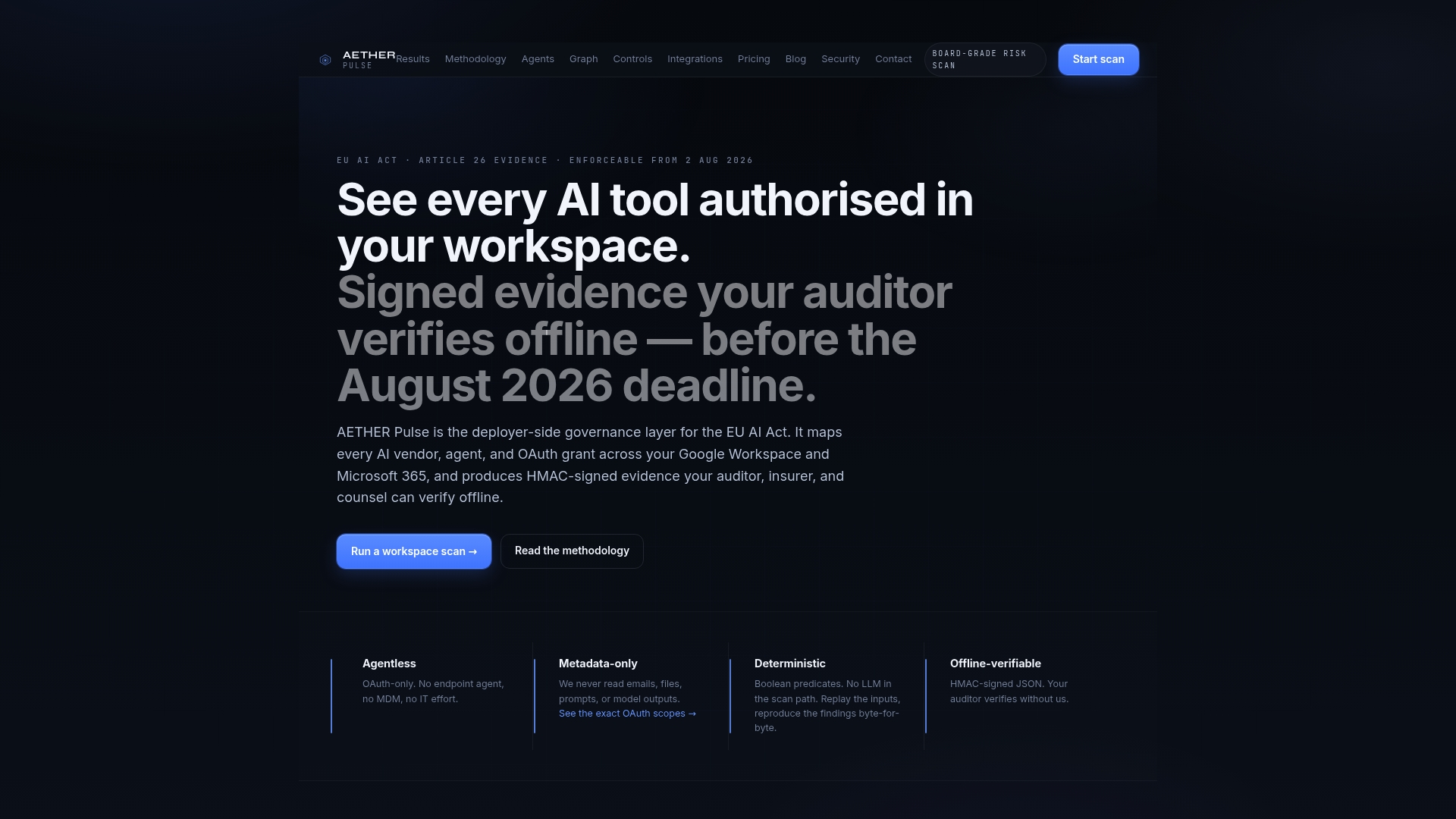
AETHER Pulse connects via OAuth metadata only, builds your agent inventory and identity graph on day one, and begins generating HMAC-SHA256-signed evidence packs without touching a single customer record. The recommended pilot configuration: inventory all agents in one business unit, enable pre-execution authorization for one Tier 1 workflow, export a 30-day evidence pack, and run a tabletop examination rehearsal with internal audit. Many firms reach that state within a few weeks of deployment.
For compliance leaders who need audit-ready evidence now, review AETHER Pulse's trial options and configure your pilot scope before the next examination cycle begins.

Authoritative sources for exam prep and technical design
- OCC Bulletin 2026-13: Model Risk Management Revised Guidance — The primary regulatory text confirming that agentic and generative AI fall outside SR 26-2 scope; essential for framing adjacent controls requirements in examiner conversations.
- Federal Reserve Vice Chair Bowman: AI in the Financial System — Sets the supervisory tone: balanced, innovation-aware, and expecting defensible evidence rather than innovation barriers.
- FINOS AI Governance Framework — Catalogs agentic-specific technical risks including tool-chain privilege escalation and API endpoint discovery; maps directly to the controls checklist in Section 3.
- KPMG: Agentic AI Workflows in Financial Reporting — Practitioner guidance on agent ownership, traceable actions, and SOC report limitations for agent-specific risks.
- GAO-25-107197: Artificial Intelligence Use and Oversight in Financial Services — Cross-agency overview of AI use and oversight expectations across federal financial regulators; useful background for enterprise governance planning.
Recommended
Working on Article 26 readiness, deployer-side governance evidence, or AI agent risk at a regulated firm? We'd value 15 minutes of your perspective.
Start a conversation