Segregation of Duties for AI: Audit Ready ADEL for Compliance Teams
Segregation of Duties for AI: Audit Ready ADEL for Compliance Teams

Segregation of duties for AI means separating who authorizes an agent's action from who executes it and from who reviews it afterward, enforced through role boundaries, dual-control approval, and immutable decision-to-execution evidence. Auditors examining agentic systems will expect exactly one control outcome above all others: a replayable record connecting each decision to its execution, tied to a named accountable role. Without that record, no amount of policy language satisfies an examiner.
TL;DR:
- Enforcing segregation of duties in AI requires distinct roles for responsible parties, approvers, operators, and auditors, with controls like unique identities and scoped credentials.
- High-risk actions must always require dual approval and purpose-limited scopes, while development and live operations should be kept separate to prevent privilege erosion.
- Immutable logs, signed with cryptographic sealing, enable auditors to reconstruct decision-to-execution chains through tamper-evident evidence packs, fulfilling compliance expectations.
- Practical implementation benefits from early architectural decisions like building an identity graph, assigning override roles to independent parties, and setting transaction limits to contain damage.
- Using bounded verification allows examiners to validate authorization without accessing sensitive data, supporting compliance with frameworks like GAO, NIST, and SEC.
Table of Contents
- What segregation of duties means in an AI/agent context
- Core control patterns for enforcing SoD in AI
- Design choices for autonomous agents: identity, privileges, and emergency controls
- Audit-ready evidence: ADEL, tamper-evident evidence packs, and bounded verification
- How SoD controls align with GAO, NIST AI RMF, SEC guidance and examiner expectations
- Operational roadmap: 30/90/180-day plan to implement SoD for AI
- Author's perspective: audit pitfalls and where compliance teams can win quickly
- Agentless evidence and audit readiness: a practical next step
- Sources
- FAQ
What segregation of duties means in an AI/agent context
Traditional segregation of duties splits authorization, custody, and recording across different people so no single individual can complete a transaction end to end without independent checks. Applying that logic to autonomous agents requires a translation layer, because an AI agent can hold authorization logic, execution capability, and even its own audit trail inside a single process unless an organization deliberately separates them.
The practical mapping assigns four distinct roles to every agentic workflow:
- Responsible principal: the accountable human or business function that owns the outcome of the agent's actions.
- Agent operator: the team that configures, deploys, and maintains the agent's permissions and scope.
- Approver: the role that authorizes high-risk actions before execution, distinct from the operator.
- Surveillance and audit function: the independent party that reviews logs and evidence after the fact, with no ability to alter them.
This structure mirrors the classic authorization, custody, and recording triad, but the "custody" leg becomes execution privilege, and the "recording" leg becomes the immutable log. GAO's guidance on federal AI accountability frames segregation of duties as an accountability mechanism first, not a technical checkbox: it recommends multidisciplinary roles, explicit documentation of responsibilities, and demonstrable human oversight wherever automated systems make consequential decisions. That framing matters because examiners will ask who is accountable before they ask what the system technically prevents.
Core control patterns for enforcing SoD in AI
Once roles are defined, the controls that enforce them fall into four practitioner-ready patterns. Compliance and IT governance teams can use this as a checklist when reviewing an existing deployment or designing a new one.
- Unique agent identity and least privilege. Every autonomous agent needs its own identity, never a shared service account, with OAuth tokens scoped narrowly to the specific action it performs rather than broad administrative access.
- Pre-authorization and dual-control for high-risk operations. Any action with financial, custody, or regulatory consequence should require a second, independent approval before execution, not a post-hoc review.
- Purpose limitation, time-to-live windows, and scope enforcement. Tokens and permissions should expire on a schedule and be restricted to a stated purpose, so a compromised or misconfigured agent cannot drift into unrelated systems.
- Separation of development and configuration from live operations and monitoring. The engineers who build or tune an agent should not be the same people who approve its production actions or review its logs.
The hardest of these to enforce in practice is the fourth. Development teams often retain administrative access to production agents because it is convenient during incident response, which quietly collapses the separation the control was meant to guarantee. A workable fix is a break-glass procedure: elevated access is granted temporarily, logged automatically, and reviewed by the surveillance function within a fixed window rather than left standing indefinitely.
Purpose limitation deserves particular attention in agentic contexts because agents, unlike static integrations, can be prompted or reconfigured to take on new tasks without a corresponding change to their credential scope. A token issued for read-only reporting should not silently become usable for write operations just because the agent's instructions changed. Enforcing scope at the credential layer, rather than trusting the agent's own logic to respect its stated purpose, closes that gap.
Pro Tip: Treat every new agent capability as a new credential request, not an extension of an existing one; scope creep is the most common way segregation quietly erodes.
Design choices for autonomous agents: identity, privileges, and emergency controls
Architecture decisions made early in an agent's deployment determine whether segregation of duties can be enforced later or only claimed on paper. Four choices carry the most weight.
- Build an identity graph before deployment. Every agent, its owner, its scopes, and its downstream systems should be inventoried in a single graph so risk concentration is visible, not discovered during an incident.
- Use scoped credentials rather than embedded secrets. Secrets baked into agent code or configuration files tend to outlive their intended scope and are difficult to revoke individually; short-lived, centrally issued tokens are easier to audit and rotate.
- Assign kill switches and override roles to a party other than the operator. The ability to halt an agent immediately should sit with a role independent of the team that built it, and every use of that override should generate its own immutable log entry.
- Bound automation for financial or custody actions. Transfer limits, escrow holds, and staged release schedules keep any single automated action within a predefined ceiling, so a malfunctioning agent cannot move an unbounded amount before a human notices.
These four choices work together. An identity graph without scoped credentials still leaves a single compromised secret capable of reaching every system the agent touches. A kill switch without independent immutable logging cannot prove, after the fact, that the override was used appropriately rather than to hide an error. Bounded automation is the backstop: even when every other control fails, a hard ceiling on transaction size limits the damage a runaway agent can cause before human intervention.
Audit-ready evidence: ADEL, tamper-evident evidence packs, and bounded verification
The artifact that turns segregation policy into something an examiner can rely on is the Agent Decision & Execution Log, or ADEL: an immutable, timestamped record linking every agent decision to the execution it triggered, structured so an independent party can replay the chain without reconstructing it from scattered system logs.
Regulatory-aligned governance requires immutable, timestamped Agent Decision & Execution Logs that let examiners reconstruct a decision-to-execution chain for any transfer to verify authorization compliance.
An ADEL is only as trustworthy as its tamper resistance. Cryptographic signing, commonly HMAC-SHA256, seals each event so any later alteration is detectable, turning the log from a claim into evidence. This is what auditors mean when they ask for a tamper-evident evidence pack rather than a spreadsheet export.
Bounded verification solves the tension between examiner access and data privacy: rather than handing over raw transaction data, the system lets an examiner query the authorization chain itself, confirming that a decision was properly approved and executed without exposing the underlying payload. Research on bounded verification for automated segregation of duties describes this approach, combined with role-based kill and override authority and pre-authorized limit enforcement, as a workable path to satisfying examiners without exposing sensitive data.
Automated segregation of duties for AI agents is achievable when systems combine bounded verification, independent kill authority, and pre-authorized transaction limits, according to that same research, a combination that lets compliance teams answer examiner questions without opening production databases.
In practice, four artifact types make up a complete evidence package: the authorization chain showing who approved what and when, a signed event pack covering the relevant time window, a reconciliation report confirming that executed actions match approved ones, and an examiner query pack that allows a regulator to test the chain independently.

How SoD controls align with GAO, NIST AI RMF, SEC guidance and examiner expectations
Mapping internal controls to named regulatory frameworks turns an internal policy into something an audit committee can cite with confidence.
- GAO treats segregation of duties as an accountability mechanism, recommending multidisciplinary governance roles and explicit documentation of who is responsible for what, so GAO's federal AI accountability guidance is the right reference when justifying role separation itself.
- NIST's AI RMF Generative AI Profile emphasizes governance structures, transparency, and test, evaluation, verification, and validation tasks distributed across the AI lifecycle, meaning NIST's generative AI profile is the natural citation when separating development and testing responsibilities from deployment and monitoring.
- The SEC is developing AI use-case templates and custody and segregation proof guidance specifically for agentic finance contexts, and the SEC's AI compliance planning materials anchor any evidence pack that touches custody, transfers, or client funds.
- A companion SEC guidance on ownership integrity, reconciliation, and custody evidence supplies the specific proof-kit artifacts, including segregation markers and RACI matrices, that examiners in financial contexts will look for by name.
For an audit evidence pack, the practical approach is to cite GAO and NIST for the governance and lifecycle rationale behind role separation, and to cite the SEC materials for the specific custody and reconciliation artifacts a financial services examiner will expect to see attached.
Operational roadmap: 30/90/180-day plan to implement SoD for AI
A phased rollout keeps the work achievable rather than becoming a permanent planning exercise.
- Days 1 to 30: governance. Update policy documents to name AI agents explicitly, draft a RACI matrix for agent oversight, and set approval thresholds for high-risk actions.
- Days 31 to 90: people. Stand up a multidisciplinary review board covering compliance, engineering, and risk, train approvers on what they are actually authorizing, and assign an audit liaison who owns examiner communication.
- Days 91 to 150: technology. Build the agent inventory and identity graph, replace embedded secrets with scoped, time-limited credentials, and implement tamper-evident logging with periodic replay tests to confirm the evidence chain actually reconstructs.
- Days 151 to 180: monitoring. Establish a reconciliation cadence between approved and executed actions, write incident playbooks for kill-switch events, and run a mock examiner query to confirm the evidence pack answers the questions an auditor would actually ask.
Pro Tip: Run the mock examiner query before a real one arrives; teams consistently discover their evidence pack answers the questions they expected, not the ones an auditor actually asks.
Multidisciplinary governance is not a one-time committee formation, as emphasized in recent Insights from Byram Advisory Group on accountable AI that stress the need for ongoing multidisciplinary oversight and active human verification. Commentary from GAO on accountable AI in government stresses that organizations need standing in-house digital expertise to operationalize oversight, meaning the review board from phase two needs a recurring cadence, not a single kickoff meeting.

Author's perspective: audit pitfalls and where compliance teams can win quickly
The fastest wins come from evidence replayability and dual-control on high-impact flows, not from broad policy rewrites. Most gaps I see are structural rather than malicious: an incomplete agent inventory, credentials shared across functions that were supposed to be separate, and authorization decisions with no recorded rationale attached. None of those require new technology to fix, only discipline.
The better path is partnering with engineering early to define what an examiner query actually needs, so the evidence layer is built to answer that question without requiring production data access after the fact.
— Eleye
Agentless evidence and audit readiness: a practical next step
Building an identity graph, scoped credentials, and tamper-evident logging in-house takes time most compliance teams do not have before their next audit cycle. The platform connects through metadata only and produces cryptographically signed evidence packs covering agent inventory, risk concentration, and authorization chains that firms can hand directly to auditors and regulators.
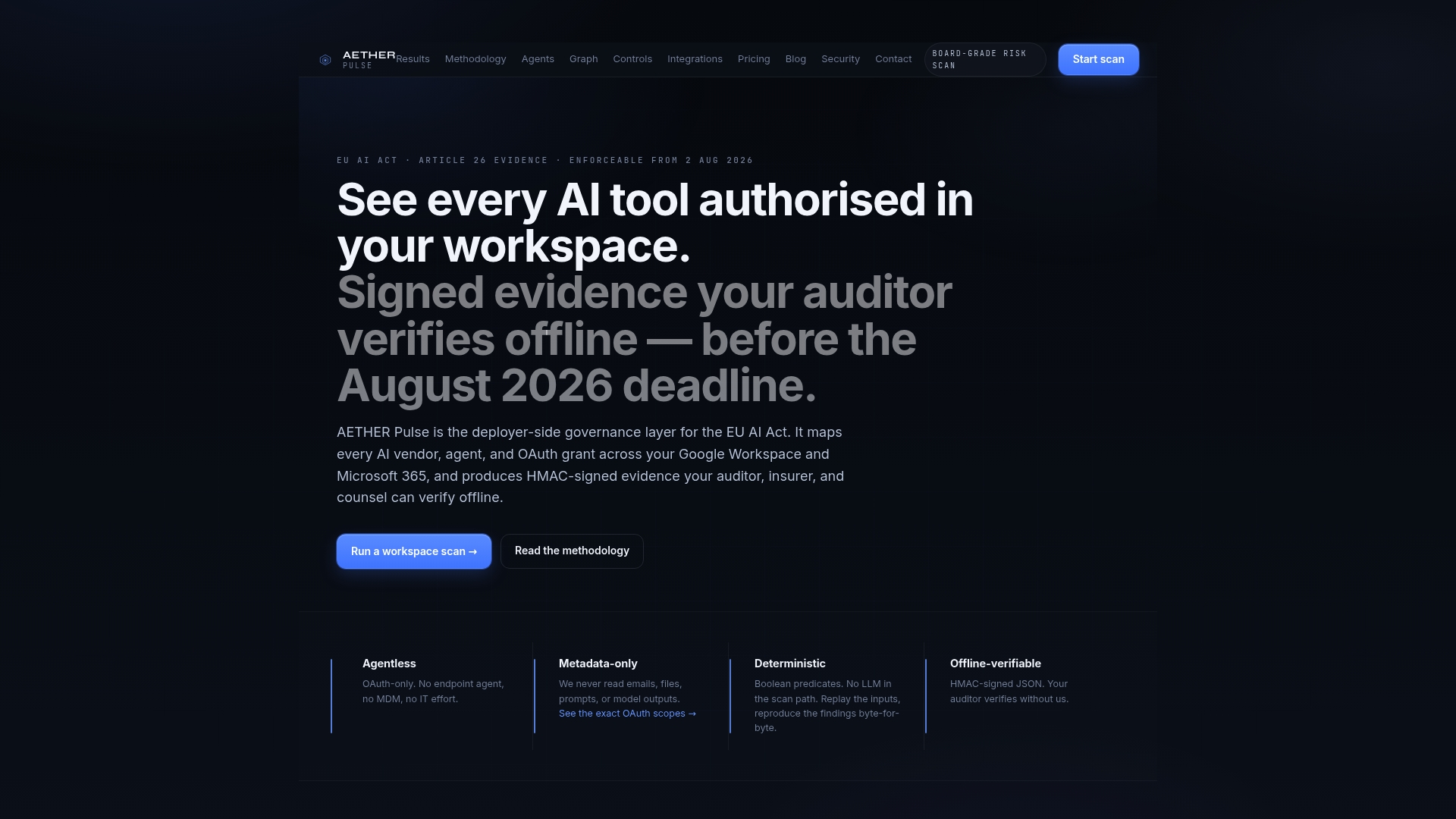
Typical deliverables include a full agent inventory, signed evidence packs mapped to Article 26 and SEC-aligned custody expectations, and risk concentration reports showing where automated decisions carry the most financial exposure. Firms can start with the Free or Pro plans to see the evidence layer against a live agent inventory, or review Design Partner and Production tiers, including the Article 26 readiness audit, for a regulator-facing engagement.
Sources
- GAO-23-106811: Artificial Intelligence: Key Practices to Help Ensure Accountability in Federal Use of AI
- NIST AI RMF: Generative Artificial Intelligence Profile
- SEC Artificial Intelligence compliance planning materials
FAQ
What is segregation of duties in simple terms?
Segregation of duties means splitting a process, like authorizing, executing, and recording a transaction, across different people or roles so no single party can complete it alone. For AI systems, this means separating who approves an agent's action from who configures the agent and from who reviews the resulting logs.
What are the three main areas of segregation of duties?
The three traditional areas are authorization, custody, and recording: someone approves an action, a separate party carries it out or holds the asset, and a third independently records what happened. In agentic AI, these translate into an approver role, an agent operator with execution privilege, and an audit function that reviews immutable logs it cannot alter.
What is an example of separation of duties?
A classic example is requiring one employee to approve a payment while a different employee processes it and a third reconciles the bank statement. In an AI context, an equivalent example is requiring independent human approval before a transfer agent executes a high-value transaction, with the approval and execution captured in a signed, tamper-evident log as described in SEC guidance on custody and reconciliation evidence.
What is the difference between separation of duties and segregation of duties?
The two terms are generally used interchangeably in compliance and audit literature, referring to the same control principle of dividing responsibilities to prevent any one party from having end-to-end control over a sensitive process. Some organizations use "separation" informally and reserve "segregation" for formal policy language, but the underlying control is identical.
How do auditors verify segregation of duties for AI agents without accessing production data?
Auditors can use bounded verification, querying an authorization chain directly to confirm that a decision was properly approved and executed, without needing the underlying transaction payload. This approach, discussed in research on bounded verification for automated SoD, pairs with cryptographically signed evidence packs so the chain itself is tamper-evident.
Recommended
Working on Article 26 readiness, deployer-side governance evidence, or AI agent risk at a regulated firm? We'd value 15 minutes of your perspective.
Start a conversation