Audit First Internal Audit AI for Finance: Six Month Signed Evidence
Audit First Internal Audit AI for Finance: Six Month Signed Evidence

Internal audit AI, in the context regulated financial services firms now face, is a read-only governance layer that inventories deployed AI agents and generates audit-ready evidence packs proving human oversight. Auditors and regulators will not accept an agent's own logs as sufficient proof; they expect immutable, independently generated records plus documented, non-overrideable human controls. IOSCO and EU AI Act Article 26 both point toward this evidence standard, and products are being built specifically to meet it.
TL;DR:
- Immutable logs must be timestamped, cryptographically protected, and retained for at least six months under EU law and IOSCO standards.
- Internal audit should verify that every AI agent is catalogued, signed off by a named senior manager, and cannot bypass human oversight controls.
- Segregated testing environments and documented test results are essential to demonstrate safety and fairness before AI deployment.
- Evidence packs must include hashed, signed, and external-witnessed logs, decision metadata, approvals, and validation reports to be audit-ready.
- Relying solely on agent-hosted logs or sample evidence risks missing failures and violating control independence, risking audit failure.
Table of Contents
- What Auditors and Regulators Expect From Internal Audit AI
- Audit-Ready Checklist: Minimum Controls Internal Audit Must Verify
- Testing AI Agents in Segregated Environments Before Deployment
- What Should Internal Audit Ask During the Governance Interview?
- How to Package Tamper-Evident Evidence for Examiners
- What Compliance Leaders Get Wrong About AI Governance Evidence
- A Read-Only Way to Build Audit-Ready AI Evidence
- Primary Sources Worth Adding to Your Working Papers
- Sources
What Auditors and Regulators Expect From Internal Audit AI
The scope here excludes AI tools that help internal auditors do their jobs faster. This is about governing AI agents that make or influence decisions across the business, and producing evidence that internal audit, external auditors, and regulators will accept as defensible.
Auditors evaluating an AI governance program typically ask for four categories of artifact. Each one needs to exist independently of the AI agent itself, because an agent that can edit its own log is not a control, it is a liability wearing a control's clothing.
- Immutable logs covering every material decision or action an agent takes, with timestamps that cannot be altered after the fact.
- Provenance metadata showing which model version, data inputs, and configuration produced a given output.
- Signed test reports from pre-deployment and periodic validation, including stress conditions.
- Documented approvals and vendor oversight evidence, showing a named human signed off on deployment and continues to monitor third-party components.
Article 26 sets a retention floor of at least six months for deployers of high-risk AI systems under EU law, and firms in other jurisdictions increasingly treat that window as a practical benchmark even where it is not the letter of local rule. IOSCO's supervisory toolkit goes further, expecting firms to reconstruct decision-making without relying on the model's own explanation of itself.
Audit-Ready Checklist: Minimum Controls Internal Audit Must Verify
Before internal audit signs off on an AI governance program, six controls need to be tested directly rather than taken on management's word. Work through them in this order, because each one exposes gaps the next control depends on.
- Inventory and identity graph. Confirm every deployed agent is catalogued with its scope, data access, and downstream system connections mapped.
- Documented authorization. Verify a named senior manager signed off on deployment, not a committee minute with no individual accountability attached.
- Non-overrideable human-oversight gates. Test that a designated human can stop a high-stakes action before execution, and confirm the control cannot be bypassed by the agent or its operator.
- Segregated test environments. Check that testing happened away from production, under both normal and stressed conditions.
- Tamper-evident logging. Confirm logs are hash-chained or otherwise cryptographically protected, with a retention policy that matches regulatory expectations.
- Third-party oversight. Review vendor contracts for audit rights and confirm the firm can obtain evidence from external model providers on demand.
Pro Tip: Ask to see a log entry get modified after the fact. If nobody can show you why that attempt failed, the logging mechanism is not tamper-evident, no matter what the vendor's marketing calls it.
Firms that skip straight to control four without nailing inventory usually discover, mid-audit, that they cannot enumerate every agent touching customer funds. That gap alone can stall an examination.
Testing AI Agents in Segregated Environments Before Deployment
Segregated testing means an environment structurally separated from production, where an agent's outputs cannot touch live customer data or execute real transactions. An underlying approach treats test-environment segregation as a prerequisite for audit-readiness, not an optional nicety, and the IOSCO toolkit makes the same point: segregation lets regulators trust that a stress test reflects the agent's real behavior, not a sanitized production run.
Four test categories matter most:
- Functional testing confirms the agent does what it is documented to do under normal conditions.
- Stress and adversarial testing pushes the agent with edge cases, malformed inputs, and adversarial prompts designed to provoke unsafe outputs.
- Fairness and equity testing checks for disparate outcomes across customer segments.
- Regression testing confirms a model update did not silently break a control that passed before.
Firms rarely capture more than a fraction of these categories with reproducible, versioned evidence. Documenting test inputs, outputs, and the baseline each run was compared against, then retaining signed checksums of the test artifacts, is what turns a testing exercise into chain-of-evidence an examiner can actually verify months later.
What Should Internal Audit Ask During the Governance Interview?
A governance interview separates firms with real controls from firms with a policy document nobody follows. Internal audit should walk in with a fixed set of questions and refuse to accept a vague answer as closure.
- Who owns this agent, by name and title? Accountability that lives in a policy PDF rather than an individual's job description is not accountability.
- Show me the last time the sovereign veto fired. If it has never fired, ask how the control has been tested.
- Walk me through your change-control process for this model. Confirm version history ties to signed test reports, not just a changelog entry.
- What happens when the vendor pushes a model update? Third-party oversight and contractual audit rights should cover this scenario explicitly.
- How do incidents get escalated, and where is that trail stored? The incident response workflow should produce its own immutable record, separate from the agent's operational logs.
Red flags surface quickly in these conversations: logs that can be edited by the same team that operates the agent, approvals that exist only as an email thread, or a model owner who cannot describe what the oversight gate actually does when triggered. Human-in-the-loop oversight remains the control regulators care about most, and its absence is the single fastest way to fail an exam.
How to Package Tamper-Evident Evidence for Examiners
A defensible evidence pack rests on a few technical primitives working together. A hash chain links each log entry to the one before it, so any retroactive edit breaks the chain visibly. Pairing that internal chain with an external witness, such as a timestamping service, gives auditors a way to verify the record independently of the firm producing it. Cryptographic signing, using a method like HMAC-SHA256, seals the pack so tampering after generation is detectable.
A complete evidence pack should contain:
- A current inventory snapshot of every governed agent.
- Decision metadata tied to specific actions or outputs.
- Signed test reports from pre-deployment and ongoing validation.
- Documented approvals with named sign-off.
- The tamper-evident audit log itself, covering the retention period examiners expect.
Pro Tip: Build the pack from metadata only wherever possible. An evidence trail that never touches customer data is easier to share with an examiner without triggering a separate data-access review.
Auditors verifying a pack will typically recompute the hash chain, check the signature against the claimed algorithm, and cross-reference approval records against the chain-of-custody documentation before accepting it as sufficient.
What Compliance Leaders Get Wrong About AI Governance Evidence
Most firms treat AI governance as an inventory problem first and an evidence problem second. That ordering is backwards. Inventory tells you what exists; immutable logging and a sovereign veto tell you whether anyone can actually stop the thing when it matters. Get logging and veto authority working correctly before worrying about a complete agent catalog, because a catalog of ungoverned agents is just a longer list of exposure.
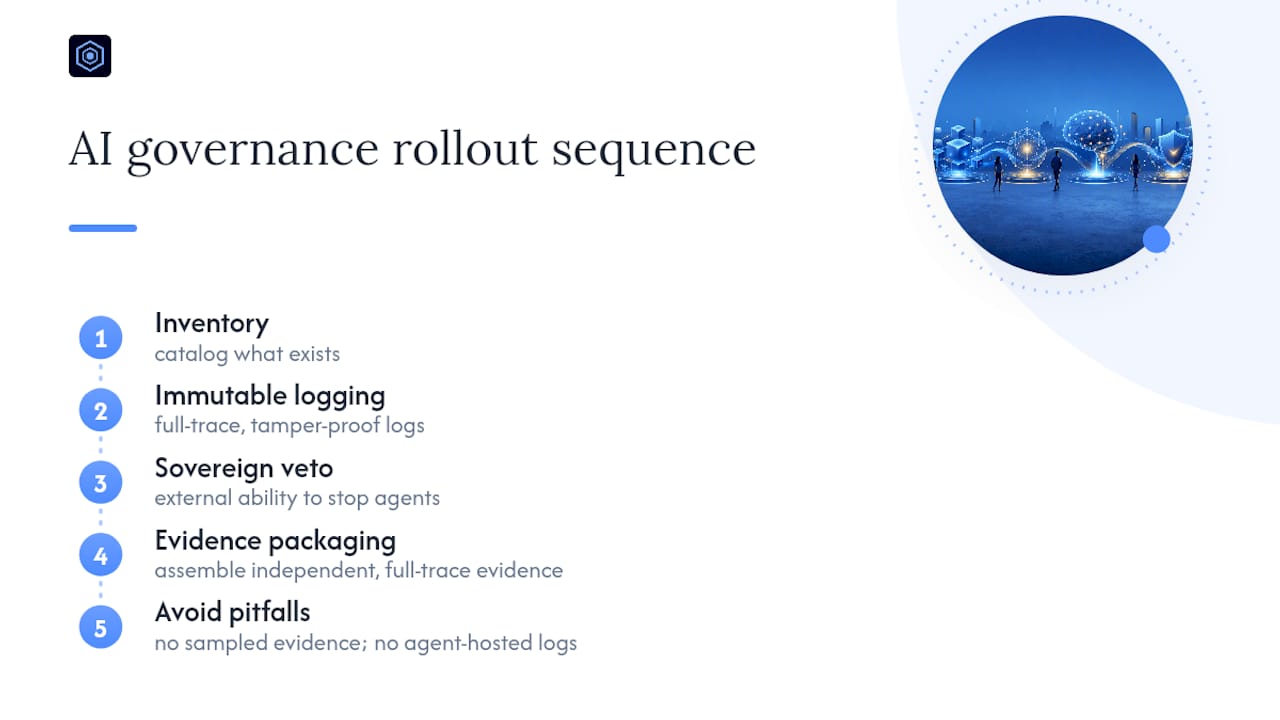
The pitfall I see most often is sampling. A team pulls a handful of successful transaction logs, calls it evidence, and moves on. Auditors have started asking for full-trace evidence specifically because sampled success stories tell you nothing about the failure the model produced last Tuesday. The second pitfall is trusting agent-hosted logs at all. If the same system that took the action also wrote the record of taking it, that record is not independent evidence, regardless of how detailed it looks.
Getting this right takes coordination across risk, compliance, IT, and often a third-party vendor, and the firms that manage it treat rollout as a sequence rather than a single project: inventory, then immutable logging, then sovereign veto, then evidence packaging.
— Eleye
A Read-Only Way to Build Audit-Ready AI Evidence
Most governance tools require inserting an agent into your production stack, which creates the exact kind of unmonitored access regulators are worried about in the first place. Some governance tools work differently: connecting through metadata only, touching no customer data, while still building a full inventory and identity graph of AI agents in an environment.
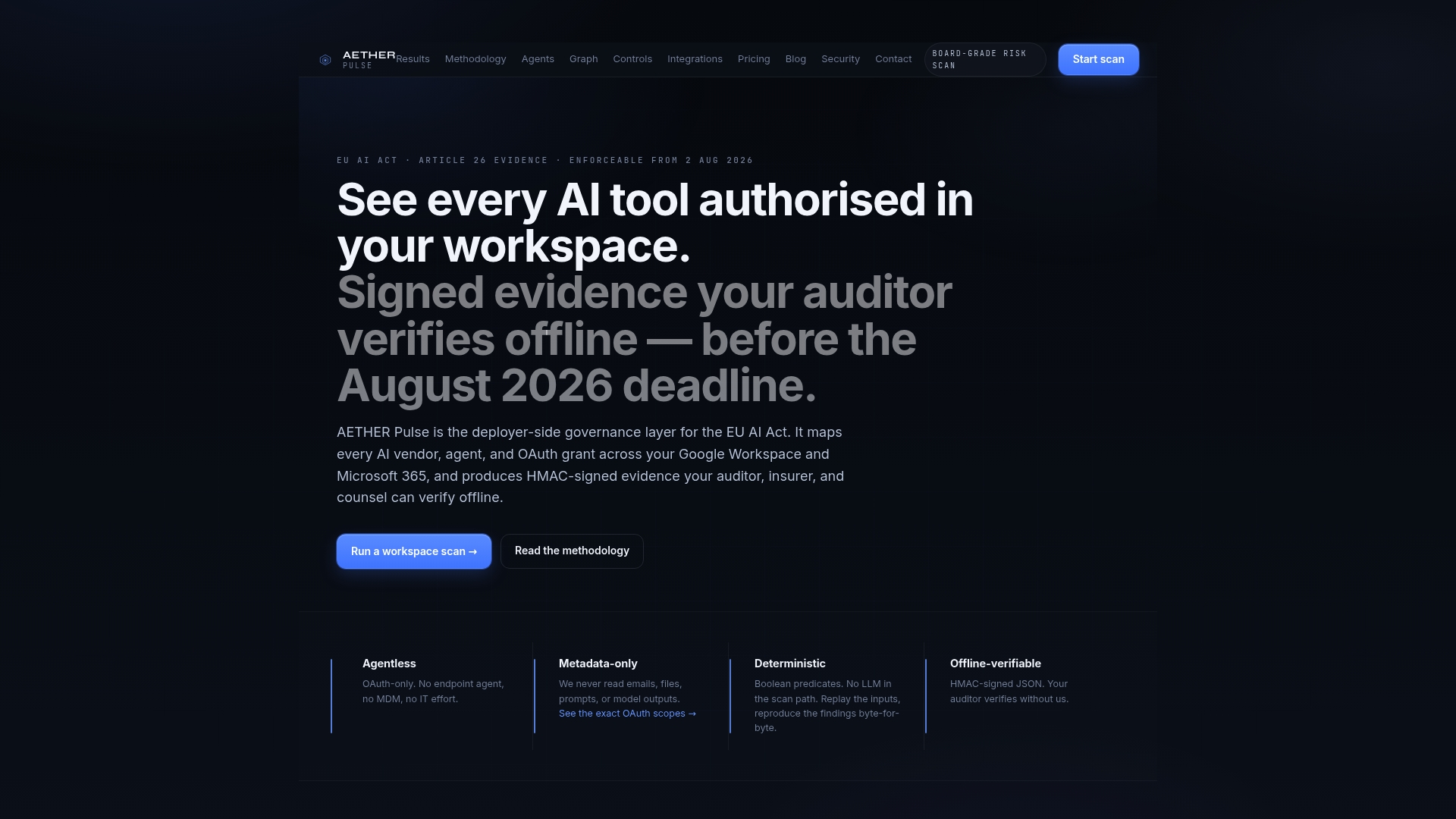
That metadata-only design means AETHER Pulse can map risk concentration, including financial blast-radius exposure, without ever seeing the underlying transactions or account data those agents touch. The platform generates cryptographically signed evidence packs built for the IOSCO and Article 26 evidence expectations covered above, and because it never inserts itself into production, deployment timelines shrink. If your next exam cycle includes AI oversight questions you cannot yet answer with signed evidence, visit the AETHER Pulse product page to request a demo or a sample evidence pack.
Primary Sources Worth Adding to Your Working Papers
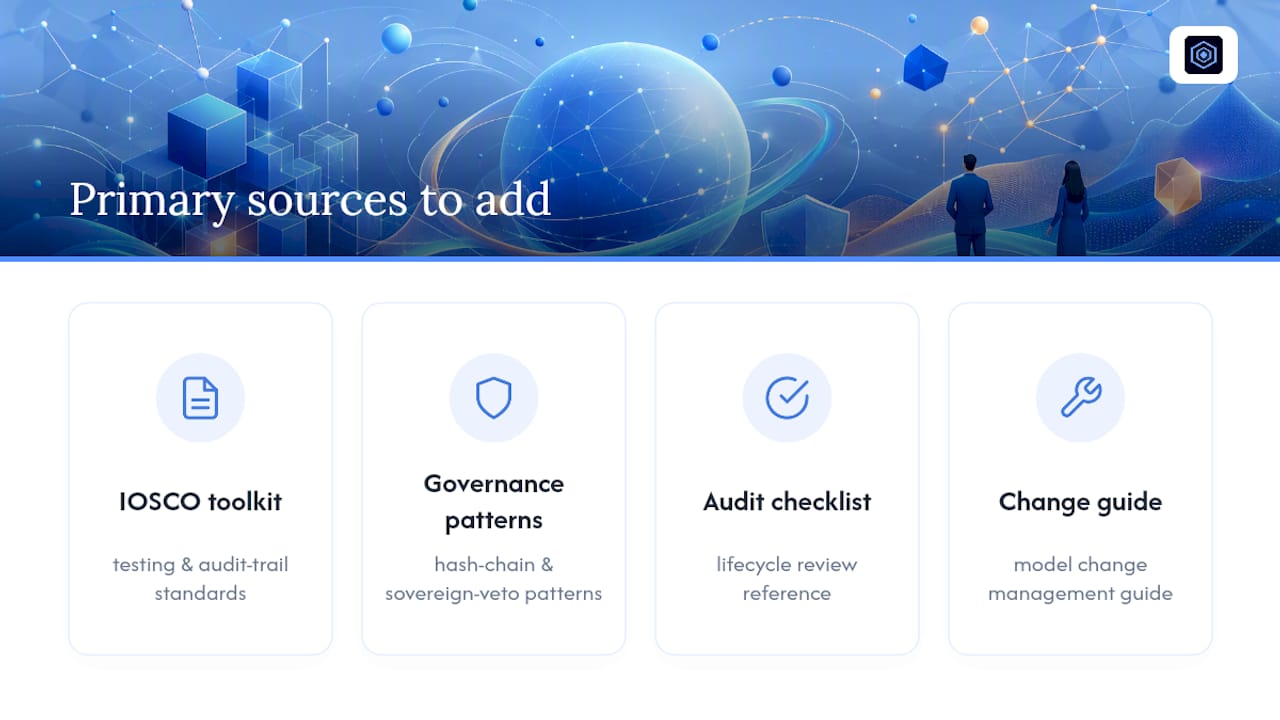
Keep these on hand when building or reviewing an AI governance file: the IOSCO supervisory toolkit for testing and audit-trail standards, the finserv-agent-audit governance patterns repository for hash-chain and sovereign-veto implementation patterns, and the AI audit checklist for a lifecycle-based review reference. For deeper model change-control practice, see the audit-ready guide to AI model change management.
Sources
- IOSCO Final Report on Principles on Outsourcing and supervisory toolkit (2025–2026)
- Article 26: Obligations of deployers of high-risk AI systems | AI Act Service Desk
Recommended
Working on Article 26 readiness, deployer-side governance evidence, or AI agent risk at a regulated firm? We'd value 15 minutes of your perspective.
Start a conversation