AI Audit Evidence Chain of Custody: 2026 Compliance Guide
AI Audit Evidence Chain of Custody: 2026 Compliance Guide

AI audit evidence chain of custody is defined as the documented, cryptographically verifiable sequence of custody and handling of AI decision data from the moment of capture through to regulatory presentation. For compliance and risk professionals in regulated industries, this is not an abstract concept. The EU AI Act Article 26, FCA Consumer Duty, and NIST AI Risk Management Framework all require firms to demonstrate that automated decisions can be reconstructed, verified, and defended. Without a defensible chain of custody, an AI system's outputs are legally rebuttable, regardless of how well the underlying model performs.
What are the essential pillars of an AI audit evidence chain of custody?
The four pillars of digital evidence chain of custody are identification, preservation, transfer, and presentation. Missing any single pillar weakens admissibility and may cause exclusion or rebuttal in US and EU courts. For AI systems, each pillar maps directly to a technical artifact.
-
Identification. The authenticated acquirer must be documented. For AI workflows, this means recording which agent, model version, and human operator initiated or approved a decision. Identity without authentication is unverifiable.
-
Preservation. Every AI decision must be captured with a cryptographic hash, such as SHA-256, and an eIDAS-qualified timestamp. Without an eIDAS qualified timestamp, integrity claims rest on operator attestation alone, which is rebuttable under formal scrutiny.
-
Transfer. Every handover of evidence between systems, teams, or jurisdictions requires a signed transfer log. Unsigned transfers create gaps that regulators and opposing counsel will exploit.
-
Presentation. A forensic expert report must accompany the evidence bundle at the point of regulatory or legal presentation. Raw logs without expert interpretation rarely satisfy auditors.
The governance receipt framework adds further granularity by recording identity, task context, evidence, draft generation, review, output, audit trail, and data boundary layers. This goes beyond policy compliance by proving what actually happened at each step of an AI workflow.
Deterministic replayability is the most demanding requirement. It means capturing the exact AI input, model version, retrieval context, and policy state so that a decision can be reconstructed byte-for-byte years later. Output logs alone do not satisfy this standard.

Pro Tip: Store the model version hash, prompt template version, and retrieval index snapshot alongside every AI output. Without these, deterministic replayability is technically impossible, regardless of how complete your output logs appear.
How do digital forensics standards apply to AI evidence management?
Digital forensics established chain of custody discipline long before AI governance became a regulatory priority. The principles transfer directly, and compliance professionals should treat them as the baseline, not a stretch goal.
ISO/IEC 27037 governs the identification, collection, acquisition, and preservation of digital evidence. ISO/IEC 27042 covers analysis and interpretation. Together, they define the procedural floor for any evidence management system handling AI decision data. In US federal proceedings, Federal Rules of Evidence 901 and 902 govern authentication and self-authentication of digital records. EU eIDAS regulation provides the legal framework for qualified electronic timestamps that bind evidence to a specific point in time.
Digital media chain of custody requires hashing source and forensic images, using write-blockers, and maintaining documented transfer logs at each handover. Gaps in documentation create vulnerabilities that can be exploited in court challenges. The same logic applies to AI audit trails: every transformation of evidence must be logged, hashed, and signed.
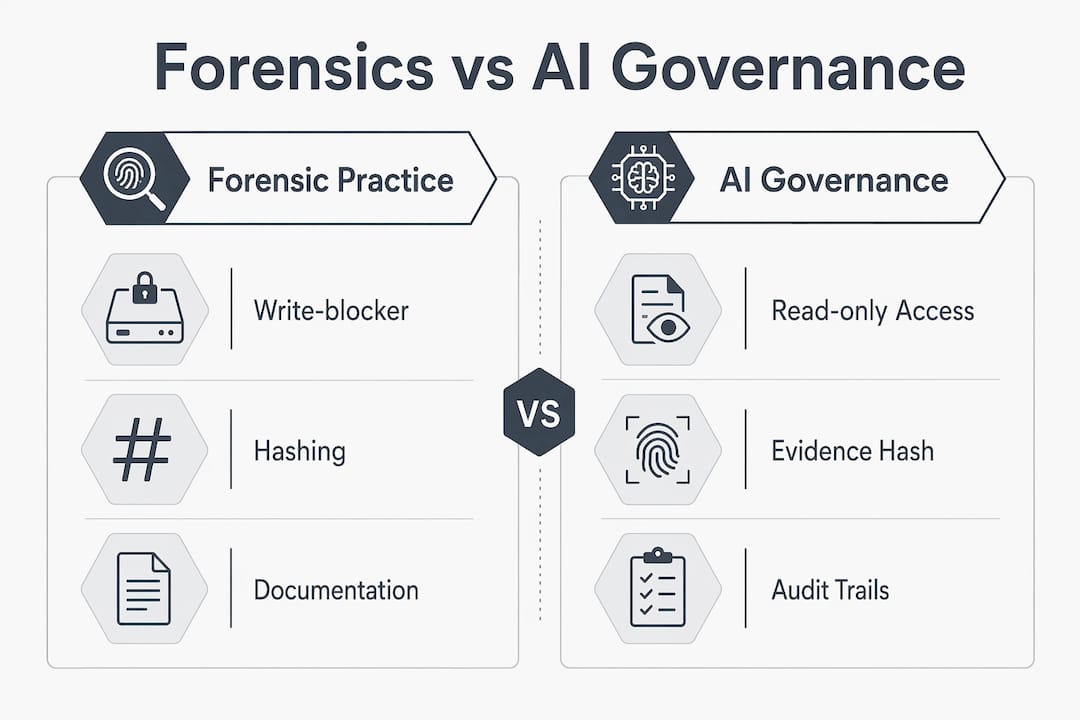
The table below maps forensic practice to AI governance equivalents.
| Forensic practice | AI governance equivalent |
|---|---|
| Write-blocker on source media | Read-only, non-invasive evidence capture |
| SHA-256 hash of source image | Cryptographic hash of AI input and output state |
| eIDAS qualified timestamp | Time-bound evidence token on each decision record |
| Signed transfer log | Cryptographically signed handover between systems |
| Forensic expert report | Compliance officer attestation with audit trail export |
| Native format preservation | Immutable raw log storage before any transformation |
Pro Tip: Never work directly on original evidence. Preserve the native format of AI decision records and create a working copy for analysis. Undocumented format conversions are one of the most common causes of broken custody chains in AI audits.
Broken custody chains often result from undocumented processing steps like format conversions or reliance on non-forensic tools. Preserving native formats and versioning every transformation mitigates this risk before it becomes a regulatory liability.
What are the common pitfalls in managing AI audit evidence?
Most compliance teams underestimate the gap between operational logging and forensic-grade audit evidence. Most organizations falsely equate logging with audit evidence but fail to reconstruct decisions in adversarial audits. The distinction matters because regulators do not accept logs as proof. They require reconstructible, tamper-evident records.
The most frequent pitfalls compliance professionals encounter include:
- Undocumented transformations. Any processing step that modifies evidence without a corresponding hash and log entry breaks the chain. This includes format conversions, data normalization, and model fine-tuning applied after initial deployment.
- Vendor portal dependency. Relying on vendor portals risks audit verification failure due to proprietary dependencies. If the vendor changes their API, goes offline, or is acquired, your evidence becomes inaccessible.
- Incomplete transfer logs. Signed transfer logs must cover every handover, including internal ones between teams and systems. A log that covers external transfers but not internal ones still has a broken chain.
- Missing eIDAS timestamps. An unsigned or untimestamped record cannot prove when a decision was made. This is a critical gap under EU AI Act Article 26 and eIDAS regulation.
- Operational logs mistaken for audit trails. System logs record what happened. Forensic audit trails prove what happened, to whom, with what inputs, and under which policy version. These are not the same artifact.
The mitigation is architectural. Regulated firms must implement a Minimum Viable Evidence Layer covering actor identification, data preservation, secure transfer, and audit replay. Failure to document any of these four pillars creates gaps that regulators exploit during inquiries.
How do you implement an effective AI audit evidence chain of custody system?
Designing an AI audit evidence system is an evidence system design problem, not a compliance checklist. The goal is defendability of decision integrity over time, not documentation for its own sake. The following process applies to regulated financial services firms operating under FCA, EU AI Act, or equivalent frameworks.
-
Capture. At the point of AI decision generation, record the full input state: prompt, model version, retrieval context, policy version, and user identity. Hash the entire bundle with SHA-256 immediately. Do not wait for downstream processing.
-
Preservation. Apply an eIDAS-qualified timestamp to the hashed bundle. Store the original in an immutable, append-only log. Never overwrite or modify the original record.
-
Transfer. Generate a signed transfer log for every handover. Include the sender identity, recipient identity, timestamp, and hash of the transferred bundle. Sign the log with a private key held by the transferring party.
-
Audit replay. Build the system so that any decision can be replayed deterministically from the captured inputs. This means storing model weights, retrieval index snapshots, and policy configurations alongside each decision record.
-
Presentation. Export self-contained evidence bundles that include cryptographic manifests, signatures, and offline verification tools. Self-contained evidence bundles with cryptographic manifests ensure evidence integrity independently of vendor infrastructure.
-
Continuous validation. Run periodic hash verification checks against stored evidence to detect any tampering or storage corruption. Schedule forensic validation reviews quarterly, not just at audit time.
The NIST AI Risk Management Framework's Govern and Measure functions map directly to steps 1 through 4. EU AI Act Article 26 requires deployers to maintain logs sufficient to enable post-market monitoring. Both frameworks converge on the same technical requirement: tamper-evident, time-bound, and independently verifiable records.
Pro Tip: Smaller compliance teams can start with a minimum viable evidence layer covering just the four pillars before building toward full deterministic replayability. A partial chain is better than no chain, provided you document its scope explicitly.
Key Takeaways
A defensible AI audit evidence chain of custody requires cryptographically signed, timestamped, and independently verifiable records at every stage of an AI decision's lifecycle.
| Point | Details |
|---|---|
| Four pillars are non-negotiable | Identification, preservation, transfer, and presentation must all be documented or the chain breaks. |
| Logs are not audit evidence | Operational logs record events; forensic audit trails prove decision integrity under adversarial scrutiny. |
| eIDAS timestamps are mandatory | Without a qualified timestamp, integrity claims are rebuttable under EU AI Act and eIDAS regulation. |
| Independent verifiability matters | Evidence bundles must be verifiable offline, without relying on vendor portals or proprietary systems. |
| Deterministic replayability is the standard | Regulators increasingly require byte-for-byte decision reconstruction, not just output records. |
The proof gap is wider than most compliance teams realize
The compliance profession has spent years building policy frameworks for AI governance. What I see consistently is that those frameworks describe intent, not proof. A policy that says "AI decisions are logged and reviewed" does not tell a regulator what model version made a specific credit decision on a specific date, under which policy configuration, with which input data. That gap is where regulatory exposure lives.
The shift from policy-based controls to proof-based audit trails is not a future trend. The FCA's SYSC requirements and EU AI Act Article 26 already demand it. What is changing is enforcement appetite. Regulators are beginning to ask for evidence bundles, not policy documents.
The firms that will handle 2026 regulatory scrutiny well are those that treated their AI evidence architecture as a forensic problem from the start. That means read-only capture, cryptographic sealing, and exports that work without the vendor in the room. The firms that will struggle are those that assumed their existing logging infrastructure was sufficient. It rarely is.
My advice: audit your current AI evidence posture against the four pillars today. Identify which pillar is weakest. Fix that one first. You do not need a perfect system to be defensible. You need a documented, honest one.
— Eleye
Aetherpulse builds the evidence layer so you do not have to
Aetherpulse is a read-only, non-invasive AI governance and evidence layer built for regulated financial services firms. It connects via OAuth metadata only, touching no customer data, and produces tamper-evident evidence packs signed with HMAC-SHA256. Every pack includes cryptographic manifests, qualified timestamps, and the artifacts needed to satisfy FCA, EU AI Act Article 26, and ICO requirements.

Aetherpulse builds an inventory and identity graph of your AI agents, surfaces risk concentration, and generates deterministic, provenance-tracked evidence on demand. Firms get audit-ready exports that work offline and require no vendor portal to verify. For compliance teams that need to close the proof gap without inserting new tooling into production systems, Aetherpulse is the starting point.
FAQ
What is an AI audit evidence chain of custody?
An AI audit evidence chain of custody is the documented, cryptographically verifiable sequence of custody and handling of AI decision data from capture through regulatory presentation. It ensures that AI-driven decisions can be reconstructed, verified, and defended under formal scrutiny.
What are the four pillars of digital evidence chain of custody?
The four pillars are identification, preservation, transfer, and presentation. Each requires specific artifacts: authenticated actor records, SHA-256 hashes with eIDAS timestamps, signed transfer logs, and forensic expert reports.
Why are operational logs insufficient for AI audits?
Operational logs record what happened but cannot prove decision integrity under adversarial conditions. Forensic-grade audit trails capture the full input state, model version, and policy configuration needed for deterministic replayability.
What is deterministic replayability in AI governance?
Deterministic replayability means capturing the exact inputs, model version, retrieval context, and policy state so that an AI decision can be reconstructed byte-for-byte years after it was made. Regulators increasingly require this level of forensic evidence.
How do eIDAS timestamps protect AI audit evidence?
An eIDAS-qualified timestamp cryptographically binds an evidence record to a specific point in time, making it legally defensible under EU regulation. Without one, integrity claims rely on operator attestation, which is rebuttable under formal scrutiny.
Recommended
Working on Article 26 readiness, deployer-side governance evidence, or AI agent risk at a regulated firm? We'd value 15 minutes of your perspective.
Start a conversation