Produce 5 Step Signed Copilot Evidence Packs Without Production Access
Produce 5 Step Signed Copilot Evidence Packs Without Production Access

Defensible copilot compliance evidence is a deterministic, tamper-evident record of an AI agent's decision that a third party can independently replay and verify without trusting the operator's word. At minimum, it requires cryptographic integrity controls, chain of custody, and reproducible inputs and outputs. Some solutions generate compliance evidence solely from metadata, employing cryptographic signatures to ensure integrity suitable for regulatory or legal scrutiny.
TL;DR:
- A comprehensive audit record must include decision inputs, provenance, model versions, policy context, action logs, human approvals, and session metadata to survive regulatory scrutiny.
- Cryptographic measures such as hash chaining and digital signatures are essential to prove evidence integrity and enable independent third-party verification.
- Building evidence packs requires a five-step workflow: discovery, metadata capture, signing, storage, and validation, with regular reattestation to prevent drift.
- Regulators demand concrete artifacts like signed decision packs, chain-of-custody logs, reproducibility replays, and human override records for compliance verification.
- Metadata-only approaches using OAuth provide a non-invasive way to generate and verify evidence packs, supporting quick pilot testing without exposing production data.
Table of Contents
- What a Compliance-Grade Agent Audit Record Must Contain
- Technical Controls: Tamper-Evidence, Cryptographic Signing, and Deterministic Replay
- Operational Workflow to Generate Audit-Ready Evidence Packs
- How Evidence Satisfies Regulator Expectations and What to Show Auditors
- Piloting a Read-Only Evidence Layer Without Touching Production Data
- The Evidence Standard Compliance Teams Keep Getting Backwards
- Get Audit-Ready Evidence Without a Production Integration
- Sources
What a Compliance-Grade Agent Audit Record Must Contain
Auditors don't accept a transcript. They want a record that lets them reconstruct why an agent did what it did, who was accountable, and whether the same inputs would produce the same outcome again. This standard is consistent with how examiners typically treat automated decisioning in lending, trading, and advice. Agent decision audit frameworks call for complete documentation and cross-session correlation, not partial logs assembled after the fact, according to FINOS's mitigations guidance.
A record that would survive supervisory review typically includes:
- Inputs and provenance: source documents, retrieval results, timestamps, and the specific data version the agent consumed.
- Instruction set and policy context: the approved prompt version, system instructions, and any policy rules active at decision time.
- Model and component identity: model version, retrieval component versions, and any tool or plugin versions invoked during the session.
- Action log: every function call, its parameters, resulting state changes, and the structured rationale behind the output, not a free-text summary.
- Human action records: who approved, overrode, or escalated the decision, with a named accountable person and timestamp.
- Session correlation and retention metadata: stable UUIDs, synchronized clocks, and retention flags so artifacts can be tied together months later.
Miss any one of these and an examiner's follow-up question has no answer. Firms that treat evidence generation as an afterthought usually discover the gap during their first real audit, not before.
Technical Controls: Tamper-Evidence, Cryptographic Signing, and Deterministic Replay
Evidence is only as strong as the mechanism proving it hasn't been altered. That mechanism is cryptographic, not procedural. Tamper-evident logging typically relies on cryptographic hash chaining and digital signatures applied to each evidence pack, with append-only storage that detects unauthorized modifications. FINOS's governance framework treats this combination, cryptographic protection plus real-time decision tracking, as a baseline control for high-risk AI systems, not an advanced option.
Independent verifiability matters more than most compliance teams assume. Anchoring a signed export or hash digest so a third party can validate it without privileged system access is what separates evidence from an assertion. An operator-maintained log that only the operator can check carries far less weight with supervisors than one a regulator can verify against a published digest.
Four elements make replay possible rather than theoretical:
- Exact inputs and retrieval results at the moment of decision.
- The active policy and configuration version, not the current one.
- Environment and component metadata, including model version.
- Stable timestamps and UUIDs linking every artifact in the chain.
The SEC's own rule language stresses reproducibility, that the same inputs and configuration should regenerate the original output, as a foundation for investigative use, per the SEC's final rule. One practical limitation worth naming: capturing a model's full internal reasoning trace is often not feasible or even meaningful. Structured rationale, what decision was made and against which policy, is the defensible substitute, and it's what auditors actually ask for.
Storage architecture rounds out the control set: synchronized time sources, segregation of duties between who generates evidence and who approves it, documented retention schedules, and export formats that hold up in legal discovery, not just internal review.
Operational Workflow to Generate Audit-Ready Evidence Packs
Building this capability is a five-step sequence, and skipping steps is where most programs stall.
- Discovery. Inventory every deployed agent and build an identity graph mapping each one's decision footprint across systems. You cannot produce evidence for an agent you haven't catalogued, which is why agent discovery workflows come before anything else.
- Capture. Ingest metadata through OAuth connections rather than touching production data directly, correlating sessions and capturing structured rationale as decisions happen, supported by robust AI agent monitoring to ensure operational controls.
- Sign. Generate a tamper-evident evidence pack for each decision or batch, applying a cryptographic signature and logging every chain-of-custody event, who exported it, where it moved, when.
- Store and export. Commit records to append-only storage and support on-demand export in formats regulators and legal teams can actually use, without a bespoke request each time.
- Validate and attest. Run internal audit or third-party checks confirming the signature holds and the replay actually reproduces the original decision before anything reaches a supervisor.
Pro Tip: Run the validate-and-attest step as a quarterly tabletop, not a one-time launch task. Evidence pipelines drift as agents get reconfigured, and a signature that verified in January can fail silently by June if nobody re-checks it.
Banking-specific governance guidance frames this same sequence around reconstructable audit trails and human override records as the defensible minimum, according to Arya. The workflow only works if metadata capture happens continuously, not retroactively when an examiner calls.
How Evidence Satisfies Regulator Expectations and What to Show Auditors
Supervisors ask specific questions, and each one maps to a specific artifact. "Who approved this override?" needs an approver ID and timestamp, not a policy statement saying overrides are reviewed. "How do you know this log wasn't altered?" needs a signed hash digest, not an assurance that access is restricted. "Can you show this decision was reproducible?" needs a documented replay, not a narrative description of the model.
Regulatory commentary increasingly reflects this shift. Firms are expected to move past aspirational governance statements toward concrete accountability evidence, according to TORI Global's analysis of FCA-aligned AI accountability. High-risk AI technical-record requirements, reproducibility expectations from the SEC's reasoning, and banking supervisory guidance on override records all converge on the same short list of artifacts.
Bring these to a supervisory meeting:
- A signed evidence pack for a representative sample of agent decisions.
- The chain-of-custody log showing every access and transfer event, itself time-stamped and signed.
- A documented replayability check demonstrating the decision reproduces from stored inputs and config.
- Human override records naming the accountable person for each intervention.
A firm that can hand over these four items in a single meeting looks fundamentally different from one still assembling logs after the request comes in.
Piloting a Read-Only Evidence Layer Without Touching Production Data
A metadata-only approach sidesteps the biggest objection compliance teams raise against new tooling: that it requires invasive access to systems already carrying customer data. Certain governance tools connect through OAuth metadata alone, build an inventory and identity graph of deployed agents, and produce tamper-evident, cryptographically signed evidence packs without ingesting the underlying data those agents process.
A workable pilot follows a tight checklist:
- Scope a small set of agents, ideally ones already flagged as higher risk in your inventory.
- Enable metadata feeds and confirm the identity graph reflects actual deployment, not just what's documented on paper.
- Validate a signed export independently, checking that the hash verifies and the replay reproduces the original decision.
- Run an internal audit tabletop using the exported pack as if a real examiner had requested it.
A staged sequence like this, inventory first, then signed export validation, then a tabletop exercise, tends to shorten time-to-evidence compared with building full in-production instrumentation before proving the concept works. What comes out the other side is a set of claims your risk function can actually defend: signed packs, an independently verifiable chain of custody, and a documented retention schedule, rather than a governance policy sitting untested in a binder.
The Evidence Standard Compliance Teams Keep Getting Backwards
Most governance advice still treats documentation as the finish line: write the policy, publish the framework, file it. The research underneath this article says the opposite. A policy statement proves intent. It doesn't prove that the agent actually behaved as intended on a Tuesday in March, and that's the exact question a supervisor asks.
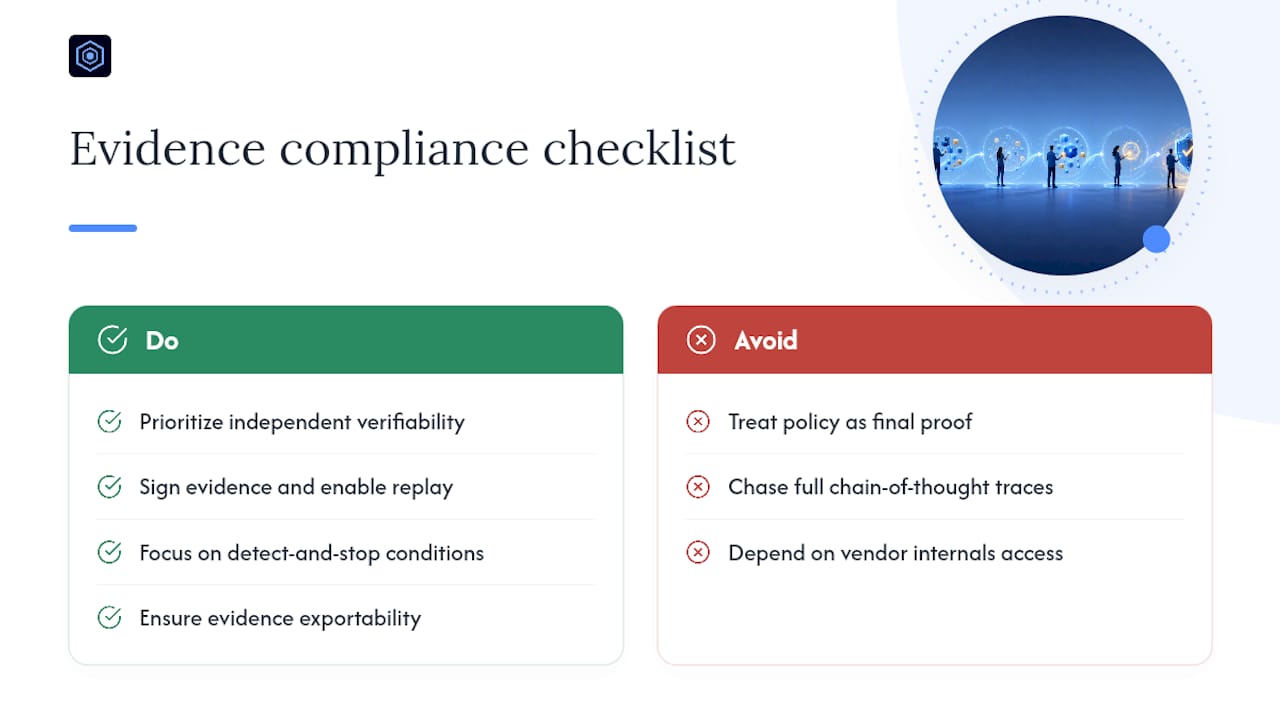
The conventional approach also overinvests in capturing model reasoning, chasing a full chain-of-thought trace that's often neither accessible nor stable across model versions. Structured rationale tied to policy context does the job auditors actually need, and it's achievable without depending on a vendor's willingness to expose internals. Focus on detect-and-stop conditions and evidence exportability for your highest-autonomy agents before worrying about capturing every intermediate reasoning step.
If you take one thing from this, prioritize independent verifiability over volume. A thin evidence pack a regulator can check unassisted beats a thick one they have to take on faith. Start with signing and replay. Everything else is refinement.
— Eleye
Get Audit-Ready Evidence Without a Production Integration
Most agent governance tools ask you to choose between visibility and invasiveness, either you plug something into production and accept the data-access risk, or you settle for policy documents that no examiner accepts as evidence. Some platforms skip that trade-off by connecting through OAuth metadata only, never touching the customer data agents actually process, and still producing cryptographically signed evidence packs an examiner can independently verify.
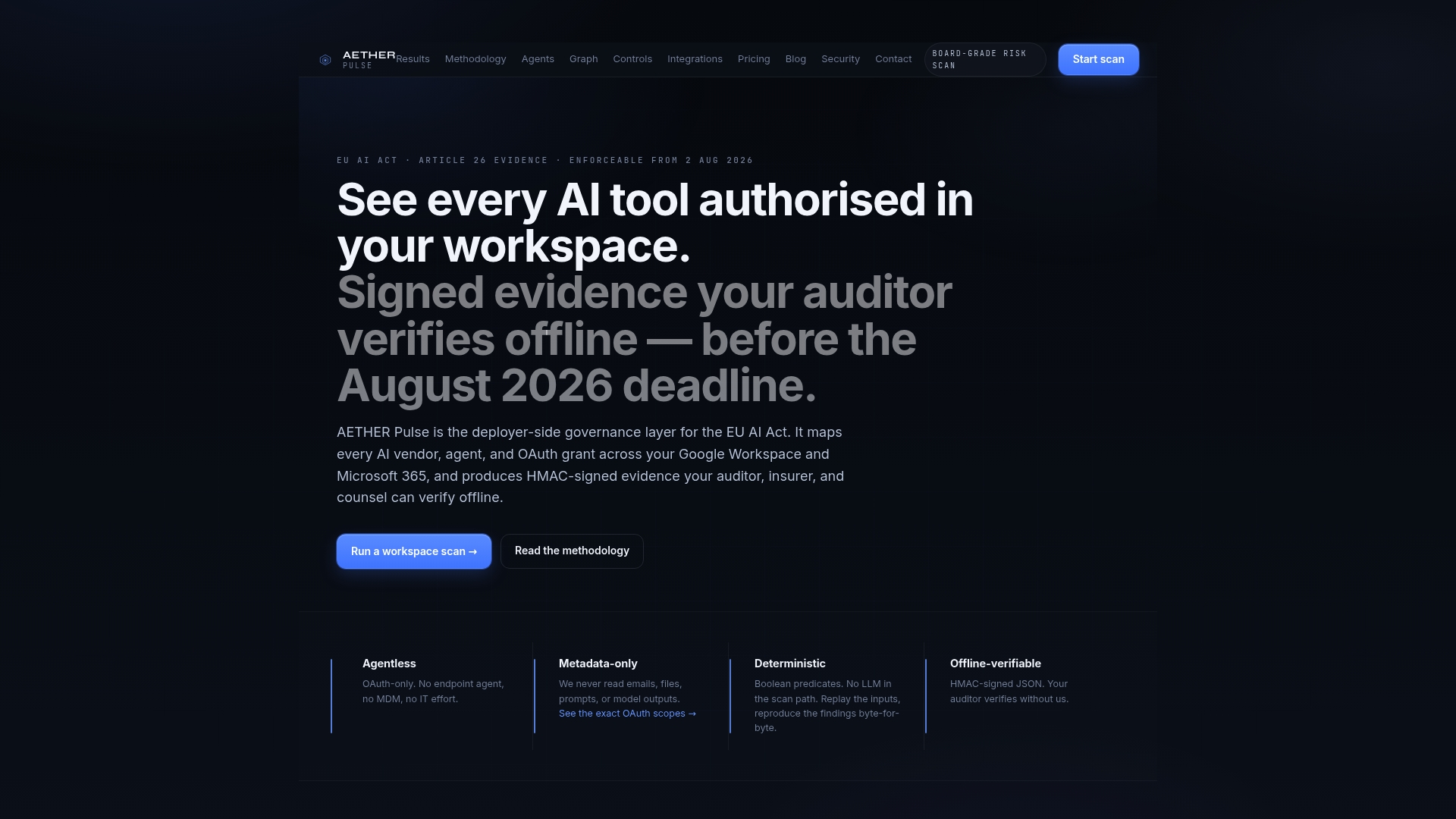
For a risk or compliance leader who just finished mapping out what a defensible record requires, the next step is straightforward: see whether your current agent inventory and evidence gaps match what a metadata-only pilot can surface in weeks, not quarters. Review the security architecture behind evidence signing or start scoping a pilot directly at AETHER Pulse.
Sources
Recommended
Working on Article 26 readiness, deployer-side governance evidence, or AI agent risk at a regulated firm? We'd value 15 minutes of your perspective.
Start a conversation