90–120 Day Agentless AI Governance for Regulated Finance, Audit Ready
90–120 Day Agentless AI Governance for Regulated Finance, Audit Ready

Agentless AI governance uses metadata and identity graphs, not endpoint agents or production-data access, to give governance teams visibility, audit evidence, and control over autonomous AI agents. It works because most regulatory scrutiny centers on demonstrable oversight, not raw system access. For firms weighing this approach, the verdict is straightforward: it delivers faster deployment and audit-ready evidence with materially lower operational risk than invasive alternatives, mapped directly to frameworks like the NIST AI RMF.
TL;DR:
- Agentless AI governance offers faster deployment and reduces operational risks by exclusively using metadata for discovering and monitoring agents without inspecting encrypted payloads.
- It maps to the NIST AI RMF functions by establishing organizational policies, building an identity graph, measuring risks through signals, and automating remediation, but cannot perform output-level behavioral testing.
- A typical 90-to-120-day rollout involves defining ownership, connecting OAuth metadata to generate inventory, setting review cadences, and developing evidence packaging for audit readiness.
- The approach faces limitations in inspecting encrypted data and managing agent sprawl, requiring supplementary controls like contractual commitments and manual attestations for comprehensive oversight.
- AETHER Pulse provides agentless, audit-ready oversight by connecting via OAuth metadata, building an identity graph, and cryptographically signing evidence, aligning with compliance standards like the EU AI Act and FCA requirements.
Table of Contents
- What "Agentless" Governance Actually Means
- Mapping Agentless Controls to the NIST AI RMF
- Building the Control Set: Discovery, Identity, and Evidence
- A 90-to-120-Day Rollout Plan for Governance Leaders
- Where Agentless Governance Falls Short
- Why Audit-Readiness Beats Perfect Visibility
- How AETHER Pulse Delivers Agentless, Audit-Ready Oversight
- Primary Sources and Further Reading
- Sources
- FAQ
What "Agentless" Governance Actually Means
Agentless governance discovers, classifies, and monitors AI agents through metadata alone. That means OAuth grant records, API call patterns, and orchestration logs, never the underlying customer data those agents touch. No software gets installed on endpoints. No agent process runs inside your production pipeline reading transaction payloads. The governance platform sits outside the data plane entirely, correlating identity and access signals to build a picture of what agents exist, what they can reach, and how that exposure changes over time.
The operational case for this is simple:
- Speed: Metadata integrations via OAuth typically connect in days, not the months a production instrumentation project demands.
- Privacy: Because no customer data crosses the platform boundary, data-protection review cycles shrink considerably.
- Lower integration risk: Nothing agentless touches your production systems directly, so there's no new failure mode introduced into live workflows.
The weakness is equally clear: agentless tools can't inspect encrypted payloads or verify what an agent actually decided inside a black-box call. Firms with agents making high-stakes, high-frequency decisions, think automated credit underwriting, may need to layer selective instrumentation on top of the agentless baseline. NIST's own AI RMF Playbook treats inventory and monitoring as necessary but not sufficient on their own, which is exactly why audit-readiness, not just visibility, has to be the design target from day one.
Mapping Agentless Controls to the NIST AI RMF
NIST's AI Risk Management Framework organizes governance work into four functions, GOVERN, MAP, MEASURE, and MANAGE, with GOVERN designed as a cross-cutting function infused across the entire AI lifecycle rather than a phase you complete and move past. Agentless architecture maps onto each function with specific, non-invasive artifacts:
- GOVERN: Policy documentation, defined decision rights, and an accountable owner assigned to every agent class. This is organizational scaffolding, roles and sign-off authority, not a technical control, and it has to exist before any inventory work means anything.
- MAP: A live agent inventory and identity graph built from OAuth and SaaS metadata, showing what each agent can access and which business process it serves. This satisfies the RMF's context-mapping intent without a single line of production code being touched.
- MEASURE: Risk concentration scoring, financial blast-radius exposure, and drift detection across entitlement changes over time. These are the quantitative proxies agentless platforms substitute for direct behavioral testing.
- MANAGE: Automated remediation workflows, tamper-evident evidence packs, and review cadences tied to specific risk thresholds.
The gap worth naming honestly: MEASURE, as NIST envisions it, often includes behavioral testing of model outputs, something agentless tools can't do without payload access. Agentless platforms compensate with access-pattern proxies and drift signals, which cover concentration and exposure risk well but leave output-quality testing to complementary tools or manual review. The NIST AI RMF Playbook explicitly frames its suggested actions, inventories, monitoring, stakeholder engagement, as building blocks rather than a complete solution, which is the right way to treat agentless controls too: essential infrastructure, not the entire governance program.
Building the Control Set: Discovery, Identity, and Evidence
Agentless architecture rests on four layered control types, each one metadata-only by design.
Discovery starts at the identity provider, then extends into SaaS admin consoles and cloud API logs to surface every OAuth grant and Model Context Protocol connection an agent holds. This is where "shadow AI", unsanctioned agent deployments running on grants nobody tracked, gets caught early.
Identity and entitlement graphing turns that raw discovery data into a structured map: which non-human identity holds which permission, against which system, on whose authority. Design this graph so every entry resolves to an accountable human owner and the minimal resource set that identity legitimately needs. Anything broader than that is unmanaged blast radius waiting to surface in an incident review.

Observability without payload access relies on signals that don't require reading content: token lineage, call frequency, orchestration traces, and permission-scope changes. It's a narrower lens than full instrumentation, but it's enough to flag anomalies like a sudden spike in an agent's data-access scope.
Practical controls here include:
- Least-privilege enforcement on every non-human identity, reviewed on a fixed cadence.
- Automated flags for entitlement drift or dormant tokens that never got decommissioned.
- Policy enforcement touchpoints tied to specific risk thresholds, not blanket rules.
Evidence packaging closes the loop. Deterministic, provenance-tracked evidence, cryptographically signed using HMAC-SHA256, lets an auditor verify a governance claim offline without ever touching your production environment.
Pro Tip: Include a cryptographic manifest with every evidence pack that lists the exact metadata sources, collection timestamps, and transformation steps used. That lets an auditor reconstruct the provenance chain independently, which is usually what turns a skeptical reviewer into a satisfied one.
A 90-to-120-Day Rollout Plan for Governance Leaders
Governance teams adopting agentless oversight rarely need a multi-year roadmap. A focused first quarter gets most firms to a defensible baseline.
- Weeks 1 to 2: Assign ownership. Name a governance lead with clear decision rights over agent approvals, and designate accountable owners for each existing agent class.
- Weeks 3 to 6: Run the discovery sweep. Connect via OAuth metadata across your identity provider, core SaaS tools, and cloud environments to produce your first complete agent inventory. Expect to find agents nobody remembered deploying.
- Weeks 7 to 9: Establish monitoring cadence. Set review intervals (weekly for high-risk agent classes, monthly for the rest) and assign named reviewers to each.
- Weeks 10 to 12: Define evidence requirements. Work backward from what your auditors and regulators will actually ask for, then build the packaging workflow that produces it on demand rather than under deadline pressure.
- Weeks 13 to 16: Pilot and iterate. Select two or three critical agent classes, measure outcomes against your risk thresholds, and refine ownership and cadence before expanding coverage firmwide.
Firms in financial services often start this process while preparing for EU AI Act Article 26 obligations, which makes the evidence-requirements step non-negotiable rather than aspirational.
Where Agentless Governance Falls Short
No agentless platform sees inside an encrypted payload or a closed-model API response, which means output-level behavioral testing stays out of reach without added instrumentation. Two operational risks show up often in practice: orphaned OAuth tokens left active after an agent is retired, and agent sprawl, where teams spin up new automations faster than governance can inventory them. IBM's research on agent management identifies both as recurring failure points in multi-agent deployments, agentless or not.
Compensating measures exist and they're practical, not exotic:
- Contractual controls requiring vendors to disclose agent behavior changes.
- Selective instrumentation on the small number of agent classes where payload visibility is genuinely required.
- Manual attestations from process owners, filed on the same cadence as automated evidence.
Regulators generally accept deterministic, signed evidence as sufficient for oversight claims, provided the firm can also show where instrumentation gaps exist and how they're managed, rather than pretending those gaps don't exist.
Why Audit-Readiness Beats Perfect Visibility

Most governance teams chase comprehensive visibility first and treat audit evidence as an afterthought. That ordering is backwards, and it shows up in exam findings constantly: firms with sprawling monitoring dashboards but no coherent evidence trail still fail to demonstrate oversight when a regulator asks a direct question.
Inventory, ownership, and deterministic evidence should be built before exhaustive instrumentation, not after. A tamper-evident evidence pack that an examiner can verify offline is worth more than a dashboard nobody outside the security team can interpret. Governance effort spent first on identity graphing and evidence packaging pays back faster than effort spent chasing full behavioral observability across every agent in the estate. Get the defensible baseline right, then expand depth where the risk actually warrants it.
— Eleye
How AETHER Pulse Delivers Agentless, Audit-Ready Oversight
AETHER Pulse is built specifically for the compliance gap this article describes: regulators expect demonstrable oversight of autonomous AI agents, but most governance tooling is either invasive or incapable of producing evidence an auditor can actually verify.
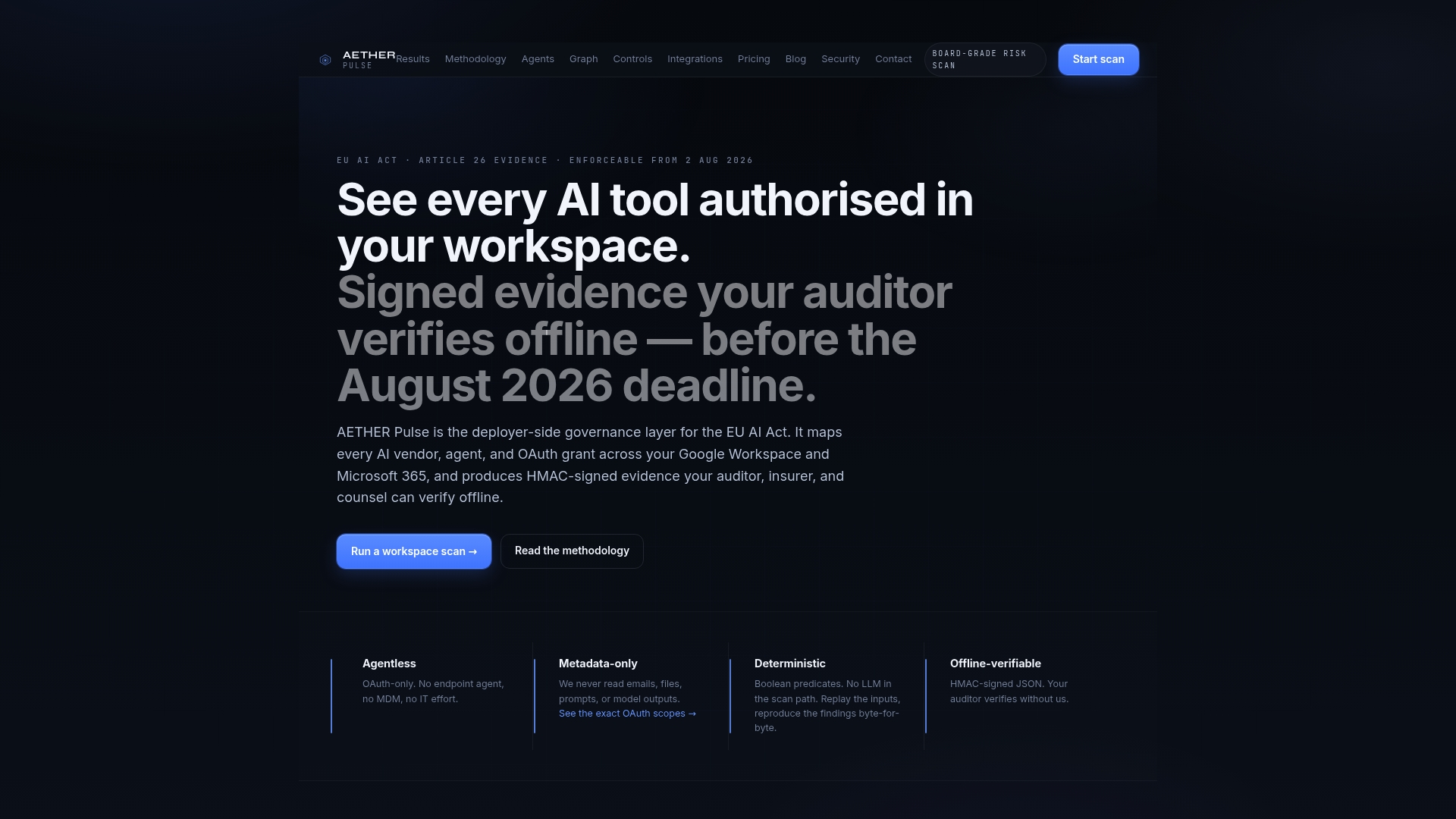
The platform connects through OAuth metadata only, touching no customer data, and builds an identity graph across your organization's AI agents while surfacing risk concentration, including financial blast-radius exposure. Every evidence pack it generates is deterministic and cryptographically signed with HMAC-SHA256, giving regulated firms tamper-evident documentation they can hand to auditors and FCA or ICO examiners without granting anyone access to production systems. It has hooks into the Data (Use and Access) Act, EU AI Act Article 26, FCA SYSC and Consumer Duty requirements, built specifically for compliance and risk leaders at UK and European financial firms.
If your team is preparing for Article 26 obligations, the Article 26 readiness audit is a direct starting point. Firms exploring a longer-term fit can review the Free, Pro, and Enterprise plans or apply for the Design Partner program on the pricing page to help shape the platform's roadmap directly.
Primary Sources and Further Reading
- NIST AI RMF — Core functions: Govern, Map, Measure, Manage
- NIST AI RMF Playbook
- What is AI Agent Management? | IBM
- Audit-Ready: Agentless vs. Agent-Based Governance
- AI Governance Without Data Access: A Compliance Guide
Sources
- NIST AI RMF — Core functions: Govern, Map, Measure, Manage
- NIST AI RMF Playbook
- What is AI Agent Management? | IBM
FAQ
What Is Agentic AI Governance?
Agentic AI governance is the discipline of overseeing autonomous AI agents that take actions and make decisions with limited human intervention. It covers inventory, risk classification, monitoring, and evidence production, whether the oversight tooling is agent-based or, as this article covers, fully agentless.
What Are the Four Pillars of AI Governance?
Under the NIST AI RMF, the four core functions are GOVERN, MAP, MEASURE, and MANAGE. GOVERN sets policy and accountability, MAP builds context and inventory, MEASURE quantifies risk, and MANAGE handles treatment and ongoing response.
What Is the "30% Rule" for AI?
There's no single, universally recognized "30% rule" tied to AI governance or the NIST AI RMF. If you've encountered this term in a specific vendor or industry context, treat it as that source's own framing rather than an established regulatory standard.
Who Are the "Big Four" AI Agents?
There's no fixed, official list of "big four" AI agents in AI governance standards; the term shows up informally in different contexts to describe leading agent platforms or model providers. What matters for governance purposes isn't which agents are biggest, but whether every agent in your environment, regardless of provider, is inventoried, owned, and covered by evidence-producing controls.
Does AETHER Pulse Require Access to Production Data?
No. AETHER Pulse connects through OAuth metadata only and never accesses customer data, which is the core distinction between agentless and traditional invasive governance tooling. Current pricing details for the Free, Pro, and Enterprise plans are available directly on the AETHER Pulse site.
Recommended
Working on Article 26 readiness, deployer-side governance evidence, or AI agent risk at a regulated firm? We'd value 15 minutes of your perspective.
Start a conversation