30/90/180-Day Audit-Ready Plan for Third-Party AI in Regulated Firms
30/90/180-Day Audit-Ready Plan for Third-Party AI in Regulated Firms

Third-party AI risk is the exposure a firm inherits when a vendor's AI model, feature, or embedded automation makes a decision, produces an output, or touches data on the firm's behalf. Managing it well means one thing above all: adopting a governance-first program that inventories every AI vendor and agent, tiers them by criticality, locks in contractual audit rights, and monitors continuously against frameworks like NIST's AI RMF. Firms that skip straight to monitoring tools without this foundation build audit evidence on sand.
TL;DR:
- Vendors can retrain or modify AI models frequently, making last assessment data potentially obsolete within weeks and requiring continuous provenance and validation documentation.
- Shadow AI embedded in routine tools often bypasses procurement and due diligence, creating blind spots for risk teams and increasing vulnerability to bias, bias, privacy leaks, and operational failures.
- Contracts must explicitly define material model change, require advance notification, and include enforceable audit rights to mitigate shifting AI risks between renewal cycles.
- Continuous monitoring should focus on output shifts, hallucination rates, latency issues, and dependency concentration at providers to detect model drift and operational outages early.
- An agentless, metadata-only governance layer can significantly accelerate evidence collection and map AI vendor risk, aligning with frameworks like NIST AI RMF and satisfying regulator expectations.
Table of Contents
- Why Third-Party AI Risk Breaks Traditional Vendor Risk Assumptions
- AI-Specific Due Diligence: What to Ask Vendors and What Evidence to Collect
- Contract Language That Actually Reduces Third-Party AI Exposure
- Continuous Monitoring: The KPIs and KRIs That Catch Drift Early
- Incident Response: What to Do When a Vendor's AI Fails
- A 30/90/180-Day Governance-First Roadmap for Risk Teams
- Why Audit-Ready Evidence Beats Another Governance Framework
- AETHER Pulse: Turning This Roadmap Into Audit-Ready Evidence
- Primary Sources for Building an AI Vendor Risk Program
- Sources
- FAQ
Why Third-Party AI Risk Breaks Traditional Vendor Risk Assumptions
Traditional third-party risk management assumes a vendor's product is relatively static between review cycles. You assess it at onboarding, reassess annually, and flag material changes when the vendor tells you about them. AI breaks that assumption at its foundation.
A model a vendor certified as low-bias in January can behave differently by June, not because anyone changed the contract, but because the vendor retrained it, swapped an underlying foundation model, or fine-tuned it on new data. NIST's Generative AI profile calls this out directly. It recommends that firms map value-chain components and document provenance precisely because GAI components shift underneath fixed contracts. Your last risk assessment can be stale within a fiscal quarter, sometimes within weeks.

Shadow AI compounds the problem. Plenty of AI capability entering your operations was never procured as "AI" at all. It arrives bundled inside a document management platform, a customer service tool, or a payments processor that quietly ships a generative feature in a routine update. RSM's practitioner guidance identifies this embedded, undisclosed AI as a primary blind spot for risk teams, precisely because it never crosses the desk of anyone doing vendor due diligence. Aetherpulse's own research into shadow AI in financial services found the pattern repeats across core banking and claims systems alike.
Layer on value-chain complexity and the attribution problem gets worse. Most vendor AI products are not built end-to-end by one company. They chain pre-trained foundation models, third-party datasets, and open-source libraries, so a failure at your vendor might trace back to a fourth-party model provider you have never heard of and never contracted with directly.
The concrete harms risk teams should prioritize fall into four buckets:
- Bias and discriminatory outcomes in credit, underwriting, or claims decisions that a vendor's model produces without disclosure.
- Hallucination and factual error in AI-generated summaries, reports, or customer communications that staff treat as reliable.
- Privacy leakage, where customer data submitted to a vendor's AI feature gets retained or used for training without consent.
- Operational outages, where a model update or dependency failure at the vendor cascades into a service disruption for your customers.
MIT Sloan's research found that 78% of organizations use third-party AI tools, and a majority of AI-related failures traced back to those third-party tools rather than internally built systems. That statistic alone should reframe how risk committees allocate scrutiny.
AI-Specific Due Diligence: What to Ask Vendors and What Evidence to Collect
Standard vendor questionnaires and SOC 2 reports were built to evaluate IT controls, not model behavior. Practitioner guidance from Mitratech makes this point bluntly: a clean SOC 2 tells you the vendor's infrastructure is reasonably secure, but it says nothing about whether the underlying model is biased, poorly validated, or trained on data the vendor never disclosed. You need a parallel due-diligence track built specifically for AI.
The first job is discovery. Many vendors do not volunteer that a feature is AI-driven, so risk teams need three overlapping methods to surface it: mapping vendor product features against known AI capabilities, reviewing telemetry and API calls for model-serving patterns, and sending targeted questionnaires that ask directly whether any feature uses machine learning, generative models, or automated decisioning.
Once you have identified AI inside a vendor's product, collect evidence in this order:
- Model provenance documentation describing the model's origin, training approach, and any foundation model it builds on.
- Training-data descriptions covering data sources, consent basis, and whether customer data feeds back into training.
- Bias and validation reports showing what testing the vendor performed and against which demographic or use-case benchmarks.
- Red-team results documenting adversarial testing for jailbreaks, prompt injection, and unsafe outputs.
- Formal attestations tying named accountable individuals at the vendor to the accuracy of the disclosures above.
CASRAI's guidance on assessing third-party AI vendor risk notes that vendor security questionnaires routinely conflate IT controls with model behavior, which is exactly why this evidence list has to exist as a separate workstream rather than an addendum to your existing security review.
Not every vendor deserves the same scrutiny. Tier vendors by three criteria: how critical the AI output is to a regulated decision, how sensitive the data it touches is, and how much operational disruption a failure would cause. A vendor whose AI drafts internal marketing copy sits in a different tier than one whose model scores loan applications or flags suspicious transactions.
At onboarding and renewal, require contract clauses that lock in your evidence access going forward, not just at signing. Insist on advance notice of model changes, ongoing access to bias and validation testing, and the right to request updated red-team results whenever the vendor materially retrains or swaps the underlying model.
Pro Tip: MIT Sloan's data shows firms using more evaluation methods, seven or more compared with three, are substantially more likely to actually uncover AI failures before they become incidents. Build your due-diligence checklist around multiple independent methods, not one questionnaire.
Contract Language That Actually Reduces Third-Party AI Exposure
Most vendor contracts written before 2023 have no concept of a "material model change." That gap is where firms get blindsided, because a vendor can retrain, fine-tune, or swap a foundation model entirely while remaining in full compliance with the letter of an outdated agreement.
Define material model change explicitly in the contract: any retraining on new data, any swap of the underlying foundation model, or any change to the model's decision logic that could shift outputs for your use case. Pair that definition with a firm notification timeline, ideally 30 to 60 days before deployment, giving your team time to re-evaluate before the change reaches production. Aetherpulse's guide on AI model change management walks through how banks can slot this into existing model risk frameworks rather than building a parallel process from scratch.
Beyond notification, contracts need enforceable audit rights. CASRAI's guidance is specific here: for regulated firms, audit rights should include account-level confirmation that opt-outs and data protections are actually configured, not just described in a policy document, along with access to red-teaming and evaluation evidence on request rather than on the vendor's schedule.
Several other clauses belong in every AI vendor contract:
- Restrictions on using your data, or any derivative of it, to train or fine-tune models serving other customers.
- Indemnities specific to AI-related harms, including biased outputs and privacy violations tied to the vendor's model.
- Limits on secondary use of data collected through the AI feature, closing the gap where "operational data" quietly becomes "training data."
- Continuity and rollback clauses that require the vendor to preserve the option of reverting to a prior model version if a new one underperforms.
- Service-level agreements covering accuracy and availability specifically for the AI feature, not just general uptime.
- Remediation triggers that specify what happens, and on what timeline, when the vendor's model breaches an agreed accuracy or bias threshold.
PwC's guidance on responsible AI and third-party risk management recommends firms revisit existing vendor contracts specifically to add these guardrails rather than waiting for the next renewal cycle. Waiting exposes you to a full contract term of unmanaged risk.
Continuous Monitoring: The KPIs and KRIs That Catch Drift Early
A point-in-time due-diligence review answers one question: was the vendor's AI defensible on the day you checked. It says nothing about whether that AI is still behaving the same way six months later. That gap is why continuous monitoring has to sit inside the vendor risk register, not outside it.
Two categories of metrics matter. Key performance indicators track how well your governance process is running: inventory coverage (the percentage of AI vendors actually captured in your register), and evidence completeness (the percentage of tiered vendors with current provenance, bias, and validation documentation on file). Key risk indicators track the underlying AI behavior itself: unexpected output rate, unresolved vendor control gaps past their remediation deadline, and the frequency of vendor-reported model changes without matching evidence updates.
On the technical side, three signals deserve dashboard placement:
- Output distribution shifts, where the pattern of a vendor's AI outputs changes meaningfully without a corresponding notification.
- Hallucination frequency, tracked through spot audits of AI-generated content for factual accuracy.
- Latency and availability anomalies, which often precede a vendor-side model swap or capacity problem before it is formally disclosed.
Concentration risk deserves its own line of monitoring. Many vendors you contract with directly rely on the same handful of foundation model or cloud providers underneath. The FTC's staff report on large AI partnerships flags exactly this pattern, noting that concentrated cloud-AI partnerships can raise switching costs and create fourth-party dependence that firms rarely map explicitly. If three of your critical vendors all sit on the same foundation model provider, a single outage or policy change at that provider becomes your risk, not theirs.
NIST's own framework insight is worth internalizing directly: measuring vendor attestations alone leaves you blind to emergent model behavior between review cycles, which is exactly why KRIs need to track live signals, not just paperwork status. Route every KRI breach into your existing alerting workflow and vendor risk register rather than a separate spreadsheet. Aetherpulse's guide to AI risk register best practices covers how to structure that integration so monitoring output feeds directly into audit-ready records instead of living in disconnected tools.
Incident Response: What to Do When a Vendor's AI Fails
Not every AI vendor incident looks the same, so the first step is triage, not escalation. Assign an owner immediately, ideally someone who sits at the intersection of vendor risk and the business unit consuming the AI output, and classify the incident by severity within the first hour: is this a data exposure, a biased or erroneous output already delivered to customers, or a service outage.
- Freeze and document. Capture timestamps, the exact inputs and outputs involved, and the model version in use at the time, before the vendor can quietly patch or roll back anything.
- Notify the vendor formally, citing the specific contractual trigger, whether that is a material change clause, an SLA breach, or a data misuse provision.
- Activate fallback processing. If the vendor's AI feeds a regulated decision, switch to manual review or a backup system rather than continuing to rely on a model under investigation.
- Collect audit evidence covering provenance records, the vendor's own incident notes, and every timestamp tied to the failure, structured so it holds up under regulator scrutiny later.
- Escalate through pre-built communication templates rather than drafting language during the incident itself, sending updates to compliance, the board risk committee, and affected customers as required.
- Hold the vendor to remediation deadlines specified in the contract, and document whether they were met.
The evidence bar for AI incidents runs higher than for a typical vendor outage, because regulators increasingly expect firms to show not just that an incident happened, but that the firm understood the model well enough to explain why. Provenance records and input/output logs are what make that explanation possible during an examination.
A 30/90/180-Day Governance-First Roadmap for Risk Teams
A governance-first program does not require a year of planning before it produces anything useful. It requires sequencing.
- First 30 days: inventory and stop the bleeding. Build a first-pass AI vendor inventory, including embedded AI features inside existing tools. Draft a stop-gap contract addendum requiring notification of material model changes for your highest-risk vendors, and run a quick tiering pass so the highest-criticality relationships get attention first.
- Next 90 days: build the evidence base. Collect provenance, training-data descriptions, and bias and validation reports for every tier-one vendor. Stand up the KPIs and KRIs described earlier, and select monitoring tooling that can ingest vendor signals without requiring invasive access to production systems.
- Next 180 days: renegotiate and rehearse. Push updated contract language, covering audit rights, rollback clauses, and remediation triggers, into every renewal that comes up. Map fourth- and nth-party dependence for your highest-tier vendors. Run at least one tabletop incident rehearsal, and establish a board reporting cadence for AI vendor risk that survives beyond the current initiative.
This sequencing maps directly onto NIST's AI RMF functions. The 30-day inventory work is Govern and Map. The 90-day evidence and monitoring build is Measure. The 180-day contract and rehearsal work is Manage, closing the loop from identification through response.
Pro Tip: Firms often try to jump straight to sophisticated monitoring tooling before they have a real vendor inventory. Resist that. A dashboard full of KRIs is worthless if half your AI vendors are not even in the register yet.
For firms working through the operational security side of this roadmap, this partner guide to 90-day account aggregation security checks offers a useful parallel structure for teams building out third-party integration reviews on a similar timeline.

Why Audit-Ready Evidence Beats Another Governance Framework
Every risk function already has a framework. What most lack is evidence that would survive a regulator asking, in plain language, "show me." That gap is where governance-first programs actually fail in practice, not in the policy document, but in the evidence drawer.
The instinct in a lot of risk teams is to treat AI governance as a documentation exercise: write the policy, get sign-off, file it. But regulators examining AI-driven decisions increasingly ask for something closer to a forensic trail, tied to specific outputs and specific model versions, not a policy statement about intentions. A governance framework that cannot produce that trail on demand is not really governance. It is paperwork with good intentions attached.
Agentless, metadata-only evidence collection matters here specifically because it shortens the distance between "we have a policy" and "here is the proof," without requiring firms to grant a new tool invasive access to production systems or customer data. That distinction should matter more to risk committees than it currently does.
— Eleye
AETHER Pulse: Turning This Roadmap Into Audit-Ready Evidence
Building the 30/90/180-day roadmap above by hand, across spreadsheets and vendor emails, is possible but slow, and slow is exactly what regulators are losing patience with. There are solutions offering an agentless governance layer that connects through metadata only, touching no customer data, to build the AI agent inventory and identity graph needed on day one.
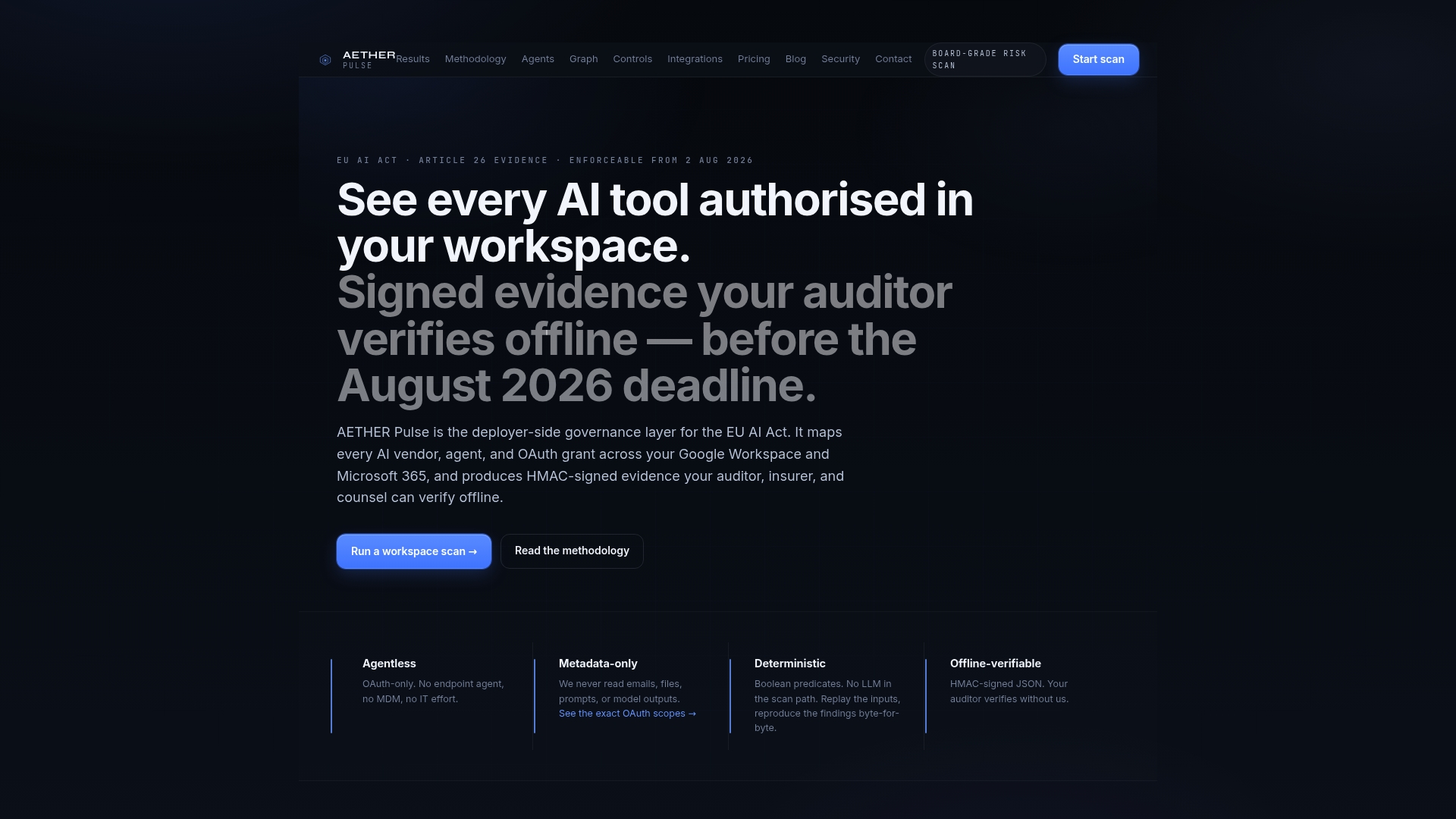
Instead of chasing vendors for evidence packs manually, Some platforms generate tamper-evident, cryptographically signed evidence on demand, mapped to frameworks including EU AI Act Article 26, FCA SYSC, Consumer Duty, and the ICO's developing AI code of practice. They also surface risk concentration, including financial blast-radius exposure, so tiering decisions rest on evidence rather than guesswork.
Aetherpulse offers Free, Pro, and Enterprise plans, along with Design Partner and Production tiers, and a dedicated Article 26 readiness audit service for firms facing that specific deadline. Pricing for each tier is available directly on the Aetherpulse site. No tool replaces the governance program itself, but a demo is a practical next step for any firm ready to move its evidence collection from manual to audit-ready.
Primary Sources for Building an AI Vendor Risk Program
Several primary sources anchor the frameworks and figures cited throughout this guide. The NIST AI Risk Management Framework and its Generative AI profile set the governance structure most regulated firms are converging toward.
MIT Sloan's survey research documents the prevalence and failure rate of third-party AI tools. PwC's TPRM guidance offers practitioner-level contracting and due-diligence detail. RSM's writeup on shadow AI remains one of the clearest breakdowns of the embedded-AI blind spot risk teams face today.
Sources
- Artificial Intelligence Risk Management Framework (AI RMF 1.0)
- Artificial Intelligence Risk Management Framework: Generative Artificial Intelligence Profile
- Third-party AI tools pose increasing risks for organizations
FAQ
What is the 30% rule in AI?
There is no single, universally recognized "30% rule" governing AI risk or oversight, and the phrase does not correspond to a NIST, FCA, or ICO standard. If you have encountered it in a vendor pitch, treat it as marketing shorthand rather than a compliance benchmark, and anchor your program to documented frameworks like the NIST AI RMF instead.
What are examples of third-party AI risk?
Common examples include a vendor's model producing biased credit or claims decisions, a customer service AI hallucinating incorrect account information, an embedded generative feature leaking customer data into a training set, and a foundation model outage at a fourth-party provider cascading into your service disruption. MIT Sloan's research found that a majority of AI failures organizations experience trace back to third-party tools rather than internal systems.
Which jobs are least likely to survive AI disruption, and why does that matter for vendor risk?
This question is really about workforce displacement, not third-party governance, and reliable predictions vary too much across studies to state a firm list here. What matters for risk teams is different: any job function a vendor's AI now performs on your behalf, whether underwriting review or customer communications, needs the same provenance and audit evidence as a role performed internally.
What did Bill Gates warn about AI?
Public commentary from Bill Gates has touched on AI's potential to disrupt jobs and the importance of getting governance and safety right as adoption accelerates, though specific quotes vary by interview and are not tied to a single primary source suitable for citation here. For risk and compliance purposes, the more actionable warning comes from regulators and frameworks like NIST, which focus on concrete governance actions rather than general predictions.
How much does Aetherpulse cost?
Aetherpulse offers Free, Pro, and Enterprise plans along with Design Partner and Production tiers, and current pricing details are available directly on the Aetherpulse site and pricing page. The Article 26 readiness audit service is priced separately and also listed there.
How do you assess third-party AI risk without invasive vendor access?
Effective assessment combines documentary evidence, provenance records, bias and validation reports, red-team results, with metadata-level monitoring that tracks vendor AI behavior without touching production data or customer records. This agentless approach is specifically what lets firms produce audit-ready evidence packs on demand rather than reconstructing a vendor's AI behavior after an incident has already occurred.
Recommended
Working on Article 26 readiness, deployer-side governance evidence, or AI agent risk at a regulated firm? We'd value 15 minutes of your perspective.
Start a conversation