Map NIST to Evidence: Regulator Ready AI Reports for Compliance
Map NIST to Evidence: Regulator Ready AI Reports for Compliance

A regulator-ready AI report gives auditors traceable provenance, signed validation results, a governance summary naming accountable owners, and a living monitoring record updated since deployment. The NIST AI RMF and banking supervisory guidance both treat documentation as evidence of oversight, not a description of intent. Tools like AETHER Pulse illustrate how tamper-evident, cryptographically signed evidence packs can turn that requirement into a repeatable process rather than a scramble before every exam.
TL;DR:
- High-risk AI systems require comprehensive validation, independent validation summaries, and detailed human oversight records to meet audit standards.
- Documentation should be continuously updated, with monitoring metrics captured daily or weekly and formal reviews every quarter to stay regulator-ready.
- A regulator-ready report includes provenance logs, signed test results, incident reports, and governance summaries with named owners and decision timelines.
- Automation tools like AETHER Pulse enable secure, cryptographically signed evidence generation and inventory tracking without operational risks or extensive manual effort.
- Tiered documentation approaches mean low-impact systems need only basic inventory entries, while high-impact models demand full technical dossiers with external validation and detailed change logs.
Table of Contents
- Reliability, Traceability, and Explainability: The Documentation Core
- What Auditors Actually Request (Hint: Not Policy Documents)
- How Much Documentation Does Each Risk Tier Need?
- Keeping Reports Current Between Audit Cycles
- Validation Metrics and Signed Test Logs That Hold Up
- Automating Regulator-Ready Reports Without Losing Auditability
- Governance Documentation: Naming Names and Owning Decisions
- Versioning and Retention: Building a Change Log That Survives Scrutiny
- How AETHER Pulse Approaches Audit-Ready Evidence in Practice
- A 90-Day Path to Handing Auditors What They Actually Need
- Get Audit-Ready Evidence Without Adding Another Agent to Your Stack
- Where to Point Auditors for the Underlying Standards
- Sources
- FAQ
Reliability, Traceability, and Explainability: The Documentation Core
Regulators do not evaluate an AI system on promise. They evaluate whether a firm can prove, on paper and on demand, that the system behaves as intended, that its decisions can be traced back to specific data and logic, and that someone can explain what it does in plain language.
Reliability means the system performs consistently within stated parameters, backed by repeatable test results rather than a single successful demo. Traceability means every output can be linked to a specific model version, data input, and decision path, which matters enormously when a regulator asks "why did the system flag this transaction on March 3 but not a similar one on March 10?" Explainability means a compliance officer, not just a data scientist, can describe the system's purpose and limitations to someone outside the technical team.
These three principles map directly onto the NIST AI RMF's four core functions. A regulator-ready report typically includes:
- A one-page system purpose statement written for a non-technical reader (maps to Govern).
- A model card documenting intended use, known limitations, and training data characteristics (maps to Map)
- Provenance logs showing data lineage and model version history (maps to Measure)
- A change history recording every material update and who approved it (maps to Manage)
Skip any one of these, and an examiner has grounds to ask what else was skipped.
What Auditors Actually Request (Hint: Not Policy Documents)
Compliance teams often hand auditors a governance policy and assume the job is done. Auditors want something different: proof the policy was followed. A 40-page AI governance charter with no dated evidence behind it tells an examiner the firm has a plan, not a track record.
The distinction matters because supervisory guidance is explicit that documentation must be detailed enough for someone unfamiliar with the model to understand how it works, what it can't do, and how it was validated. That standard rules out vague summaries.
In practice, an auditor examining an AI system will typically request:
- A validation report dated and tied to a specific model version, not a generic "our AI works well" summary
- Signed test logs showing who ran which test, when, and what the results were
- Incident reports documenting any failures, near misses, or unexpected outputs since the last review
- Governance meeting minutes showing the model was discussed by named accountable individuals, not just referenced in passing
Firms that keep these four items current rarely struggle during an exam. Firms that reconstruct them after receiving an information request usually do.
Pro Tip: Keep a single "audit response folder" per AI system, updated continuously rather than assembled reactively. When a request lands, you should be exporting, not producing.
How Much Documentation Does Each Risk Tier Need?
Not every AI system needs a full technical dossier. A chatbot answering hours-of-operation questions does not carry the same documentation burden as a model influencing credit decisions. The practical approach is to tier systems by risk and materiality, then scale documentation depth accordingly.
- Low tier (limited customer or financial impact): inventory entry with owner, purpose, and last review date
- Medium tier (some influence on customer outcomes, but with human review): inventory entry plus a summary covering validation approach, known limitations, and monitoring cadence
- High tier (material influence on lending, pricing, claims, or other regulated decisions): full technical dossier
High-risk systems carry the heaviest requirements, and skipping any of the following is a common audit finding:
- In-depth validation covering performance, fairness, and robustness testing
- Human oversight records showing who can override the system and how often they do
- A documented post-deployment monitoring plan with defined thresholds for retraining or shutdown
- Independent or third-party validation summaries where materiality warrants outside review
Mapping internal risk ratings to these tiers should happen once, in writing, and get revisited whenever a system's use case expands. A model that started as "low risk" often creeps into medium or high territory as new business units adopt it. NIST's Generative AI profile recommends exactly this kind of periodic inventory review to catch that drift before an examiner does.
Keeping Reports Current Between Audit Cycles
A regulator-ready report is a living record, not a document you dust off once a year. Static reports age badly. The version that looked airtight in January often misses six months of model updates by the time an examiner asks for it in July.
A workable cadence looks like this:
- Daily or weekly: automated capture of monitoring metrics, including drift indicators and performance against baseline
- Monthly: review of incident logs, flagged anomalies, and any remediation actions taken
- On material change: an update to the model card, provenance log, and change history the moment a retrain, parameter shift, or scope expansion occurs
- Quarterly: a governance review confirming the documentation still matches how the system actually operates
Firms that maintain this rhythm satisfy regulator requests in days rather than weeks, because the evidence already exists. The alternative, reconstructing six months of monitoring history from scratch after an information request lands, is where most audit friction actually comes from.
Validation Metrics and Signed Test Logs That Hold Up
Validation is where documentation either convinces an auditor or invites more questions. A single accuracy score means little without context. What auditors want is a full picture: what was tested, against what threshold, and what the result actually means for the system's real-world use.
Common validation types worth documenting:
- Unit tests confirming individual components behave as designed
- Holdout performance testing against data the model has never seen
- Stress tests simulating edge cases and unusual input volumes
- Fairness and bias checks across demographic or protected categories relevant to the use case
- Robustness tests measuring how the system handles corrupted, incomplete, or adversarial inputs
Every metric needs context: the acceptance threshold, how the result compares to that threshold, and any known limitations of the test itself. A model that scores 94% on a holdout set means little if the report doesn't state what the passing threshold was and why.
NIST's core guidance notes that independent validation strengthens an audit submission considerably for high-risk models, particularly when internal teams built and tested the same system. A dated, signed validation report, ideally from someone outside the model's development team, carries more weight in an exam than an internal self-assessment ever will.

Automating Regulator-Ready Reports Without Losing Auditability
Manual report assembly does not scale once a firm runs more than a handful of AI systems. Automation solves the volume problem, but only if it preserves the traceability an auditor needs. Automated pipelines that produce clean-looking dashboards but no underlying evidence trail actually make audits harder, not easier.
Effective automation for regulator-ready reporting should deliver:
- Aggregated data pulled directly from monitoring and validation systems, not manually re-entered
- Standardized templates so every system's report follows the same structure regardless of who built it
- Signed, exportable evidence packs that hold up when opened outside the vendor's own platform
- Reconciliation across regulatory frameworks, so one evidence base serves EU AI Act, GDPR, and domestic supervisory requests without duplicated work
The most common pitfall is treating automation as a reporting layer bolted onto systems that were never designed to produce evidence in the first place. Automated regulatory reporting works best when it pulls from inventory, monitoring, and validation systems that were built with audit output in mind from the start, not retrofitted after the fact. A useful framework for structuring this work comes from partner resources on applying NIST's risk functions alongside sector-specific rules.
Governance Documentation: Naming Names and Owning Decisions
Regulators want to see accountability with names attached, not abstract references to "the compliance team." A governance summary that cannot answer "who approved this model going live, and who can pull it if it misbehaves" fails the basic test of demonstrating oversight.
A governance section auditors accept typically includes:
- Named owner responsible for the system's day-to-day performance
- Named approver who signed off on deployment and any material updates
- Human oversight role describing who can intervene, override, or shut down the system
- Review cadence stating how often governance reviews occur, not just that they happen
- Board or senior management reporting line showing escalation reaches leadership when warranted
- Retention policy covering how long decision logs and signed evidence are kept.
Decision logs should read as a timeline: date, decision, approver, rationale. Skip the narrative prose and present it as a table an examiner can scan in minutes.
Vendor models add a layer auditors scrutinize closely. Third-party AI often arrives with thin internal documentation, so firms need contractual access clauses guaranteeing visibility into the vendor's own validation evidence, plus a contingency plan for what happens if that access disappears.
Versioning and Retention: Building a Change Log That Survives Scrutiny
Every model update, retrain, and rollback needs a paper trail an examiner can follow years later. A workable versioning scheme uses a simple two-part number, one digit for major changes like a retrain, another for minor adjustments like a threshold tweak, matching the structure NIST's own playbook uses for its own updates.
A compact, audit-ready change log includes:
- Version number and effective date for every material update
- A one-line rationale for the change, written for a non-technical reader
- The approver's name, not just a department
- A note on any rollback, including why the previous version was reverted to
Retention rules should keep signed test logs and validation reports for at least as long as the model remains in production, plus whatever additional period your sector's supervisory guidance requires. NIST plans to formally review the AI RMF itself no later than 2028, a reminder that this whole framework is built to be updated, not filed away and forgotten.
How AETHER Pulse Approaches Audit-Ready Evidence in Practice
Most of the guidance above describes what a regulator-ready report needs. AETHER Pulse offers one concrete example of how firms produce it without adding operational risk in the process.
The platform connects to a firm's AI environment through metadata only and builds an inventory and identity graph of AI agents in operation. From there it surfaces risk concentration, including financial blast-radius exposure, and generates evidence on demand rather than requiring a manual scramble.
That evidence maps directly onto what auditors ask for:
- Tamper-evident, cryptographically signed (HMAC-SHA256) evidence packs that function as the signed test logs and dated reports examiners request
- An agent inventory and identity graph that satisfies the inventory requirement NIST's Generative AI profile calls for
- Deterministic, provenance-tracked outputs that give auditors the traceable chain of custody a governance summary alone cannot provide
- Risk concentration mapping that helps firms sort systems into the tiers described earlier, rather than treating every AI agent as equally material
None of this replaces the underlying governance work. It packages that work into a form an outside reviewer can verify independently, which is the entire point of regulator-ready documentation.
A 90-Day Path to Handing Auditors What They Actually Need
Most compliance teams don't lack the will to build regulator-ready documentation. They lack a sequence. A 90-day roadmap keeps the work from sprawling into an open-ended project.
Weeks 0 to 4: Build a complete AI system inventory and assign risk tiers to each entry. You cannot document what you haven't counted, and this step alone usually surfaces shadow AI nobody had flagged.
Weeks 5 to 8: Fill documentation gaps for high-risk systems first: model cards, provenance logs, and governance summaries with named owners. Establish signed test logging as a standing practice, not a one-time exercise.
Weeks 9 to 12: Automate exports where possible, then run a tabletop exercise with someone playing the auditor's role. Ask them to request evidence cold. If they can't get an answer in minutes, tighten the gap before a real examiner asks.
Firms that follow a structured gap assessment tend to find this sequence far less painful than starting from scratch under exam pressure.
— Eleye
Get Audit-Ready Evidence Without Adding Another Agent to Your Stack
Building the documentation described above by hand, spreadsheet by spreadsheet, is exactly the friction AETHER Pulse was built to remove. It connects through metadata only, requiring no endpoint agents or access to production data, which means faster deployment and lower operational risk than tools that insert themselves into your AI pipeline.
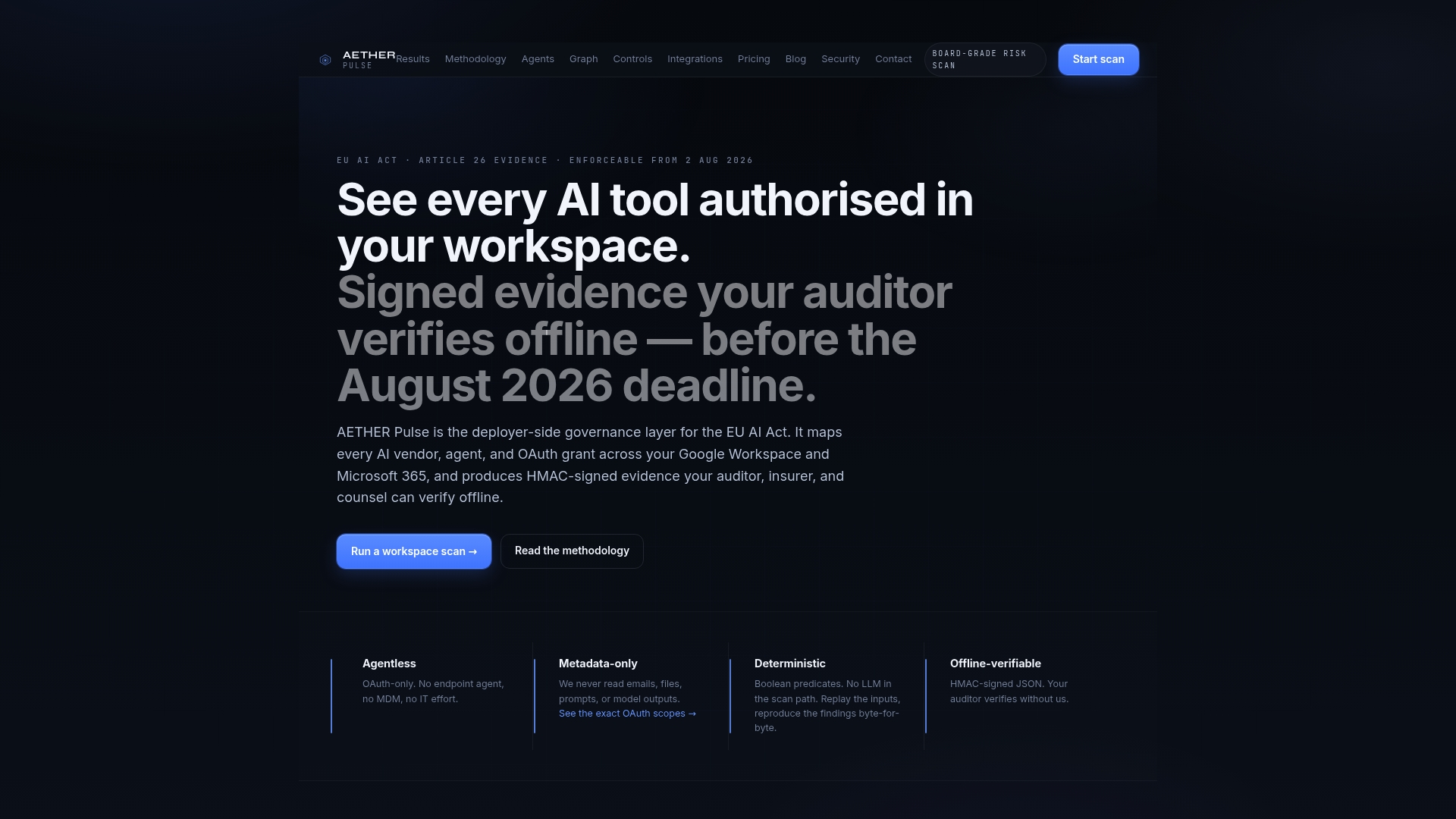
Every risk classification and evidence item produced is deterministic, traceable, and cited to public regulatory sources, so what you hand an auditor is something they can verify independently rather than take on faith. That fits directly into the 90-day roadmap above: build your inventory, tier your systems, then let signed evidence packs do the heavy lifting when weeks 9 through 12 arrive.
Compliance teams evaluating this approach can review plan options on the AETHER Pulse site or check pricing for the Article 26 readiness audit to scope a readiness engagement before the next exam cycle lands.
Where to Point Auditors for the Underlying Standards
Cite these when a regulator asks for the framework behind your methodology, not just your conclusions:
- NIST AI RMF core: the four-function structure your governance summary should mirror
- NIST Generative AI profile: inventory and provenance specifics for generative systems
- OCC supervisory guidance: the banking-sector standard for documentation depth
- Microsoft's transparency report: a real-world model of continuous reporting at scale
Sources
- AI RMF core — NIST
- AI RMF profile for Generative AI — NIST
- Model risk management — OCC 2026 bulletin
- Responsible AI transparency report — Microsoft (2026)
FAQ
What Is a Regulator-Ready AI Report?
It's documentation proving an AI system's governance actually happened, not just that it was planned, including traceable provenance, signed validation results, and a current monitoring record. The NIST AI RMF provides the structural framework most regulated firms map this documentation to.
How Often Should AI Compliance Documentation Be Updated?
Monitoring metrics need daily or weekly capture, governance reviews should happen quarterly, and any material model change requires an immediate update to the model card and change history. Firms that follow this cadence typically satisfy regulator requests in days rather than reconstructing months of history under deadline pressure.
What Documents Do Auditors Request Most Often for AI Systems?
Auditors most commonly ask for a dated validation report, signed test logs, incident reports, and governance meeting minutes naming accountable individuals. Supervisory guidance specifically requires documentation detailed enough for someone unfamiliar with the model to understand its operation and limits.
Does Every AI System Need the Same Level of Documentation?
No. Documentation depth should scale with risk tier: low-risk systems need only an inventory entry, while high-risk systems require a full technical dossier with independent validation and human oversight records. Materiality to customer or financial outcomes should drive that classification, not the system's technical complexity.
Can AETHER Pulse Help Produce Regulator-Ready Evidence?
AETHER Pulse generates tamper-evident, cryptographically signed evidence packs and an agent inventory through metadata-only integration, without touching customer data. Plan and pricing details, including the Article 26 readiness audit, are available on the AETHER Pulse site.
Recommended
Working on Article 26 readiness, deployer-side governance evidence, or AI agent risk at a regulated firm? We'd value 15 minutes of your perspective.
Start a conversation