Regulated AI Deployment Risk Checklist for Finance
Regulated AI Deployment Risk Checklist for Finance

A regulated AI deployment risk checklist is a structured set of controls and documented requirements that ensures AI use in financial services complies with the EU AI Act, FCA expectations, NIST AI RMF, and operational resilience mandates like DORA. Regulatory enforcement now targets governance failures directly, not just technology defects. Compliance professionals who treat AI oversight as a one-time exercise face the highest exposure. The checklist framework described here covers inventory, human oversight, lifecycle monitoring, vendor due diligence, and documentation controls that regulators currently inspect.
1. What must a regulated AI deployment risk checklist include?
A complete AI compliance checklist starts with a live inventory of every AI system the firm deploys or procures. Each entry must capture the system's purpose, version, data inputs, affected population, and the regulatory classification under EU AI Act Annex III or Annex I. Inventory and classification are the foundation because you cannot govern what you have not identified.
The core checklist items for regulated firms are:
- AI system inventory: Maintain a continuously updated register with version control, classification status, and accountability mapping for every AI workflow.
- Human oversight assignment: Designate a named accountability owner for each AI decision point. Article 26 of the EU AI Act mandates that deployers document oversight roles, input data representativeness, and escalation routes.
- Data representativeness and input validation: Confirm training and inference data is representative of the population affected. Document validation results and refresh cycles.
- Model explainability controls: Define the minimum explainability standard for each system. High-risk systems require decision-level traceability, not just aggregate performance metrics.
- Automated logging pipelines: Build logging of AI inputs, outputs, and decision logic into deployment pipelines before going live. Retrofitting logging after deployment undermines regulatory compliance readiness.
- Vendor due diligence: Apply the same scrutiny to third-party AI products as to traditional IT vendors. Review Annex IV technical files where applicable and document contractual protections.
- Incident detection and reporting: Define AI-specific incident thresholds, escalation paths, and reporting timelines distinct from standard IT incident procedures.
- Operational resilience integration: Map each AI system to the important business services it supports. Incorporate AI failure scenarios into impact tolerance testing and recovery plans aligned with DORA and SM&CR.
Pro Tip: Treat your AI inventory as a living document, not a project deliverable. Assign a named owner to update it within 48 hours of any model version change or new deployment.
2. How should compliance professionals assess risk throughout the AI lifecycle?
Risk assessment for AI is not a point-in-time exercise. Regulators expect continuous lifecycle management from development through decommissioning. A model that passes pre-deployment review can drift, degrade, or become a liability as data distributions shift or adversarial conditions emerge.

The NIST AI Risk Management Framework provides a structured approach to triage and prioritize AI risks dynamically. It separates governance, mapping, measurement, and management into distinct functions, which allows compliance teams to assign controls proportional to each system's risk profile. Applying NIST AI RMF alongside EU AI Act obligations gives firms a defensible, internationally recognized methodology.
Adversarial risks deserve explicit checklist coverage. Data poisoning, model inversion, and prompt injection attacks are not theoretical. Third-party AI dependencies require the same security-by-design rigor as traditional IT vendor management, including adversarial robustness testing before and after deployment.
Deployers bear full regulatory liability for AI decision explainability and traceability, regardless of vendor black-box opacity. Firms must develop internal capabilities to trace and audit AI models rather than relying on vendor assurances.
Explainability and auditability must be operationally effective throughout the deployment period. This means logging must capture not just outputs but the decision logic and data inputs that produced them. Human intervention must be technically possible at every significant decision point, not just theoretically permitted in policy documents.
Embedding AI governance into documented supervisory procedures closes the gap between policy and practice. Compliance teams should map each AI system to the supervisory procedure that governs its use, and update those procedures when models are retrained or replaced.
3. What practical steps enable effective AI governance and documentation?
Effective AI governance documentation is the difference between passing a regulatory inspection and failing one. The following steps translate checklist principles into operational practice.
- Build a live AI inventory with version control. The register must be accessible to compliance, audit, and senior management. Each entry should include the model version, deployment date, data sources, accountability owner, and regulatory classification.
- Develop AI-specific governance policies. Generic IT policies do not address model drift, explainability obligations, or automated decision-making risks. Draft an AI acceptable use policy and a supervisory procedure for each high-risk workflow.
- Assign accountability under SM&CR. Define which Senior Manager Function holder owns each AI system's governance. FCA expectations have shifted from principles to granular practice, requiring operationally effective human-in-the-loop controls for significant automated decisions.
- Document vendor obligations explicitly. Contracts with AI vendors must specify explainability requirements, audit access rights, incident notification timelines, and data handling obligations. Review Annex IV technical documentation for any system classified as high-risk under the EU AI Act.
- Configure automated logging before go-live. Logging must capture inputs, outputs, and decision logic at the transaction level. Automated logging built into deployment pipelines before launch is the only approach that satisfies regulatory inspection readiness.
- Write AI-specific incident response playbooks. Define what constitutes an AI incident, who is notified, and what the remediation timeline is. AI failures often manifest differently from traditional IT outages, including silent degradation, biased outputs, or adversarial manipulation.
- Schedule regular model performance reviews. Set a review cadence tied to the risk classification of each system. High-risk systems warrant quarterly reviews at minimum, with ad hoc reviews triggered by data distribution changes or incident reports.
Pro Tip: Separate your AI incident response playbook from your standard IT incident runbook. Regulators will ask for it specifically, and a generic IT response plan will not satisfy an AI-focused supervisory review.
4. How to integrate AI risk into broader financial services risk frameworks
Integrating AI risk into existing frameworks is the step most compliance teams delay, and it is the step regulators now inspect most closely. AI risk does not sit in isolation. It connects to cyber resilience, operational resilience, third-party risk, and board-level reporting.
| Integration Area | Requirement | Regulatory Reference |
|---|---|---|
| Operational resilience | Map AI systems to important business services; include in impact tolerance testing | DORA, FCA PS21/3 |
| Cyber resilience | Integrate AI vulnerability triage into cyber risk programs; automate at scale | Bank of England, FCA, HM Treasury joint statement |
| Third-party risk | Apply proportional due diligence to AI vendors; monitor continuously | EU AI Act Article 26, DORA |
| Board reporting | Include AI risk metrics and incidents in senior management and board reporting | FCA SYSC, SM&CR |
| Fallback controls | Define manual override procedures for AI system outages or failures | DORA, FCA operational resilience |
UK regulators require boards to oversee AI-related cyber risk, including third-party supply chain vulnerabilities. This is not a technology team obligation. It sits at the governance level, which means compliance professionals must translate AI risk into board-ready reporting formats.
Regulators emphasize that manual processes are insufficient to triage and remediate AI vulnerabilities at scale. Automation is required. Firms that rely on spreadsheet-based AI risk tracking will not meet the speed or coverage regulators expect as AI deployments multiply.
Fallback and manual controls deserve explicit documentation. If an AI system fails or produces unreliable outputs, the firm must demonstrate it can revert to a manual process without breaching its impact tolerances. This scenario should appear in operational resilience testing, not just in policy documents.
Key Takeaways
A complete AI risk management framework for regulated finance requires continuous inventory, documented human oversight, and automated logging built into deployment pipelines before any system goes live.
| Point | Details |
|---|---|
| Inventory first | Maintain a live, version-controlled AI register accessible to compliance and audit teams. |
| Assign accountability | Name a Senior Manager Function holder as the governance owner for each AI system. |
| Log before launch | Build automated logging of inputs, outputs, and decision logic into pipelines prior to go-live. |
| Integrate, don't isolate | Map AI risk into operational resilience, cyber, and third-party risk frameworks explicitly. |
| Prepare for EU AI Act deadlines | A compliance program for the december 2027 deadline requires 12–24 months of lead time. |
The governance gap is the real risk
The firms that will face enforcement action in the next two years are not the ones using the most sophisticated AI. They are the ones that deployed AI without building the governance infrastructure to answer supervisory scrutiny. I have seen this pattern repeat across technology cycles, and AI is no different in that respect.
What is different is the speed. AI systems can be deployed, retrained, and replaced faster than governance frameworks can track them. That gap between deployment velocity and oversight capacity is where regulatory liability accumulates. The answer is not to slow down AI adoption. The answer is to build governance infrastructure that runs at the same speed.
AI compliance success is defined by early recognition of governance gaps and building infrastructure to answer supervisory scrutiny, not by technology sophistication alone. That framing matters. It shifts the question from "Is our AI good?" to "Can we prove we are governing it?" Those are very different questions with very different answers.
The EU AI Act's december 2027 deadline for high-risk systems sounds distant. A compliance program to meet it takes 12–24 months to build properly. Firms that start in 2026 are already working with a compressed timeline. Firms that wait for final regulatory guidance before acting will not make it.
My strongest recommendation is to treat AI governance as an evidence production problem, not a policy writing problem. Regulators want to see logs, audit trails, accountability records, and incident reports. They want to inspect the evidence, not read the policy.
— Eleye
Aetherpulse: governance infrastructure for regulated AI
Regulated financial services firms deploying AI agents face a specific problem: regulators expect evidence of oversight, but most governance tooling either accesses sensitive data or cannot produce defensible audit records.
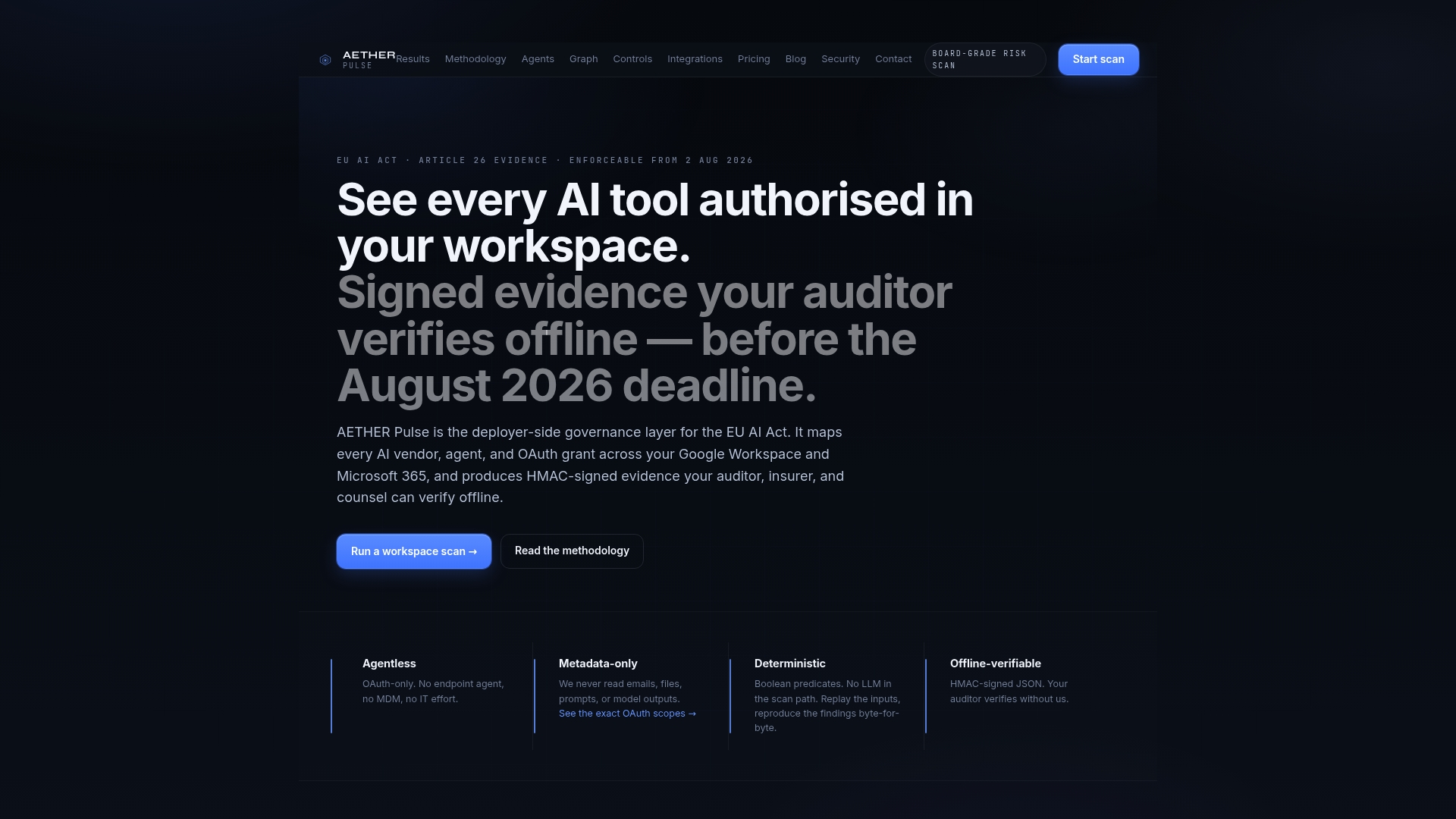
Aetherpulse addresses this directly. The platform connects via OAuth metadata only, touching no customer data, and builds a live inventory and identity graph of every AI agent in your environment. It surfaces risk concentration, including financial blast-radius exposure, and generates tamper-evident, cryptographically signed evidence packs using HMAC-SHA256. Those packs are ready for auditors, regulators, and internal risk functions on demand. Aetherpulse maps to EU AI Act Article 26, FCA Consumer Duty, SYSC requirements, and the ICO's developing code of practice, giving compliance teams the documentation layer the checklist requires without inserting tooling into production systems.
FAQ
What is a regulated AI deployment risk checklist?
A regulated AI deployment risk checklist is a structured set of controls and documentation requirements that ensures AI systems in financial services comply with frameworks including the EU AI Act, FCA expectations, and NIST AI RMF. It covers inventory, human oversight, logging, vendor due diligence, and incident response.
What does Article 26 of the EU AI Act require from deployers?
Article 26 requires deployers to document oversight roles, input data representativeness, and escalation routes for each AI workflow. Records must capture the system's purpose, version, and population impact.
How long does EU AI Act compliance preparation take?
A compliance program for the december 2027 high-risk system deadline takes 12–24 months to build properly, making 2026 the critical year to begin.
Why can't AI compliance be outsourced to vendors?
Deployers bear full regulatory liability for AI decision explainability and traceability regardless of vendor opacity. Regulators hold the deploying firm responsible, not the model provider.
How does AI risk integrate with operational resilience frameworks?
AI systems must be mapped to important business services and incorporated into impact tolerance testing and recovery strategies under DORA and FCA operational resilience requirements. Fallback manual controls must be documented and tested.
Recommended
Working on Article 26 readiness, deployer-side governance evidence, or AI agent risk at a regulated firm? We'd value 15 minutes of your perspective.
Start a conversation