3 Controls for Audit Ready Read Only AI Oversight in Financial Services
3 Controls for Audit Ready Read Only AI Oversight in Financial Services

Read-only oversight reduces the blast radius of an AI agent, but it does not, by itself, provide safe governance. Enforce read-only below the model, not through it, and pair that infrastructure control with query logging, provenance tracking, and human approval gates before writes or high-impact actions occur. Prioritize three controls first: engine-enforced read-only access, tamper-evident query logs, and approval gates for anything beyond observation.
TL;DR:
- Read-only enforcement must be implemented at the database, network, and query levels, with cryptographically signed logs for proof and auditability.
- Distinguishing between read-only by instruction and by construction is crucial, with the latter providing a more durable and regulator-friendly guarantee.
- Read-only agents remain vulnerable to prompt injection, overbroad reads, and side effects outside SQL, which require layered, technical controls and testing.
- Tiered human approval gates should match the risk level, with strict logging, signed artifacts, and well-defined thresholds for high-impact decisions.
- Building a scalable, compliance-aligned oversight system involves inventorying agents, testing for injection, enforcing standards centrally, and leveraging metadata-only evidence layers.
Table of Contents
- What Does Read-Only AI Oversight Actually Mean?
- Why Read-Only Alone Doesn't Guarantee Safety
- Building Provable Read-Only Guarantees Into Your Architecture
- How Should You Design Human-in-the-Loop Approval Gates?
- Mapping Controls to NIST, OECD, and OWASP Frameworks
- How Do You Deploy Read-Only Oversight in Practice?
- How a Metadata-Only Evidence Layer Satisfies Auditors
- Scaling Read-Only Oversight Across Complex AI Systems
- Privacy Rules Shaping How Read-Only Oversight Gets Built
- What's Next for Read-Only AI Oversight Research?
- Read-Only vs. Write-Capable vs. Supervisory Oversight Models
- Prioritizing Read-Only Controls: An Editorial Take
- AETHER Pulse: Read-Only Governance Built for Financial Services Auditors
- Where to Verify These Standards and Controls
- Sources
What Does Read-Only AI Oversight Actually Mean?
Ask ten vendors what "read-only AI oversight" means and you will get ten different answers, and that ambiguity is exactly the problem compliance teams need to close before an auditor asks the same question. The phrase gets used loosely across the industry, but for regulated firms, precision here is not academic. It determines whether a control actually holds under adversarial conditions or just under polite ones.
The most important distinction is between read-only by instruction and read-only by construction. Read-only by instruction means a system prompt or policy tells the model "only read, never write." It is a request, not a constraint, and the model has no mechanism forcing it to comply. Read-only by construction means the model physically cannot execute a write. The database role it connects through lacks INSERT, UPDATE, or DELETE privileges. A broker sitting between the model and the data source parses every query and rejects anything that is not a SELECT statement. There is no instruction to violate, because there is no capability to misuse.
This distinction matters enormously for audit conversations. When a regulator or internal risk committee asks "how do you know the agent didn't write anything," the answer "we told it not to" satisfies no one. The answer "the database credential has no write grant, and every write attempt would fail closed and generate an error log" is a durable, defensible claim. Practitioner patterns for enforcing read-only at the database and broker layers show that SELECT-only roles and read replicas make write operations structurally impossible rather than merely discouraged.
In practice, "read-only" covers several distinct modes, and choosing the wrong one for the risk level is a common early mistake:
- Observe mode: The agent monitors data streams or dashboards passively, with no query initiation and no user-facing output beyond alerts.
- Recommend mode: The agent reads data and generates a recommendation for a human to act on, but never touches the source system.
- Read-replica query mode: The agent queries a replicated copy of production data, isolating any performance or contention risk from live systems.
- Audit-only mode: The agent's sole function is reviewing logs, transactions, or prior decisions to flag anomalies, with access scoped narrowly to audit trails rather than operational tables.
Each mode carries a different risk profile and a different evidentiary burden. An agent in observe mode needs far less scrutiny than one operating in recommend mode against a live customer database, even though both are technically "read-only." Naming the mode precisely, in policy documents and in vendor contracts, keeps everyone including your auditors talking about the same thing.
Why Read-Only Alone Doesn't Guarantee Safety
Read-only access blocks direct writes, but it does not close off every path to harm. Field analysis on AI agent containment makes the point plainly: read-only agents reduce the blast radius by preventing writes, but they do not guarantee safety on their own, because reading is often enough to cause damage.
Prompt injection is the clearest example. An attacker embeds instructions inside data the agent is meant to read, a customer support ticket, a document field, an email body, and the agent follows those embedded instructions as if they came from its operator. A read-only agent can still be manipulated into querying tables it should never touch, formatting sensitive output for exfiltration, or summarizing data in a way that leaks information the requester was never authorized to see. Instruction-only controls fail here because the injected text is, from the model's perspective, just more text to process. There is no privilege boundary to stop it, only a suggestion.
Overbroad reads present a second failure mode. A query scoped to "customer transaction history" can, depending on schema design, pull PII columns, internal risk scores, or free-text notes fields containing sensitive commentary never meant for automated processing. Large-result queries compound this: an agent asked to "summarize recent activity" that returns 50,000 rows instead of 50 has effectively performed a bulk data export, even though every individual read was technically permitted.
Statistic Callout: Read-only agents can still generate exfiltration paths through their outputs even when every underlying query is compliant, because the risk shifts from what the model writes to what it reveals. Layered controls for data access, execution, network egress, approvals, sharing, and audit remain necessary regardless of read-only status, according to field research on containment for read-only agents.
The third failure mode sits outside the database entirely. Many enterprise agents have side effects beyond SQL: sending emails, posting to Slack or Teams, scheduling calendar events, or triggering downstream workflows through connected APIs. A "read-only" designation applied to the database layer says nothing about these adjacent capabilities. An agent that reads a flagged account and then automatically emails the customer, or triggers a case-management workflow based on its own read, has taken a real-world action, regardless of how its database access was scoped.
Three short field notes illustrate the pattern:
- A support agent summarizing tickets pulled a hidden instruction from a ticket body and forwarded internal notes to an external email address embedded in the injected text.
- An analytics agent asked for "top customers by exposure" returned a full column of national insurance numbers because the view it queried had never been column-masked.
- A monitoring agent detected a threshold breach and, without any write access to the core ledger, still triggered an external webhook that escalated a case to a third-party collections' vendor.
None of these required a database write. All three would have passed a naive "is this agent read-only" audit question with a confident yes.
Building Provable Read-Only Guarantees Into Your Architecture
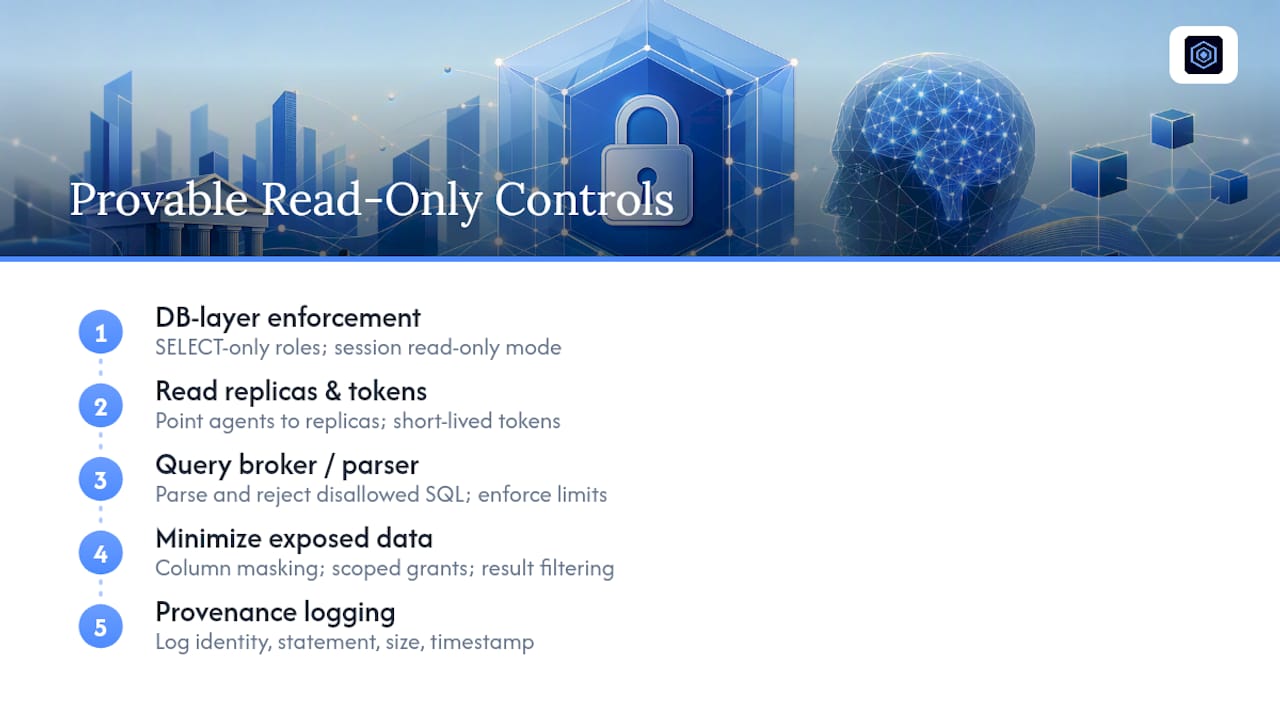
Provable read-only status is an engineering outcome, not a policy statement, and it requires enforcement at multiple layers so that no single point of failure undermines the guarantee. The goal is a system where a write attempt does not just get discouraged, it errors out, and that error itself becomes part of your audit trail.
1. Enforce read-only at the database layer. Create dedicated SELECT-only roles with schema-scoped grants, so the credential the agent uses has no INSERT, UPDATE, DELETE, or DDL privileges at all. In Postgres environments, set transaction_read_only = on for the session, which causes any write statement to fail at the engine level regardless of what the application code attempts. Technical descriptions of read-only-by-construction patterns confirm this approach causes write attempts to error out and produces audit-legible failure records automatically.
2. Route through read replicas or connection-level read intent. Point agent traffic at a read replica rather than the primary database, isolating both performance risk and write risk in one move. For SQL Server environments, ApplicationIntent=ReadOnly in the connection string routes queries to available replicas transparently. Credential brokering, where the agent never sees a long-lived database password but instead requests short-lived, scoped tokens, adds a second layer that limits the damage if a credential leaks.
3. Put a broker or parser in front of every query. A query broker parses incoming SQL against a strict grammar before execution, rejecting anything outside an allow-listed pattern. This step catches what role-based grants alone might miss: enforce single-statement execution so an agent cannot chain a SELECT with a semicolon-delimited write, detect and restrict common table expressions (CTEs) that could mask a write inside a nested query, cap row counts on any result set to prevent bulk exports disguised as normal reads, and apply statement_timeout values so a runaway or malicious query cannot hold connections or scan entire tables unchecked.
4. Minimize the data actually exposed. Column masking hides or tokenizes sensitive fields like national identifiers, account numbers, or free-text notes before they ever reach the model's context window. Scoped grants restrict which schemas or views the read-only role can touch in the first place, and result filtering at the broker layer strips fields that were not explicitly requested for the task at hand. This reduces the exfiltration surface even in a scenario where a query is technically permitted but returns more than the task requires.
5. Log everything with provenance attached. Every query needs to be logged with the identity that initiated it, the exact statement executed, the result size, and a timestamp, ideally written to an append-only or cryptographically signed store so the log itself cannot be quietly edited after an incident. Identity mapping, tying each query back to a specific agent instance and the human or process that triggered it, is what turns a raw log into an evidence artifact rather than a debugging aid.
Pro Tip: Test your broker's rejection behavior before you trust it. Send it a write statement disguised inside a CTE, a batched multi-statement string, and a query with an intentionally oversized LIMIT. If any of the three executes instead of failing closed, your read-only guarantee has a gap you have not found yet.
Taken together, these five layers turn "read-only" from a claim into something closer to a guarantee: an engine-enforced boundary, a network-level isolation, a query-level filter, a data-level minimization, and a durable record of everything that happened.
How Should You Design Human-in-the-Loop Approval Gates?
Not every AI agent needs the same level of scrutiny, and treating a low-stakes summarization tool with the same rigor as an agent that touches customer funds wastes review capacity you will need elsewhere. A risk-tiered autonomy model solves this by matching the intensity of oversight to the actual consequence of getting something wrong.
A workable three-tier structure looks like this in practice:
- Tier 1, autonomous observation: Agents reading internal metrics dashboards or summarizing already-public information can operate with logging alone and no approval gate, since the downside of an error is low and self-correcting.
- Tier 2, recommend with review: Agents that surface a suggested action, flagging a transaction pattern, drafting a customer response, still require a named human to approve before anything leaves the system, with the approval itself logged against the recommendation it responded to.
- Tier 3, high-impact and gated: Agents whose output could affect customer funds, regulatory filings, or external communications need a hard approval gate with defined cost or impact thresholds, and no action proceeds without a named approver's sign-off recorded at the moment of decision.
Designing the approval gate itself means setting concrete thresholds rather than vague judgment calls. A gate that triggers "when the recommended action affects more than $10,000 in exposure" or "whenever the output includes an external communication" is auditable. A gate that relies on "reviewer discretion" with no defined trigger is not, because there is no way to demonstrate afterward that the threshold was applied consistently.
Audit-ready evidence has to satisfy three properties simultaneously, and skipping any one of them weakens the whole package. Logs need to be deterministic, meaning the same input and system state produce the same recorded output every time, so an auditor can trust that the log reflects reality rather than a reconstruction. Artifacts need to be signed in a way that proves they have not been altered since creation. And the whole chain, from query to recommendation to human approval to final action, needs a documented chain of custody linking each step to the identity responsible for it.
Security practitioners describing evidence-by-design argue that the strongest oversight model combines read-only investigation with approval-gated actions so that investigators can retrace an entire sequence automatically after the fact, rather than reconstructing it from fragmented logs across systems. That retraceability is exactly what an incident investigation depends on: you need to know which agent queried what, when, under whose credential, what recommendation it produced, who approved it, and what downstream system received the resulting action. Preserve those records before, not after, an incident occurs. A compliance team that only starts collecting this evidence once something goes wrong has already lost the case for demonstrable oversight.
Mapping Controls to NIST, OECD, and OWASP Frameworks
Technical controls only satisfy regulators when they translate into language and artifacts those frameworks already recognize. Building that translation layer early saves considerable pain during an actual examination.
NIST's AI Risk Management Framework organizes obligations around four functions: govern, map, measure, and manage. Read-only enforcement at the infrastructure level maps most directly to the "manage" function, since it is a concrete risk-response control, but the logging and provenance layer supports "measure" by giving you quantifiable evidence of how the control performs over time. NIST has also published crosswalks aligning the AI RMF with ISO/IEC standards, which is useful when a firm operates under both US and international expectations simultaneously.
The OECD's due diligence guidance for responsible AI takes a governance-first angle rather than a technical one. It recommends assigning oversight responsibility explicitly to senior management or the board, maintaining detailed records of AI system behavior, engaging relevant stakeholders in risk assessment, and building contingency plans for when something goes wrong. A read-only control system feeds this directly: the query logs and approval records are the "records" OECD guidance calls for, and the tiered autonomy model is a natural artifact for demonstrating oversight assignment.
OWASP's AI Exchange guidance is the most technically specific of the three, listing general controls for AI program governance alongside targeted controls for sensitive-data limitation. It explicitly calls out the value of testing for prompt injection and runtime data exposure, which maps directly to the red-team exercises a mature read-only program should already be running.
Statistic Callout: NIST's ongoing standards coordination work, including its published crosswalks between the AI RMF and international ISO/IEC standards, gives compliance teams a documented reference point for aligning internal control language with frameworks examiners already recognize, according to NIST's AI standards program.
Regulators and auditors tend to request a consistent set of artifacts once they understand a firm is running AI agents against production data:
- The agent inventory, listing every deployed agent, its data scope, and its assigned risk tier.
- Query and access logs showing what each agent read, when, and under which credential.
- Approval records for any tier-two or tier-three action, with named approvers and timestamps.
- The results of prompt-injection and sensitive-data-exposure testing, ideally run on a recurring schedule.
- A signed, tamper-evident evidence pack summarizing the above for a given period or incident.
Building toward an AI governance maturity model that explicitly tracks these artifacts against NIST's functions gives risk teams a clear roadmap rather than a reactive scramble each time an examiner asks a new question.
How Do You Deploy Read-Only Oversight in Practice?
Moving from concept to a working pilot follows a predictable sequence, and skipping steps almost always shows up later as rework or a failed audit finding.
- Discovery. Build a complete inventory of AI agents operating across the enterprise, including shadow deployments that were never formally sanctioned. For each agent, document the exact scope of table and column grants it currently has, flag any sensitive columns (PII, account numbers, risk scores) within reach, and identify where risk concentrates, meaning which agents, if compromised or misused, would touch the largest volume of sensitive or high-value data. A structured agent discovery workflow makes this step repeatable rather than a one-time manual audit.
- Pilot. Select a low-risk agent as the test case and create a dedicated SELECT-only database role for it, with grants scoped to only the tables it needs. Route its traffic through a read replica or a session with
transaction_read_onlyenabled, and place a query broker in front that parses every statement and rejects anything outside an approved grammar. - Policy. Define approval gate thresholds in writing, specify who is authorized to approve tier-two and tier-three actions, and set retention periods for logs and evidence artifacts consistent with your firm's existing records-retention policy.
- Testing. Run prompt-injection red-team exercises against the pilot agent using realistic attack payloads embedded in data fields, and run hostile-content tests to see whether the agent can be manipulated into producing harmful or non-compliant output through its read access alone. Build at least one replayable audit exercise where a compliance reviewer reconstructs an agent's actions purely from the logs, without additional context, to confirm the evidence trail actually works.
- Operationalize. Formalize retention schedules, automate the generation of tamper-evident evidence packs on a recurring basis, and define a small set of metrics, query volume by agent, approval gate trigger rate, injection test pass rate, to report to the board on a regular cadence. Sample governance reporting metrics built specifically for regulated firms give a useful starting template rather than inventing a reporting format from scratch.
Pro Tip: Run your first replayable audit exercise before you go live, not after your first real incident. If a compliance reviewer with no prior context cannot reconstruct what an agent did purely from your logs, your evidence trail has a gap that a real regulator will find eventually.
How a Metadata-Only Evidence Layer Satisfies Auditors
A read-only evidence layer that connects at the metadata level rather than the data level solves a specific tension compliance teams face: regulators want proof of oversight, but adding another system with access to customer data expands your risk surface rather than shrinking it. AETHER Pulse is built around that constraint directly, connecting through OAuth metadata only and touching no customer records at any point in its operation.

The platform builds an inventory and identity graph of an organization's deployed AI agents, surfacing where risk concentrates, including what AETHER Pulse frames as financial blast-radius exposure, the total value or volume of activity a given agent could affect if it acted incorrectly. Because the connection is metadata-only, this visibility comes without the platform ever ingesting the sensitive customer data those agents work with.
Evidence generated by the platform is packaged as cryptographically signed artifacts using HMAC-SHA256, producing tamper-evident records that a firm can hand directly to an auditor, a regulator, or an internal risk committee without additional processing. That signature is what turns a log export into defensible evidence: anyone reviewing it can verify the artifact has not been altered since it was generated.
In the deployment sequence described above, a layer like this sits at the operationalize stage, providing the automated, recurring evidence generation that manual log review struggles to sustain at scale. For boards and auditors asking for proof that oversight exists and functions continuously, rather than a one-time attestation, that is precisely the gap a metadata-only, signed evidence layer is designed to close.
Scaling Read-Only Oversight Across Complex AI Systems
A single well-governed agent is manageable by hand. Fifty agents across a dozen business units, each with slightly different data scopes and risk profiles, is not. The most common failure at scale is inconsistent enforcement: one team configures a proper SELECT-only role and broker, while another team, under deadline pressure, grants a new agent broader access "just for now" and never revisits it.
The best practice that addresses this is centralizing the enforcement pattern rather than the enforcement itself. Each business unit can run its own agents, but the SELECT-only role templates, the broker configuration, the logging schema, and the evidence-signing process should come from a single, centrally maintained standard that every deployment inherits by default. Deviating from that standard should require an explicit, documented exception, not a silent shortcut.
A second challenge is alert fatigue in the approval-gate layer. If every tier-two action requires a human review and the volume scales into the thousands per day, named approvers either become a bottleneck or start rubber-stamping requests without real scrutiny, which defeats the purpose of the gate. Scaling this well means periodically recalibrating thresholds based on actual outcomes, tightening them where errors cluster and loosening them where a tier has proven reliably low-risk over a sustained measurement period.
Finally, evidence volume itself becomes a management problem. Logging every query across dozens of agents generates enormous data volume, and firms that do not plan storage and retrieval architecture up front find their own evidence system becomes too slow to query during an actual investigation, undermining the goal it was built to serve.
Privacy Rules Shaping How Read-Only Oversight Gets Built
Privacy law does not treat "read-only" as automatically safe, and that assumption trips up more compliance programs than any technical gap does. Reading personal data is still processing personal data under most privacy frameworks, so an oversight agent scanning customer records triggers the same obligations as a write operation, including lawful basis, purpose limitation, and data minimization requirements.
Purpose limitation is the sharpest edge here. An agent granted read access for fraud monitoring that also gets used, even informally, to answer unrelated customer service questions has stepped outside its original lawful basis, regardless of whether it ever wrote anything back to the database. Documenting the specific purpose behind every agent's read scope, and enforcing that scope technically rather than trusting it to policy, is what keeps a read-only deployment inside its privacy mandate.
Data minimization principles push directly toward the column-masking and result-filtering controls described earlier, since an agent that can technically read an entire customer record but only needs three fields for its task should be scoped to exactly those three fields, not the whole row. This is also where regulatory attention is actively developing. The UK's Information Commissioner's Office has signaled ongoing work on a code of practice specifically addressing AI and automated decision-making, and firms operating under the EU AI Act face Article 26 obligations around deployer oversight that apply regardless of whether the underlying access pattern is read-only or read-write. Building minimization and purpose-limitation logging into the broker layer now, rather than retrofitting it once a specific rule lands, is the more defensible position.
What's Next for Read-Only AI Oversight Research?
The direction most active development is heading is toward standardizing what "provable read-only" actually requires as a certifiable claim, rather than leaving each firm to define it independently. Expect frameworks to converge on requiring engine-level enforcement (not policy-level) as the baseline for any claim of read-only status, closing the gap that currently lets instruction-only controls pass casual audits.
A second emerging direction is real-time behavioral anomaly detection layered on top of static read-only enforcement. Static controls tell you an agent cannot write, but they say nothing about whether an agent's read pattern itself looks suspicious, an unusual spike in query volume, an agent suddenly accessing tables outside its normal pattern, a request shape that resembles a known prompt-injection signature. Research into applying anomaly detection specifically to agent query logs, rather than general network traffic, is likely to mature into a standard component of the evidence layer over the next several years.
A third area worth watching is the formalization of prompt-injection testing as a recurring, standardized control rather than an ad hoc red-team exercise. OWASP's ongoing work on AI-specific controls points toward testing frameworks that firms can run on a fixed schedule and report against, similar to how penetration testing became a standardized, auditable practice in traditional infosec. As that testing methodology matures, expect regulators to start asking for evidence of it by name, the same way they now ask for SOC 2 reports or penetration test summaries, rather than accepting a general assurance that "the model was checked for safety."
Read-Only vs. Write-Capable vs. Supervisory Oversight Models
Every oversight model trades control for capability, and understanding where each one sits on that trade-off clarifies which fits a given agent's job.
A write-capable model, where an agent can directly modify records or trigger transactions, offers the most operational efficiency since no human bottleneck sits between decision and action. The cost is that every failure mode, a bad recommendation, a successful prompt injection, a bug, translates immediately into a real-world change that has to be detected and reversed after the fact rather than caught before it happens.
A supervisory model, where a human reviews every agent output before anything takes effect, maximizes control at the cost of throughput. This works well for genuinely high-stakes, low-volume decisions, but it does not scale to thousands of daily agent actions without either overwhelming reviewers or degrading into the rubber-stamping problem described earlier.
Engineered read-only oversight sits deliberately between these two. It gives up the ability to act directly, which write-capable models retain, in exchange for structurally eliminating an entire category of failure before it can occur. It also avoids the throughput ceiling of full human supervision, because observation and recommendation can run continuously and automatically, with human review reserved only for the tier-two and tier-three actions that actually warrant it.
The practical answer for most regulated deployments is not choosing one model exclusively but tiering agents across all three based on their risk profile, using read-only as the default posture and reserving write capability or full supervisory review for the narrow set of use cases that genuinely require it.
Prioritizing Read-Only Controls: An Editorial Take
The industry's biggest blind spot is treating "read-only" as a settled fact once it appears in a system prompt. It is not settled until it is enforced somewhere the model cannot argue with, a database role, a broker, a network boundary. Compliance leaders should stop accepting vendor assurances phrased as instructions and start asking a sharper question: what happens, technically, when the model tries to write anyway?
Start small and low-risk. Pilot on an agent where a mistake costs little, prove the SELECT-only role and broker actually hold under adversarial testing, then expand. Every control you add should map to something a specific framework already asks for, an OECD record-keeping requirement, a NIST function, an OWASP test category, so you are never building evidence nobody asked for. And guard the chain of custody obsessively. An unsigned log is a claim. A signed one is proof.
— Eleye
AETHER Pulse: Read-Only Governance Built for Financial Services Auditors
AETHER Pulse gives regulated firms the missing piece most read-only architectures still lack on their own: an evidence layer that never touches customer data yet produces exactly what an auditor needs to see. Instead of deploying another agent with its own access risk, it connects through OAuth metadata only, mapping your existing agent fleet and surfacing risk concentration without adding a new data-exposure surface to manage.
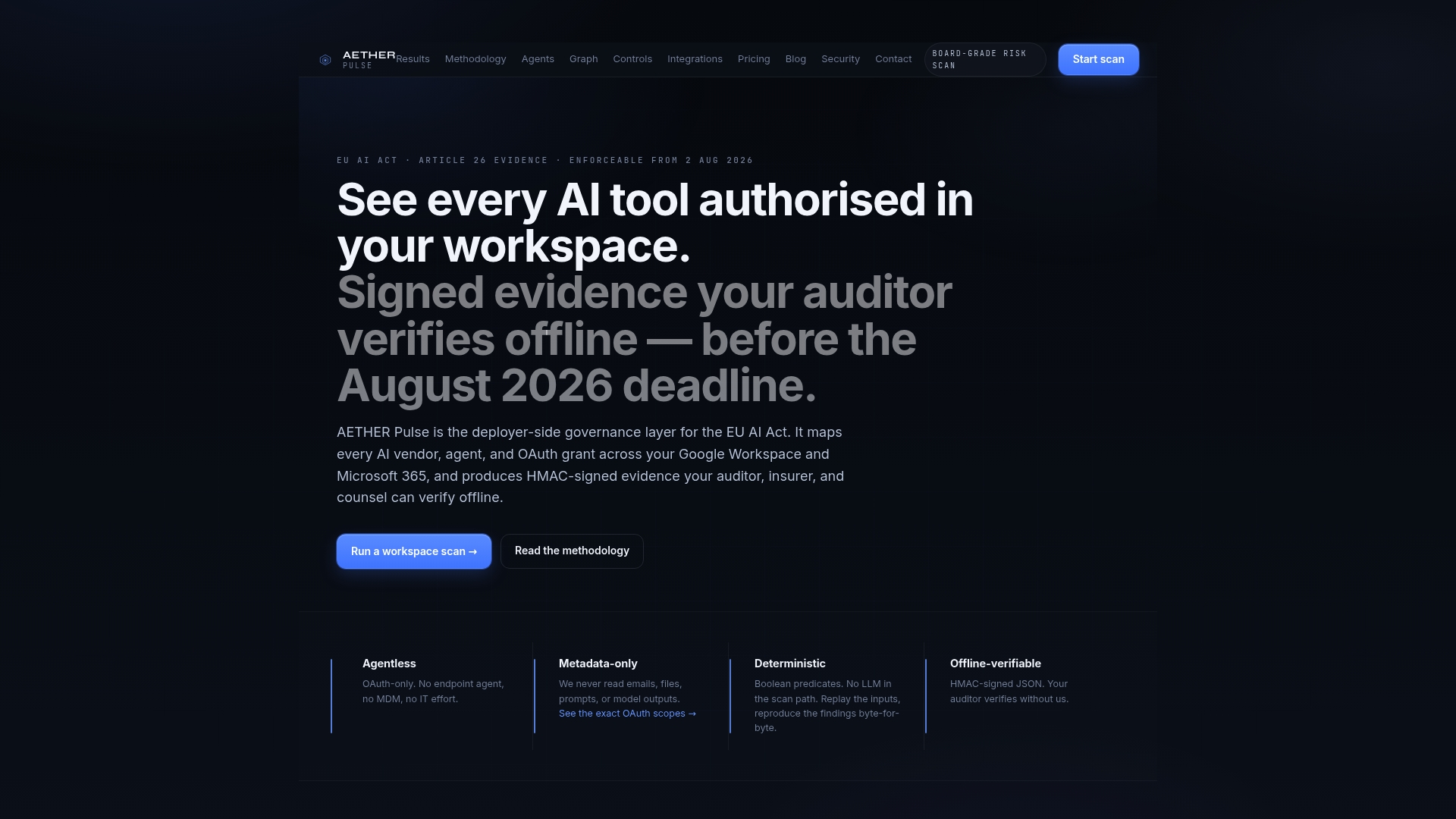
Every evidence pack it generates is cryptographically signed with HMAC-SHA256, giving you the tamper-evident, chain-of-custody artifact that turns a controls checklist into something a regulator can actually verify. That maps directly onto the deployment checklist covered above: agent inventory, risk-tiered exposure mapping, and recurring signed evidence, without the months of custom engineering it would take to build that pipeline internally. The platform's hooks into EU AI Act Article 26, FCA SYSC and Consumer Duty, and the Data (Use and Access) Act mean the artifacts it produces are already shaped for the frameworks your examiners reference.
If you are preparing for your next FCA or internal audit cycle, request a demo at Aetherpulse and ask specifically how the platform maps your current agent inventory to financial blast-radius exposure before you commit to a broader rollout.
Where to Verify These Standards and Controls
- NIST's AI standards program publishes the AI RMF itself along with crosswalks to ISO/IEC standards, the primary reference for mapping technical controls to a recognized US framework.
- The OECD's due diligence guidance for responsible AI sets out the governance-side expectations, oversight assignment, record-keeping, stakeholder engagement, that technical controls need to satisfy.
- OWASP's AI Exchange general controls documents specific, testable controls for sensitive-data limitation and AI program governance, useful as a technical testing checklist.
- Practitioner guidance on read-only-by-construction database patterns walks through the SELECT-only role and broker approach in implementation detail.
- Field research on containment beyond read-only status documents the specific failure modes, prompt injection, overbroad reads, side effects, that read-only alone does not close.
Sources
- NIST — AI standards
- OECD due diligence guidance for responsible AI (2026)
- 1. General controls | AI Exchange
- Read-only AI agents still need containment
- Read-Only by Design: Letting AI Explore Your Database Without the Risk of Writes - DEV Community
Recommended
Working on Article 26 readiness, deployer-side governance evidence, or AI agent risk at a regulated firm? We'd value 15 minutes of your perspective.
Start a conversation