Audit Ready EU AI Act Article 26: 7 Evidence Items Deployers Need
Audit Ready EU AI Act Article 26: 7 Evidence Items Deployers Need

Article 26 makes deployers of high-risk AI legally responsible for using systems according to the provider's instructions, backed by competent human oversight, active monitoring, retained logs, and prompt reporting when something goes wrong. That duty extends to informing affected workers and cooperating with authorities on request. EU AI Act Article 26 is not a documentation exercise. It requires operational proof, the kind of evidence a platform like AETHER Pulse is built to generate without touching customer data. This article breaks the clause down piece by piece and turns it into a checklist your team can actually run.
TL;DR:
- Deployers must retain system logs for at least six months and ensure they include input, output, and human interventions to enable thorough monitoring.
- Human oversight roles need clear documentation of authority, training, and competence, with separate owners for oversight management, daily monitoring, and incident escalation.
- Input data should be regularly tested for relevance and representativeness, with provenance metadata and versioned records to defend against drift and bias.
- Monitoring involves automatic logs and prompt incident reporting, notification to providers within the required period, and fallback procedures if providers are unreachable.
- Register or seek authorization for high-risk systems when required, especially those used by public authorities or involving biometric identification, and connect these activities with GDPR and DPIA obligations.
Table of Contents
- What Does EU AI Act Article 26 Require of Deployers?
- How Should You Structure Human Oversight?
- Is Your Input Data Relevant and Representative Enough?
- What Logging and Monitoring Does Article 26 Actually Require?
- When Must You Inform Workers or Affected Individuals?
- Which Systems Need Registration or Special Authorization?
- How Does Article 26 Connect to DPIA and GDPR Obligations?
- What Should Be in Your Article 26 Evidence Pack?
- What Happens When a Regulator Contacts You?
- What Are the Most Common Article 26 Audit Findings?
- Where Should Compliance Leaders Focus First?
- How AETHER Pulse Supports Article 26 Compliance
- Where to Read the Original Article 26 Text
- Sources
What Does EU AI Act Article 26 Require of Deployers?
Article 26 sits at the center of the EU AI Act's deployer obligations, and each paragraph maps to a distinct operational task. Reading the official text alongside the consolidated version makes the structure clearer than either does alone.
- Paragraph 1 requires deployers to take appropriate technical and organizational measures to use the system in accordance with the provider's instructions for use.
- Paragraph 2 requires assigning human oversight to natural persons who have the necessary competence, training, and authority, along with the support they need.
- Paragraph 3 ties oversight duties to the deployer's control over the operation of the system, including relevant input data where the deployer controls that input.
- Paragraph 4 covers monitoring operation based on the instructions for use and, where relevant, informing the provider under Article 72's post-market monitoring framework.
- Paragraph 6 requires deployers to keep the logs automatically generated by the system for a minimum of six months, unless other Union or national law sets a longer period.
Two adjacent provisions matter as much as the text of Article 26 itself. Article 19 defines what those logs must contain and how providers design logging capability into the system in the first place. Article 72 and Article 73 govern what happens when monitoring surfaces a problem, including the deployer's duty to inform the provider and, in serious cases, the fallback procedure when a provider cannot be reached.
Recitals 91 through 95 fill in intent that the operative text leaves implicit, particularly around proportionality of oversight measures and the balance between deployer autonomy and provider responsibility. Treat paragraphs 1, 2, and 6 as must-do items with no reasonable exception. Paragraph 4's monitoring cadence and paragraph 3's data-control obligations are should-consider items where the right intensity depends on the system's risk classification and deployment context.
How Should You Structure Human Oversight?
Paragraph 2 of Article 26 sets a specific bar: oversight must sit with natural persons who have competence, training, and authority. Many compliance teams satisfy the letter of that requirement with a name on an org chart and fail the substance of it, because a named owner without documented authority or training records will not survive a regulator interview.
A workable governance model splits oversight into three distinct roles.
- Oversight owner. Accountable for the system's risk posture at committee level, typically a senior compliance or risk officer with sign-off authority over deployment changes.
- Day-to-day monitor. Reviews system outputs, flags anomalies, and escalates according to defined thresholds. This role needs hands-on familiarity with the system's actual behavior, not just its documentation.
- Escalation owner. Receives flagged issues from the monitor, decides whether to suspend use, and holds the authority to trigger provider or authority notification under paragraph 5.
Each role needs its own evidence trail. Training records should show what the person was trained on and when, not just that a course was completed. Competence matrices should map named individuals to the specific systems they oversee, since blanket competence claims across a portfolio of AI tools rarely survive scrutiny. Authority charters should state explicitly what each role can decide alone versus what requires escalation, because ambiguity here is one of the most common findings in internal audits.
Decision gates work best when oversight is embedded rather than bolted on. Build a checkpoint into the deployment workflow itself, so a new model version cannot go live without the oversight owner's sign-off, and build exception handling so an anomaly automatically routes to the day-to-day monitor rather than sitting in a queue.

Pro Tip: Auditors trust dated, versioned training records far more than a static policy document. If your evidence pack can show who was trained, on which system version, and when their competence was last reviewed, you have already answered the question most examiners ask first.
Is Your Input Data Relevant and Representative Enough?
Paragraph 3 makes deployers responsible for the quality of input data they control, and "sufficiently representative" is a phrase regulators will test against your actual population, not your intentions. The gap between a model's training data and the population it operates on in production is where most representativeness failures actually live.
Operational checks that hold up under audit include sampling against known population characteristics, coverage metrics broken out by demographic and temporal segments, and bias detection runs at defined intervals rather than once at go-live. A credit scoring model validated on last year's applicant pool needs revalidation when your customer base shifts, and a system that performed well in testing can drift quietly once real transaction volume replaces the sample set.
Provenance metadata should travel with the data without exposing anything sensitive. Recording the source system, extraction date, transformation steps, and any filtering applied gives you a defensible chain of custody without ever touching the underlying customer records. That distinction matters more once third-party or synthetic data enters the picture.
- Log the origin and licensing terms of any third-party dataset before it feeds a live system.
- Document how synthetic data was generated and validated against real-world distributions.
- Flag any data source that has changed vendors, schemas, or collection methods since the last review.
- Keep a versioned data dictionary so provenance claims can be checked against the dataset actually in use.
A simple documentation template works better than a bespoke one for every system. Use one sheet per dataset that captures source, collection window, representativeness test results, and last review date, then link it to the specific AI system it feeds.
Pro Tip: Treat data provenance documentation as a living artifact, not a one-time sign-off. A dataset that was representative at deployment can drift out of alignment within months, especially in fast-moving sectors like consumer lending.
What Logging and Monitoring Does Article 26 Actually Require?
Monitoring and logging are where Article 26 stops being a policy statement and becomes an infrastructure requirement. Paragraph 4 requires deployers to monitor the operation of the system based on the instructions for use, and paragraph 6 sets the retention floor for the logs that monitoring depends on.
What to log follows directly from Article 19's design requirements: system inputs and outputs relevant to identifying risks, timestamps, version identifiers, and any human interventions in the decision loop. The point of the log is not volume. It is the ability to reconstruct exactly what the system did and who, if anyone, intervened, at any point in the retention window.
Deployers must keep those automatically generated logs under their control for at least six months, unless another Union or national law sets a longer period, which is common in financial services where record-keeping rules already exceed that floor. If your firm operates under retention rules tied to SYSC or equivalent sectoral requirements, use the longer period and document why.
The six-month floor is a minimum, not a target. Firms in regulated sectors routinely need to justify a longer retention window against existing record-keeping obligations, and doing that justification in writing once is far cheaper than reconstructing it under regulator pressure later.
Incident response follows a defined sequence rather than an ad hoc judgment call:
- Detect an anomaly through monitoring or an escalation from the day-to-day oversight role.
- Notify the provider without undue delay, since Article 26 requires informing the provider first when a use presents a risk.
- Notify the relevant market surveillance authority in parallel where the risk is serious, and suspend use of the system if the risk cannot be otherwise mitigated.
- If the provider is unreachable, fall back to the procedure set out in Article 73, which shifts more of the evidentiary burden onto the deployer.
A tool designed for AI governance can compress the detection and evidence steps of that workflow by generating tamper-evident logs and provenance records automatically, without needing to sit inside the production system itself. That practical guidance on monitoring and internal controls sits at the heart of EU AI Act compliance for financial firms.
When Must You Inform Workers or Affected Individuals?
Article 26's workplace notification duty is easy to overlook because it sits outside the technical compliance workflow, yet it carries real legal weight. Where a high-risk AI system is deployed at work, deployers acting as employers must inform workers' representatives and the affected workers before the system is put into service, in accordance with Union and national law and practice.
Notice needs to reach the right people at the right time, with content that actually answers what they will ask.
- Who gets notice: workers' representatives where they exist, and directly affected workers regardless.
- What the notice should cover: the system's purpose, how oversight works, what redress looks like if something goes wrong, and a named contact point.
- When: before the system goes live in the workplace, not after, and documented with a timestamp.
- What else to check: whether the deployment also triggers a data protection impact assessment and any national consultation requirements that sit alongside the AI Act duty.
Building this into your rollout checklist as a gating step, rather than a courtesy communication, avoids the common failure mode of notice arriving after the system is already running.
Which Systems Need Registration or Special Authorization?
Registration and authorization rules apply unevenly depending on who is deploying and what the system does, which is exactly where firms get tripped up assuming a blanket rule.
- Public authorities deploying high-risk AI systems generally must register the deployment, and Article 26 explicitly bars use of an unregistered system where registration is required through its cross-reference to Article 49 and the EU database.
- Private-sector deployers should still verify that their provider has completed its own registration obligations, since a provider's failure to register can expose downstream deployers to risk even where the deployer itself has no direct registration duty.
- Law enforcement use of post-remote biometric identification carries its own procedural rule: deployers must request ex-ante authorization, or authorization within 48 hours in urgent cases, from a judicial or administrative authority, except in narrowly defined initial-identification scenarios.
- Law enforcement deployments of these systems also carry annual reporting and aggregation duties, which sit alongside, not instead of, the standard Article 26 obligations.
Financial services firms rarely operate biometric identification systems of this kind, but the underlying discipline, verifying provider registration status before go-live, applies to every high-risk deployment regardless of sector.
How Does Article 26 Connect to DPIA and GDPR Obligations?
Article 26 does not exist in isolation from data protection law, and paragraph 9 makes that link explicit. Deployers must use the information providers supply under Article 13 to meet their data protection impact assessment obligations under GDPR Article 35 where the deployment involves personal data processing likely to result in high risk.
A DPIA built for an AI Act deployment should draw on a specific evidence set:
- The provider's Article 13 instructions for use, particularly any stated limitations or known risks.
- Documented human oversight arrangements, since a DPIA that ignores who actually reviews outputs is incomplete.
- Data provenance and representativeness records from your input data governance process.
- Incident notification history, if the system has already generated any risk events.
For regulated financial firms, this is also the point where AI Act evidence should align with existing governance frameworks like SYSC and Consumer Duty, so the same underlying records serve multiple regulatory purposes rather than creating duplicate compliance trails. A combined record structure, one file per system linking the DPIA, the Article 26 evidence, and any sectoral governance sign-offs, saves significant time when multiple regulators ask for the same underlying facts in different formats. Audit-ready guidance for regulated firms covers this mapping in more depth.
What Should Be in Your Article 26 Evidence Pack?
Auditors and market surveillance authorities do not want a narrative. They want documents, timestamped and attributable. Building the evidence pack in priority order keeps a compliance team from scrambling when a request lands with a short deadline.
- System logs covering the retention window, showing inputs, outputs, and any human interventions.
- Human oversight charters naming the oversight owner, monitor, and escalation owner, with dated authority sign-off.
- Training and competence records tied to the specific system version each person oversaw.
- Provider contact and notification logs, including any Article 26(5) risk notifications sent and received.
- Input data governance records, covering representativeness testing and provenance metadata.
- DPIA extracts, where the deployment involves personal data processing.
- Registration confirmation, where the deployment or its provider is subject to registration duties.
| Evidence category | Primary owner | Minimum retention | Update trigger |
|---|---|---|---|
| System logs | Day-to-day monitor | 6 months (or sectoral minimum if longer) | Continuous |
| Oversight charter | Oversight owner | Life of deployment | Role or authority change |
| Training records | Compliance/HR | Life of deployment | New training or system version |
| Provider notifications | Escalation owner | 6 months minimum | Each notification event |
| Data governance file | Data owner | Life of deployment | Each representativeness review |
| DPIA extract | Data protection officer | Per GDPR requirements | Material processing change |
Tamper-evidence matters as much as completeness. A pack built from screenshots and exported spreadsheets invites questions about whether the records were altered after the fact. Cryptographically signed evidence, generated automatically at the point of capture rather than assembled after an incident, closes that credibility gap. This is the specific problem addressed by signed evidence packs built for AI governance, producing a defensible, non-invasive record without ever touching the underlying customer data the AI system processes.
Assign a named owner and a review cadence to each evidence category rather than treating the pack as a one-time compilation project. A pack that is six months out of date is barely more useful to an auditor than no pack at all. The AI audit readiness guide for compliance leaders walks through building that cadence into a standing governance calendar.
What Happens When a Regulator Contacts You?
A market surveillance request rarely arrives with much warning, and how quickly your team can respond says as much about your governance maturity as the underlying compliance itself.
- Establish a fixed response timeline internally, typically 48 to 72 hours to acknowledge and scope the request, well before any regulatory deadline forces the pace.
- Route the request immediately to a named legal and compliance contact, with a clear internal approval chain for what gets released.
- Prepare records with appropriate redactions where personal data or law enforcement sensitivity applies, rather than withholding entire documents.
- Log every step of the response internally, since the audit trail of your regulatory engagement is itself evidence of governance maturity.
- For cross-border deployments, confirm which national authority has lead jurisdiction before responding, since aggregated reporting duties can span multiple member states.
Pro Tip: Draft your regulator response template before you ever need it. A firm that can produce a scoped, redacted evidence set within 48 hours signals operational control; a firm that needs three weeks to locate the right documents signals the opposite, regardless of whether the underlying compliance was actually sound.
What Are the Most Common Article 26 Audit Findings?
The same handful of gaps show up across most Article 26 audits, and none of them require exotic fixes.
- Incomplete logs. Systems that log outputs but not the human interventions around them leave auditors unable to verify oversight actually happened.
- Missing proof of oversight. A named role without dated training records or a documented authority charter reads as oversight in name only.
- Weak representativeness checks. Data validated once at deployment, never revisited as the population shifts.
- No provider notification trail. Risk events handled informally, with no timestamped record of when the provider was told.
Remediation works best prioritized by regulator risk rather than effort. Fix logging gaps first, since they undermine every other piece of evidence. Then close oversight documentation gaps, since they are usually the fastest to remediate. Present remediation to auditors as a dated action plan with named owners, not a promise, since a plan with accountability attached carries far more weight than a statement of intent.
Where Should Compliance Leaders Focus First?
Most firms treat Article 26 as a documentation problem when it is actually an evidence infrastructure problem. Writing a policy that describes human oversight is trivial. Proving, on demand, that oversight happened on a specific date for a specific decision is where most governance programs quietly fall apart.
Three priorities deserve attention over the next 12 months. First, close the logging gap: confirm your systems actually retain what Article 19 requires, not just what feels sufficient. Second, formalize oversight roles with dated authority charters, because ambiguous accountability is the single most common audit finding. Third, build a standing evidence cadence rather than an annual scramble, since evidence assembled after an incident always looks weaker than evidence that already existed.
Non-invasive, provenance-tracked evidence matters because it removes the tradeoff between governance visibility and data exposure that has slowed AI governance tooling adoption in regulated firms. Governance architecture research increasingly frames deployer obligations this way: not as a compliance checklist, but as a demonstrable evidence trail with clear provider boundaries. Risk committees should track evidence pack completeness and notification response times as standing KPIs, reviewed quarterly rather than surfaced only when a regulator asks.
— Eleye
How AETHER Pulse Supports Article 26 Compliance
Aetherpulse gives regulated firms a way to satisfy Article 26's logging, oversight, and monitoring duties without inserting itself into production systems or touching customer data. It connects through metadata only, using OAuth grants, to build an inventory and identity graph of the AI agents already running across your organization, then generates cryptographically signed evidence packs on demand.
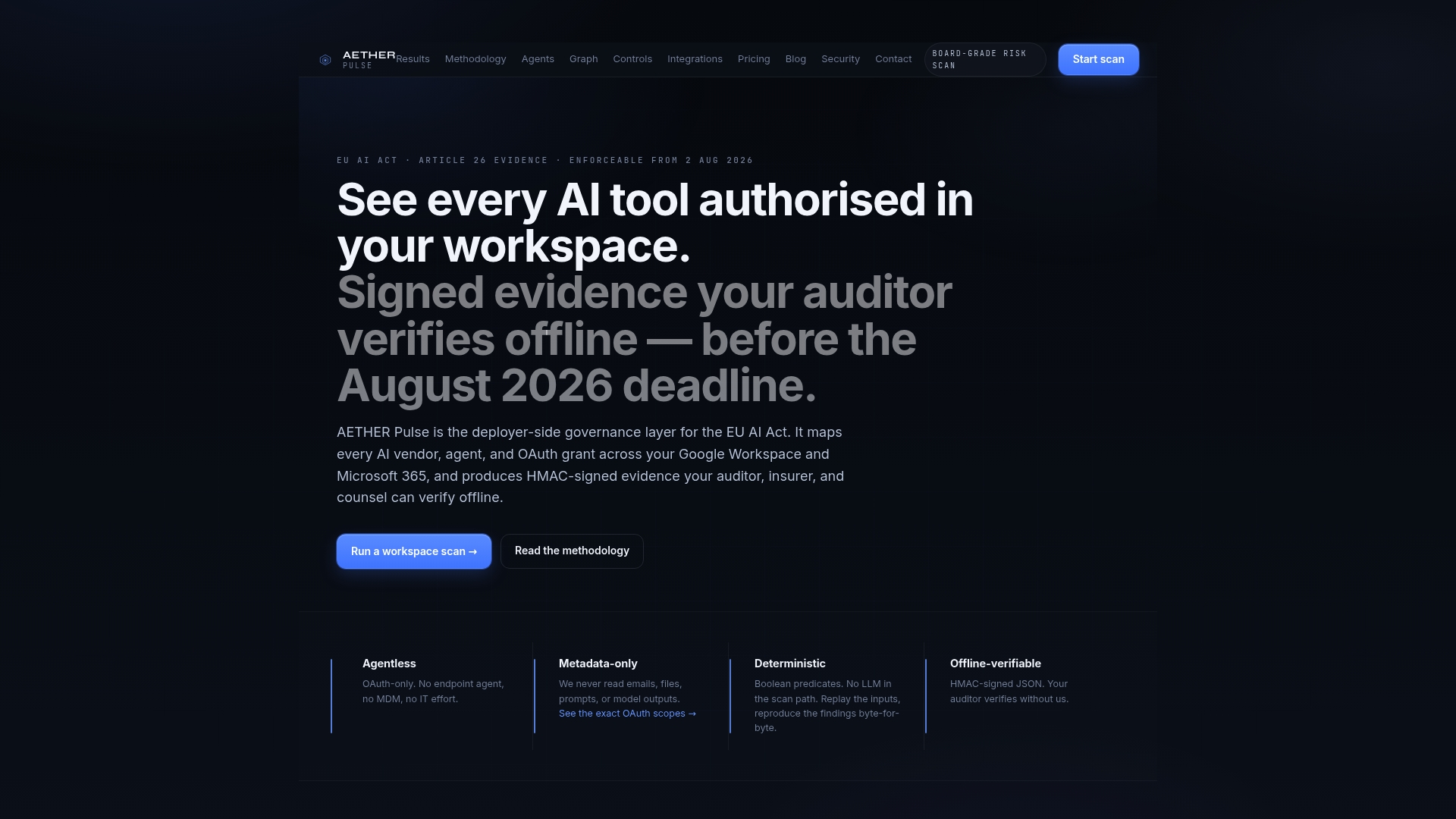
For firms working through the ISMS control mapping for financial services, Aetherpulse fills a specific gap: turning log retention, oversight charters, and provider notification records into audit-ready output without a separate manual compilation exercise every time a regulator asks. Use cases include maintaining the six-month log retention floor with tamper-evident timestamps, documenting human oversight authority for audit interviews, and keeping a defensible record of provider contact during incident notification.
If your evidence pack currently lives across spreadsheets, email threads, and a shared drive, request a demo at Aetherpulse to see how a read-only metadata layer can consolidate that evidence into something you would actually want to hand a regulator.
Where to Read the Original Article 26 Text
For the authoritative clause language, consult the AI Act Service Desk's Article 26 entry and the consolidated EU AI Act text. For deeper analysis of provider/deployer boundaries and governance design, the SSRN working paper on deployer obligations offers the most rigorous treatment currently available. A sector-specific primer on what deployers must actually do rounds out the practical side.
Sources
- Article 26: Obligations of deployers of high-risk AI systems | AI Act Service Desk
- Article 26: Obligations of Deployers of High-Risk AI Systems
- Deployer Obligations under the EU AI Act: Article 26, Provider Boundaries, and Governance Architecture
- Article 26: Obligations of deployers of high-risk AI systems — AI Act
Recommended
Working on Article 26 readiness, deployer-side governance evidence, or AI agent risk at a regulated firm? We'd value 15 minutes of your perspective.
Start a conversation