AI Oversight Evidence Requirements Explained for Risk Leaders
AI Oversight Evidence Requirements Explained for Risk Leaders

AI oversight evidence is defined as the set of tangible, verifiable artifacts that prove humans competently monitor, intervene in, and control AI systems as required by regulations such as EU AI Act Article 26. For compliance and risk management professionals, understanding ai oversight evidence requirements explained in regulatory terms means moving well beyond written policies. Regulators expect concrete records: intervention logs, training documentation, override trails, and cryptographically verifiable audit packs. Frameworks including the NIST AI Risk Management Framework, ISACA guidance, and the EU AI Act all converge on the same standard. Evidence must prove that oversight actually happened, not merely that a governance policy exists.
What types of evidence are required to demonstrate AI oversight?
Effective human oversight evidence requires concrete artifacts such as routing rules, intervention logs, reviewer logs, and system-specific training documentation. Regulators do not accept policy statements as proof. They require records showing that named humans had the authority, competence, and opportunity to intervene in AI decisions.
The concept of external reasoning faithfulness is the preferred evidentiary standard over opaque model explanations. This means the evidence must show that a human reviewer received an interpretable signal from the AI system, assessed it, and either approved or overrode the output. The record of that assessment is the evidence. Internal model weights or confidence scores alone do not satisfy this standard.
Human oversight must be operational and demonstrable through named owners, training records, intervention authority, review frequency logs, overrides, exceptions, and sign-off records. Each of these is a distinct artifact category, not a single document.
Key evidence artifact types regulators expect to see include:
- Routing rules: Documentation showing which AI outputs trigger human review and under what conditions.
- Intervention logs: Timestamped records of every human review event, including the reviewer's identity and decision.
- Training records: Proof that reviewers were trained on the system's known failure modes and override procedures.
- Override and exception logs: Records of every instance where a human rejected or modified an AI output.
- Sign-off records: Formal approvals confirming periodic review of AI system behavior and risk classification.
- Vendor documentation: Supplier-provided technical specifications confirming the system operates within its intended use.
Pro Tip: Map each artifact type to a specific regulatory requirement before an audit. A one-to-one mapping between your evidence file and the relevant Article 26 obligation removes ambiguity for auditors and shortens review cycles.
Organizations must document evidence proving that human reviewers received training on failure modes and intervention criteria. Training records are not a formality. They are the proof that the human in the loop was qualified to exercise meaningful control.

Why tamper-proof logs alone do not satisfy oversight evidence requirements
Tamper-proof logs are necessary but not sufficient for regulatory compliance. Log integrity tells you a record is intact. Answerability tells you the record contains the legal fact a regulator needs to find. These are two entirely different properties, and conflating them is one of the most common compliance failures in AI governance programs.
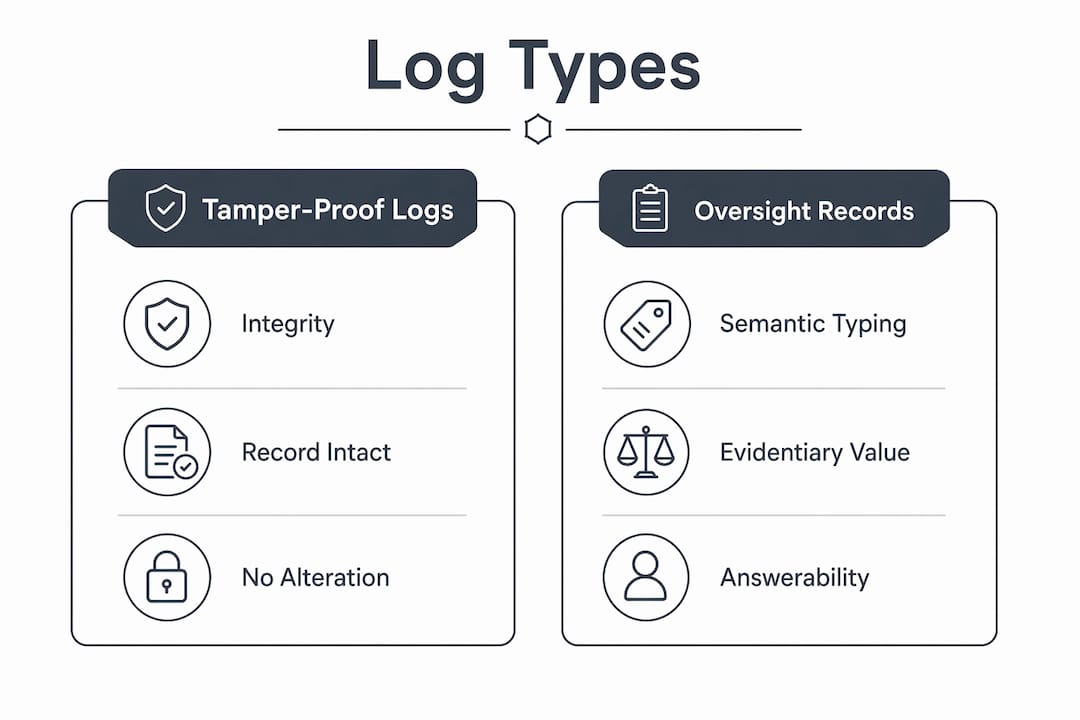
A cryptographically signed log proves that no one altered the record after it was written. It does not prove that an oversight intervention occurred, that the reviewer had valid authority, or that the AI output was assessed against the correct criteria. Regulators conducting audits under the EU AI Act or FCA SYSC requirements ask specific questions. The evidence must answer those questions directly.
| Characteristic | Traditional tamper-proof log | Semantically typed oversight record |
|---|---|---|
| Integrity guarantee | Yes, cryptographic | Yes, cryptographic |
| Maps event to legal category | No | Yes |
| Identifies named oversight owner | Rarely | Required field |
| Supports regulatory query response | Limited | Designed for it |
| Proves intervention occurred | No | Yes, with authority reference |
| Audit defensibility | Low to moderate | High |
A common compliance trap is confusing log integrity with evidentiary answerability. Strongly typed semantic records that map technical events to legal categories are necessary for audit defensibility. The record must state not just that an event occurred, but what legal fact that event constitutes.
Cryptographic proof structures such as Merkle tree anchoring and zero-knowledge proofs enable legally meaningful, third-party verifiable evidence of AI operational events without centralized infrastructure trust. A signed Merkle root encodes a complete, verifiable audit trail independent of any single system's trustworthiness. This approach moves evidence from "we kept a log" to "we can prove what happened."
Pro Tip: Before your next audit, test your logs against a sample regulatory query. Ask: "Can this record prove that a named, qualified human reviewed this specific AI output on this date and made this decision?" If the answer requires manual reconstruction, your evidence layer needs semantic typing.
How does continuous AI assurance support oversight evidence?
AI assurance is evolving into a continuous, operating discipline that produces evidentiary records supporting governance verification and risk underwriting. The analogy to cyber insurance telemetry is precise. Just as insurers require ongoing network monitoring data rather than a single annual penetration test, regulators increasingly expect continuous evidence loops rather than point-in-time audit snapshots.
AI governance sets policies defining accountability and thresholds, while AI assurance collects continuous technical evidence proving governance is effective in practice. This distinction matters for compliance officers. Governance without assurance is a policy document. Assurance without governance is data without meaning. Both are required, and the evidence layer connects them.
AI assurance must integrate directly into enterprise control environments to prioritize verifiability over mechanistic transparency. This means embedding evidence collection into existing risk and control frameworks rather than treating it as a separate compliance exercise.
Practical approaches for embedding continuous assurance into organizational processes include:
- Automated evidence capture: Configure AI systems to write structured oversight events to a governed evidence store at the point of each human review, not retrospectively.
- Periodic attestation cycles: Schedule formal sign-off reviews at defined intervals, with records tied to the specific AI system version and risk classification in effect at that time.
- Incident integration: Route AI-related incidents through the same evidence file as routine oversight logs, creating a single traceable record of system behavior over time.
- Control testing: Include AI oversight controls in internal audit scope, testing whether evidence artifacts are complete, semantically typed, and retrievable on demand.
The ai oversight continuous monitoring model treats evidence as a living record, not a pre-audit collection exercise. Systems that generate evidence continuously are audit-ready at any point, which is the standard regulators are moving toward.
Practical steps to assemble defensible AI oversight documentation
Audit failures most often originate from fragmented evidence management. Maintaining a single controlled evidence file per AI system that connects inventory, risk decision, vendor documents, assigned ownership, oversight logs, and incident processes is the recognized best practice for traceable audit readiness.
The following steps build a defensible evidence file for each AI system in scope:
- Register the system. Create a system record that includes the AI system's name, version, deployment date, risk classification under the EU AI Act or equivalent framework, and the business function it supports.
- Assign a named oversight owner. Document the individual responsible for human oversight, their role, their authority to intervene, and the date of their appointment. Update this record whenever ownership changes.
- Record competence evidence. Attach training completion records showing the oversight owner was trained on the system's failure modes, intervention criteria, and escalation procedures.
- Maintain operational logs. Capture every review event with a timestamp, reviewer identity, AI output reviewed, decision taken, and any override or exception raised. These logs must be semantically typed to map each event to its legal category.
- Retain vendor documentation. Store supplier-provided technical specifications, intended use statements, and change notifications. These prove the system operated within its approved parameters.
- Document escalation and incident procedures. Record the process for escalating anomalous AI behavior, including who receives the alert, what authority they hold, and how the incident is logged and resolved.
- Apply cryptographic verification where required. High-risk AI systems must support automatic recording of operational events, enabling monitoring, post-market analysis, and effective human oversight with stoppable mechanisms. For these systems, HMAC-SHA256 signing or equivalent cryptographic anchoring of evidence packs provides the strongest audit defensibility.
The ai oversight attestation process is the formal step where the oversight owner signs off that the evidence file is complete, accurate, and current. Schedule attestations at least quarterly for high-risk systems, and retain each signed attestation as part of the evidence record.
Key Takeaways
Defensible AI oversight evidence requires semantically typed, continuously maintained artifacts that prove human intervention occurred, not merely that logs were kept.
| Point | Details |
|---|---|
| Evidence over policy | Regulators require concrete artifacts, not written governance statements, to prove AI oversight. |
| Semantic typing is required | Tamper-proof logs must map technical events to legal categories to answer regulatory queries. |
| Continuous assurance wins | Point-in-time audits are giving way to ongoing evidence loops modeled on cyber insurance telemetry. |
| Single controlled evidence file | Linking inventory, ownership, logs, and incidents in one file is the recognized best practice for audit readiness. |
| Cryptographic verification | HMAC-SHA256 signing and Merkle tree anchoring provide the strongest third-party verifiable evidence for high-risk systems. |
The evidence gap most compliance programs still haven't closed
The most persistent problem I see in regulated firms is not a lack of governance documentation. It is the assumption that documentation equals evidence. A policy stating "humans review all AI credit decisions" is not evidence that any human ever reviewed a specific decision. That distinction sounds obvious written down. It is routinely missed in practice.
The firms that pass AI oversight audits cleanly share one characteristic: they treat evidence as an operational output, not a compliance artifact assembled before an audit. Their oversight logs exist because the process generates them automatically. Their training records exist because competence is a condition of the oversight role, not a box checked at onboarding. Their evidence files are current because they are maintained continuously, not reconstructed from email threads and spreadsheets.
The regulatory direction is clear. The EU AI Act, FCA Consumer Duty, and the ICO's developing code of practice on automated decision-making all point toward verifiable, continuous, semantically meaningful evidence. Firms that build their evidence layer now, before enforcement pressure arrives, will find audits manageable. Firms that wait will find themselves reconstructing evidence under scrutiny, which is the worst possible position.
The ai oversight maturity model I would advocate for has three levels: policy existence, operational evidence, and continuous verifiable assurance. Most regulated firms are at level one. The regulatory expectation is moving to level three.
— Eleye
How Aetherpulse supports AI oversight evidence and audit readiness
Compliance officers managing AI oversight evidence programs need a governance layer that generates defensible artifacts without touching production systems or customer data.
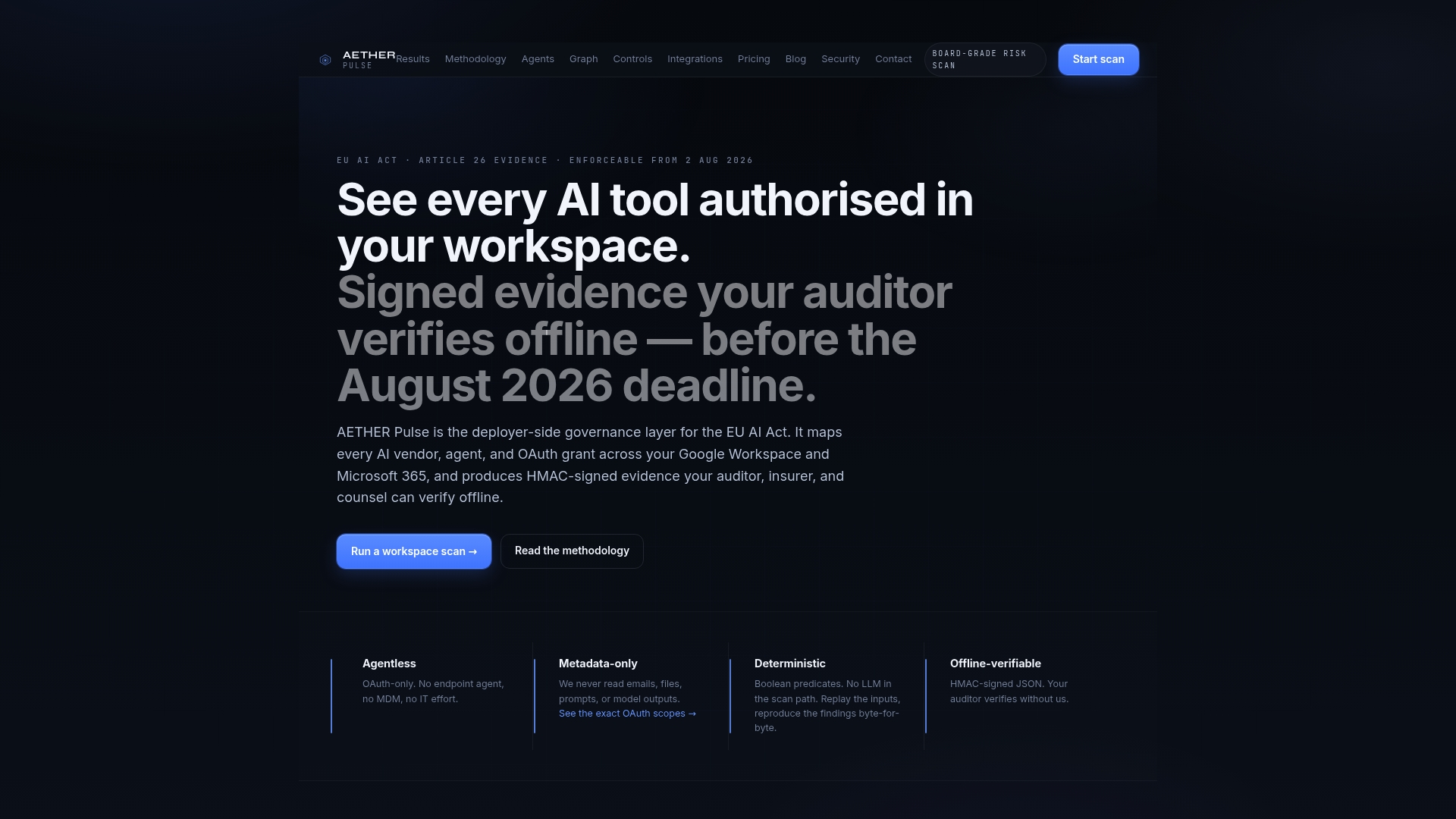
Aetherpulse is built precisely for this requirement. The platform connects via OAuth metadata only, builds an inventory and identity graph of an organization's AI agents, and generates tamper-evident, HMAC-SHA256-signed evidence packs on demand. It aligns with EU AI Act Article 26, FCA SYSC requirements, and the ICO's developing code of practice. Aetherpulse surfaces risk concentration, tracks oversight ownership, and produces provenance-tracked evidence that auditors and regulators can verify without requiring access to underlying systems. For regulated financial services firms, it is the audit-ready evidence layer that continuous assurance programs require.
FAQ
What is AI oversight evidence?
AI oversight evidence is the set of tangible artifacts, including intervention logs, training records, override trails, and signed audit packs, that prove humans effectively monitored and controlled an AI system. Regulators require these records to confirm that oversight was operational, not merely documented in policy.
Why are tamper-proof logs not enough for AI oversight audits?
Tamper-proof logs confirm a record was not altered, but they do not prove that a legally relevant oversight event occurred. Regulators require semantically typed records that map each technical event to a specific legal category, such as a named human intervention with verified authority.
What does continuous AI assurance mean in practice?
Continuous AI assurance means generating oversight evidence as an ongoing operational output rather than assembling records before an audit. It involves automated evidence capture, periodic attestation cycles, and integration of AI oversight controls into existing enterprise risk frameworks.
What is the AI oversight attestation process?
The attestation process is the formal sign-off by a named oversight owner confirming that the evidence file for a specific AI system is complete, accurate, and current. Attestations should be scheduled at least quarterly for high-risk systems and retained as part of the permanent evidence record.
How does the EU AI Act define human oversight evidence requirements?
EU AI Act Article 26 requires deployers of high-risk AI systems to assign human oversight to individuals with the competence, authority, and training to interpret and override AI outputs. Evidence must demonstrate that these conditions were met in practice, with operational logs and training records as the primary artifacts.
Recommended
Working on Article 26 readiness, deployer-side governance evidence, or AI agent risk at a regulated firm? We'd value 15 minutes of your perspective.
Start a conversation