Types of Automated Decision Oversight Controls, Explained
Types of Automated Decision Oversight Controls, Explained

Automated decision oversight controls fall into four families: design and technical controls built into the model itself, runtime process controls that govern how humans intervene while a decision is being made, governance controls that define who has authority and how that authority is trained and documented, and monitoring and audit controls that generate the evidence proving the other three actually work. The governing rule is proportionality: the control mix should scale with how much autonomy the system has and how severe the consequences of a wrong decision would be.
That framing matters because most oversight failures do not stem from having zero controls. They stem from applying the wrong controls, at the wrong intensity, to systems that have quietly outgrown them.
- Design and technical controls: interpretable models, explainability layers, confidence scoring, logging, and provenance capture built into the system architecture.
- Runtime process controls: pre-authorization gates, live intervention interfaces, and stop-go authority exercised while a decision is live.
- Governance controls: assigned operator authority, documented standard operating procedures, training curricula, and data protection impact assessments.
- Monitoring and audit controls: intervention success rate, detection latency, override frequency, and tamper-evident evidence trails.
A practitioner-centered framework for evaluating oversight sufficiency assesses five dimensions across autonomy levels: observability, intervention capability, timeliness, accountability, and adaptability. A system rated insufficient on any one dimension is, by that framework's logic, insufficiently overseen regardless of how the other four score. That is the standard risk and compliance teams should be building toward, not a checklist of "human in the loop, box checked."
Key Takeaways
Automated decision oversight works only when technical, process, governance, and monitoring controls are matched to autonomy and consequence, and backed by measurable, verifiable evidence.
| Point | Details |
|---|---|
| Four control families | Match technical, process, governance, and monitoring controls to autonomy level and consequence severity. |
| Oversight mode selection | Use pre-authorization for irreversible actions, runtime intervention for moderate risk, post-hoc review for high-volume low-risk decisions. |
| Meaningful over nominal | Oversight only counts when operators have intervention ability, information access, real agency, and proper training. |
| Metrics prove the claim | Track intervention success rate, detection latency, and override frequency rather than asserting oversight exists. |
| Agentless evidence layer | Aetherpulse generates signed, tamper-evident evidence packs from metadata alone, supporting the monitoring and audit control family without touching customer data. |
Table of Contents
- What Are the Types of Automated Decision Oversight Controls?
- Which Technical Controls Actually Prove Oversight Works?
- How Should Process Controls Govern When Humans Step In?
- What Governance Controls Turn Oversight From Theater Into Evidence?
- Which Metrics Prove Oversight Is Actually Working?
- How Do You Match Controls to Risk Tier in Practice?
- How Agentless Evidence Layers Support Oversight Without Touching Customer Data
- What Limits Current Oversight Controls, Even When Well Designed?
- What Regulatory Frameworks Should Shape Your Oversight Design?
- How Do You Integrate Oversight Controls Without Disrupting Existing Systems?
- What Should You Prioritize in the Next Quarter?
- How Aetherpulse Fits Into Your Oversight Program
- Sources
What Are the Types of Automated Decision Oversight Controls?
The regulatory literature on human oversight, including guidance published by the European Data Protection Supervisor, converges on a small number of oversight postures. Understanding the taxonomy first prevents the common mistake of picking a control because it is familiar rather than because it fits the system's actual autonomy profile.
Human-in-the-loop (HITL) requires a person to approve a decision before it takes effect. Nothing executes without a human touch, which makes HITL the right posture for irreversible, high-consequence actions such as large fund transfers, credit line changes, or account terminations. Its cost is throughput: HITL does not scale to high-volume, low-stakes decisions without becoming a bottleneck that operators start rubber-stamping to keep pace, which defeats the purpose entirely.
Human-on-the-loop (HOTL) lets the system act autonomously while a human monitors output and can intervene after the fact or pause the pipeline. This is the workhorse posture for moderate-risk, moderate-volume decision streams, such as transaction monitoring alerts or automated pricing adjustments, where full pre-authorization would be operationally impossible but unsupervised autonomy would be reckless.
Human-command and human-in-command describe governance postures rather than moment-to-moment mechanics. Human-command means a person sets the objectives and constraints the system operates within but does not review individual outputs. Human-in-command sits above the whole architecture: a designated accountable person retains ultimate authority to disable or override the system regardless of how it is normally operated, satisfying the accountability dimension even when day-to-day oversight is automated.
Here is how design-time and process-time controls typically divide:
- Interpretable-by-design models: choosing decision trees, scorecards, or rule-based logic over opaque architectures when the decision is high-stakes and the performance gap is small enough to justify the trade-off.
- Explainable AI (XAI) layers: bolting local-explanation techniques onto a model that must remain complex for performance reasons.
- Confidence and uncertainty scoring: flagging low-confidence outputs for mandatory human review rather than treating every output as equally trustworthy.
- Circuit breakers and kill switches: automated or manual triggers that halt a decision pipeline when error rates, drift, or anomaly counts cross a threshold.
- Runtime intervention interfaces: dashboards and alerting that give an operator enough context to act within the available time window, not just a log entry after the fact.
The choice between these families should follow one question: if this specific decision goes wrong, how fast does it go wrong, and how hard is it to undo? Slow, reversible errors tolerate HOTL and post-hoc review. Fast, irreversible errors demand pre-authorization or a circuit breaker, full stop.
Which Technical Controls Actually Prove Oversight Works?
Technical controls are the substrate everything else runs on. Get them wrong and governance policies become paperwork that nobody can verify against reality.
Explainability techniques split into two practical categories. Local explanation methods (SHAP, LIME-style attribution) show which input features drove a specific output, useful when an operator needs to justify a single decision to a customer or regulator. Counterfactual explanations show what would need to change for the outcome to differ, which tends to be more useful for the person affected by the decision than for the operator overseeing it. EDPS guidance notes that these techniques improve interpretability but do not eliminate the need for layered observability. A model that explains itself poorly still needs a human who can see enough surrounding context to catch a bad call, explanation or not.
Observability design determines what you can actually prove happened. At minimum, a defensible logging architecture captures the input the model received, the output it produced, the confidence or uncertainty score attached to that output, the version of the model in production at that moment, and the identity of any human who reviewed or overrode it. Skip any one of those fields and you have a log, not evidence. A developer-facing guide to AI output observability breaks down how engineering teams typically structure this capture layer without adding meaningful latency to the decision path.
Confidence scores and rationale metadata change what the operator is actually reviewing. Without a confidence signal, an operator reviewing 200 flagged transactions a day has no way to triage; every case looks the same. With a calibrated score, low-confidence outputs route to senior review while high-confidence outputs clear faster, which is how oversight scales without either drowning operators or rubber-stamping everything.
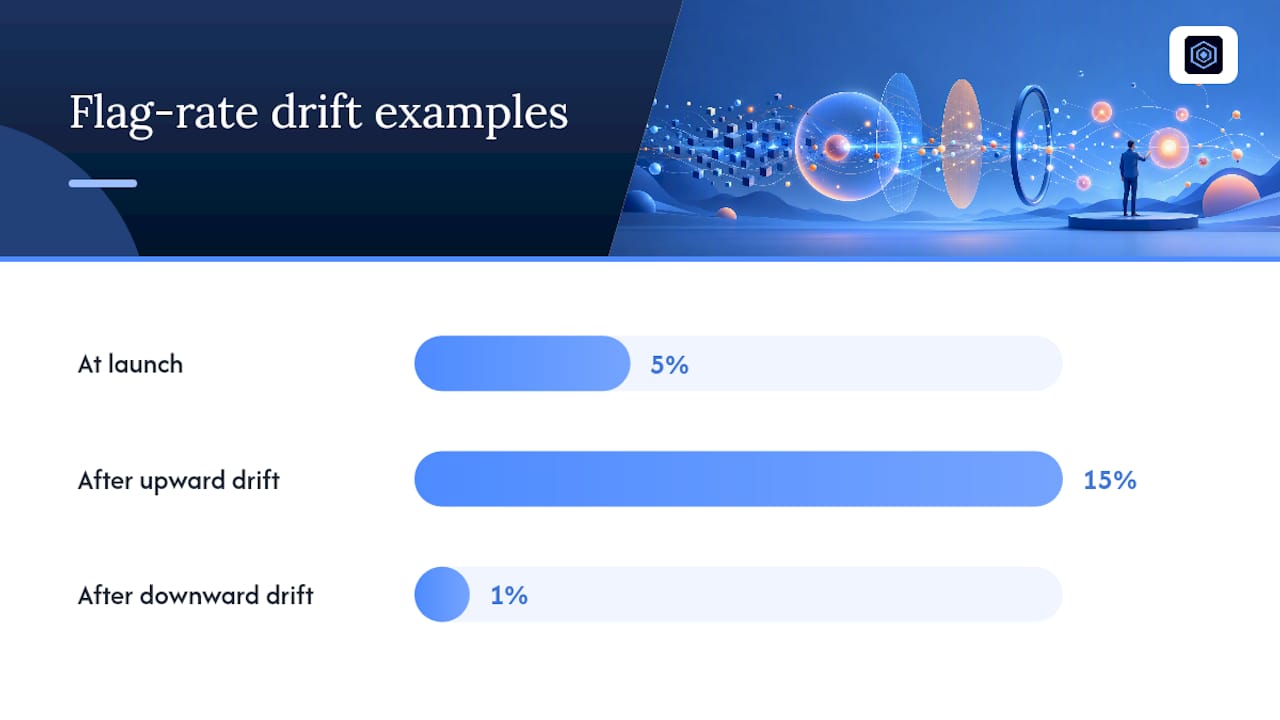
Pro Tip: Don't calibrate confidence thresholds once and forget them. Model drift shifts the distribution of confidence scores over time, so a threshold that flagged 5% of decisions for review at launch can silently flag 15% or 1% a year later. Recalibrate quarterly against a labeled sample, not against the model's own internal metric.
Tamper-evident evidence closes the loop between "we have controls" and "we can prove we have controls." A log that anyone with database access can edit is not evidence in any audit sense; it is a claim. Cryptographically signed artifacts, of the kind produced by agentless, metadata-only evidence layers, give an auditor something they can verify independently rather than something they have to trust on the compliance team's word.
Performance trade-offs are real and worth naming plainly. Explanation generation adds latency; storing full provenance at scale adds storage and query cost; runtime intervention interfaces that require a human response within a fixed window impose a staffing cost that grows with decision volume. The mitigation is not to skip these controls but to scope them: apply the expensive, high-latency controls to the decision tiers where consequence justifies the cost, and use lighter-weight sampling and post-hoc review everywhere else.
- Local explanations for individual-decision disputes and regulatory inquiries.
- Confidence scoring to triage review volume, not to replace review entirely.
- Signed, tamper-evident logs for anything that could end up in front of a regulator.
- Circuit breakers scoped to the specific failure modes that matter for that system, not generic error thresholds.
How Should Process Controls Govern When Humans Step In?
Technical controls create the signal. Process controls determine whether a human actually acts on it in time to matter, which is where a lot of oversight programs quietly fail.
Pre-authorization requires explicit human sign-off before an action executes. It is the correct mode for irreversible, high-consequence, or externally visible actions: releasing a large payment, denying a credit application above a threshold, or closing an account for suspected fraud. The COMPEL framework's reading of AI Act Article 14 treats pre-authorization as one of four distinct oversight modes, each with its own signal and latency requirements rather than a single generic "human review" bucket.

Runtime intervention lets the system act while a human monitors and can interrupt it mid-process. This mode lives or dies on interface design. An operator given a raw log stream cannot intervene meaningfully; an operator given a dashboard that surfaces the decision, its confidence score, and a one-click override within the actual decision window can. The EDPS guidance's operational recommendation is blunt on this point: test the interface with real assessors before deployment to find out how much time they actually need to intervene, then design the latency budget around that number, not around what engineering finds convenient.
Post-hoc review samples completed decisions after the fact rather than reviewing every one in real time. This is where volume-heavy, lower-consequence decision streams belong. The design question is sampling strategy: random sampling catches systemic drift but misses targeted edge cases, so most mature programs pair a random sample with rules-based escalation that pulls in any decision matching known risk patterns (large dollar amounts, protected-characteristic proxies, low-confidence scores) for guaranteed review.
Stop-go authority is the organizational backstop: a named person or committee with the standing power to halt a decision pipeline entirely, independent of the system's normal operating cadence. This authority needs a change-control process behind it, because a stop-go decision that is not documented and does not trigger a defined remediation path is just a pause button, not oversight.
- Classify the action type first: irreversible versus reversible, internal versus externally visible.
- Assign the oversight mode that matches that classification, not the mode that is easiest to build.
- Set a concrete latency and information budget for that mode and test it with real operators.
- Define the escalation path for anything flagged in runtime or post-hoc review.
- Document who holds stop-go authority and what triggers its use.
That sequencing matters more than any single control choice. A well-built intervention interface attached to the wrong oversight mode is still the wrong control.
- Pre-authorization for anything irreversible or externally visible.
- Runtime intervention for moderate-consequence, moderate-volume streams with a defined response window.
- Post-hoc review for high-volume, lower-consequence decisions, with escalation rules layered on top of random sampling.
- Stop-go authority as a named, documented power, not an assumed one.
What Governance Controls Turn Oversight From Theater Into Evidence?
The gap between nominal oversight and meaningful oversight is where most audit findings land. Guidance from the EDPS on human oversight of automated decision-making sets out four conditions for oversight to count as meaningful: the operator must be able to intervene, must have access to the information needed to evaluate the decision, must have genuine agency to overrule the system, and must act with appropriate training and intent. Miss any one of those and you have a person sitting next to an automated system, not a person overseeing it.
Assigning authority on paper is not the same as assigning it in practice. An operator who can technically click "override" but whose performance is measured on how many decisions they process per hour will learn, quickly, that overriding costs them more than approving does. That incentive misalignment is the most common cause of override rates near zero on systems that clearly should be generating some disagreement.
Training curricula need to target a specific failure mode: automation bias, the tendency to defer to a system's output simply because it is a system's output. Effective training does not just explain how the model works; it walks operators through cases where the model was confidently wrong, so they build the interpretive habit of treating a high confidence score as one input rather than a verdict.
Documentation carries real audit weight. A data protection impact assessment (DPIA) that names the oversight mode, the operator's authority, and the training regime for a given system gives a regulator something concrete to test against. A governance operating model built for regulated financial services firms typically ties DPIA content directly to the SOPs operators actually follow, so the paperwork and the practice do not drift apart over time.
Pro Tip: Ask any operator who has stop authority to describe, in their own words, the last time they used it. If they cannot recall a single instance, that authority is nominal, not meaningful, regardless of what the policy document says.
- Tie operator incentives to override quality, not override rate alone.
- Train against confident-but-wrong cases, not just system mechanics.
- Keep DPIAs and SOPs in sync rather than treating them as separate compliance artifacts.
- Audit stop-go authority for actual use, not just documented existence.
Which Metrics Prove Oversight Is Actually Working?
A control you cannot measure is a claim, not a control. The oversight sufficiency framework built for production AI systems ties its five qualitative dimensions to measurable proxies, which is what lets compliance teams move from "we believe this is overseen" to "here is the evidence."
| Metric | What it measures |
|---|---|
| Intervention success rate | Share of flagged decisions where human review changed or blocked the outcome |
| Detection latency | Time between a decision occurring and a human or system detecting an issue with it |
| Override frequency | Rate at which operators disagree with the automated output |
| False positive/negative rate | Accuracy of the flagging logic that routes decisions to human review |
| Evidence-pack completeness | Proportion of decisions with a full, signed audit trail available on demand |
A consultation paper on meaningful human intervention recommends tracking assessor override rates over time and running mystery-shop style controlled tests, deliberately feeding edge cases into the system to see whether the oversight process catches them. This matters because a static override rate can mean two very different things: operators agreeing because the system is genuinely reliable, or operators agreeing because they have stopped actually reviewing.
Testing methodology should include red-team exercises that deliberately probe for failure modes the model was not trained to handle, backtesting against historical decisions where the ground truth is now known, and drift detection that flags when the input distribution has shifted enough to make the original oversight calibration stale. Set explicit thresholds for each. A detection latency that creeps from four hours to four days is not a metric quietly degrading; it is an oversight control failing in slow motion.
Dashboard and reporting design for compliance committees should surface these metrics against their thresholds, not just as raw numbers. A set of reporting metrics examples built for regulated firms shows what this looks like in practice: trend lines against defined tolerance bands, not static snapshots that tell a committee nothing about direction.
How Do You Match Controls to Risk Tier in Practice?
Oversight design gets simpler once you stop asking "what controls should we have" and start asking "what does this specific action's risk tier require." The Article 14 oversight mode framework treats this mapping exercise as the actual design task, not a preliminary step before the real work begins.
- Classify the action by consequence severity (reversible, minor financial impact versus irreversible, externally visible) and by autonomy level (fully automated, human-assisted, human-gated).
- Assign the minimum control set per tier: high-consequence, high-autonomy actions need pre-authorization plus signed evidence capture; moderate tiers need runtime intervention with a defined latency SLA; low-consequence, high-volume tiers need post-hoc sampling with escalation rules.
- Set concrete SLAs, not aspirational ones. If runtime intervention requires an operator response within 90 seconds, staff and interface design need to actually support that window, tested with real operators.
- Sequence the build: quick wins first, deeper investment second.
| Investment horizon | Typical actions |
|---|---|
| Quick win (weeks) | Add confidence scoring to existing outputs; define escalation rules for post-hoc sampling |
| Mid-term (one quarter) | Build or procure a runtime intervention interface with tested latency budgets |
| Long-term (two or more quarters) | Deploy signed, tamper-evident evidence capture across the full decision inventory |
A short roadmap for a compliance team starting from a low baseline typically looks like: inventory every automated decision system in production first, classify each by consequence and autonomy, retrofit confidence scoring and basic logging onto the highest-risk tier within the first quarter, then extend signed evidence capture outward as budget allows. A change management guide for production AI models covers how to keep this roadmap synchronized with version changes, since a model update that changes decision logic without updating the oversight mapping is one of the more common ways controls quietly go stale.
How Agentless Evidence Layers Support Oversight Without Touching Customer Data
Most governance tooling on the market requires an agent inside the decision pipeline, or direct access to the data the model touches, to generate evidence. That access requirement is itself a risk for a regulated firm: every integration point is another thing to secure, audit, and explain to a data protection officer.
An agentless, metadata-only approach sidesteps that trade-off. Rather than sitting inside the decision flow, it connects through OAuth metadata, builds an inventory and identity graph of the AI agents operating across the firm, and surfaces risk concentration, including where a cluster of agents creates outsized financial exposure if one goes wrong, without ever touching the underlying customer data those agents process. A compliance guide to AI governance without data access walks through why this integration pattern matters specifically for firms that cannot risk a governance tool becoming its own data exposure incident.
The output that matters most to an auditor is the evidence pack itself.
Evidence that a regulator can independently verify, rather than evidence the compliance team simply asserts, is the difference between an audit that closes quickly and one that drags into months of follow-up requests. Cryptographically signed, tamper-evident artifacts give an auditor exactly that: a record they can check against a signature rather than take on trust.
This is where AETHER Pulse fits the taxonomy described throughout this article. It does not replace runtime intervention interfaces or governance training. It sits in the monitoring and audit family, generating the deterministic, provenance-tracked evidence that proves the other three control families, technical, process, and governance, are actually functioning as documented.
- Metadata-only ingestion means no agent inside the decision pipeline and no customer data exposure.
- HMAC-SHA256 signed evidence packs give auditors an artifact they can verify independently.
- Risk concentration mapping surfaces financial blast-radius exposure across an agent inventory before a regulator has to ask about it.
What Limits Current Oversight Controls, Even When Well Designed?
Even a well-built control mix has real limits worth naming plainly, because pretending otherwise sets up compliance teams for uncomfortable audit conversations later.
Explainability techniques degrade as models get more complex. A SHAP value on a deep ensemble model tells an operator which features mattered statistically, not necessarily why the model weighted them that way, which leaves a real interpretability gap for genuinely opaque architectures.
Operator fatigue is a structural problem, not a training problem. An operator reviewing hundreds of flagged decisions a day will, over time, revert to pattern-matching on confidence scores rather than substantively evaluating each case, which is exactly the automation bias oversight is supposed to prevent.
Latency and volume trade-offs do not disappear with better engineering; they shift. A faster intervention interface still needs a human available to use it, and staffing that availability at scale is an ongoing operational cost, not a one-time build.
Cross-border and cross-framework inconsistency adds friction for firms operating in multiple jurisdictions, where the EU AI Act's oversight mode language, UK FCA expectations, and other regimes do not map onto identical control definitions, forcing compliance teams to maintain a translation layer between frameworks. And evidence quality varies enormously across tools: a log is not an audit trail, and a dashboard is not proof, regardless of how each is marketed.
What Regulatory Frameworks Should Shape Your Oversight Design?
Oversight controls do not exist in a vacuum. They exist to satisfy specific regulatory obligations, and the strongest programs design backward from those obligations rather than building generic controls and hoping they fit.
The EU AI Act's Article 14 requirements for human oversight, as read through frameworks like COMPEL, set the clearest structural template: four oversight modes, each with defined signal and latency requirements, mapped to specific action types. Firms building for this framework should design their oversight mode assignment first and their technical controls second.
Firms operating in the UK financial services market face a parallel set of obligations under FCA SYSC governance rules and the Consumer Duty, both of which expect firms to evidence that automated decisions serving retail customers produce good outcomes, not just compliant ones on paper. The evidentiary bar here leans heavily on documentation: DPIAs, SOPs, and training records that a supervisor can request and review.
Data protection guidance, including the EDPS's conditions for meaningful human oversight, sits underneath both of these regimes and applies regardless of sector: intervention ability, access to information, operator agency, and appropriate training and intent. Any control mix that satisfies those four conditions will generally satisfy the sector-specific overlays with targeted additions, not a redesign.
How Do You Integrate Oversight Controls Without Disrupting Existing Systems?
The best-designed oversight control fails if it requires ripping out production systems to deploy. Integration strategy matters as much as control selection.
Start with what already exists. Most firms have some logging, some approval workflows, and some governance documentation; the gap is usually completeness and connection between the pieces, not a total absence. Map existing infrastructure against the four control families before building anything new, so investment goes toward genuine gaps rather than duplicating what a legacy system already half does.
Prefer read-only, metadata-based integration wherever the goal is evidence and inventory rather than active intervention. Adding an agent to every decision pipeline to gather oversight data multiplies the attack surface and the audit burden; a metadata layer avoids both while still answering "what agents do we have, and what could go wrong" for the risk committee.
Sequence governance changes with technical ones. A governance operating model that assigns clear authority before the technical monitoring layer goes live tends to produce cleaner adoption than the reverse order, because operators know what they are accountable for before the dashboard starts generating alerts they are expected to act on.
Build the evidence layer to serve existing audit and risk committee cadences rather than creating a parallel reporting track. If the risk committee already meets quarterly, oversight metrics should land in that existing meeting with existing reporting formats, not spin up a new process operators have to learn separately.
What Should You Prioritize in the Next Quarter?
Every automated decision oversight control that gets built without a measurement attached to it eventually becomes a compliance liability rather than a compliance asset.
Most oversight programs get the sequencing backward. They start with governance documentation, a policy stating that humans oversee automated decisions, and only later discover that no technical infrastructure exists to make that oversight observable, let alone measurable. That order should flip. Build the observability and logging layer first, because without it, every governance claim downstream is unverifiable by definition.
The conventional advice to "add human review" for high-risk automated decisions is not wrong, but it is incomplete to the point of being misleading. Review without the four conditions the EDPS lays out, genuine intervention ability, real information access, actual agency, and proper training, is not oversight. It is a signature on a document that will not survive serious regulatory scrutiny.
If there is one thing worth prioritizing above all else, it is this: pick the two or three metrics from the oversight sufficiency framework that map to your highest-risk system, start measuring them this quarter, and let the gaps that measurement reveals dictate where you invest next. Measurement first, governance narrative second, is the reverse of how most programs are built, and it is the order that actually survives an audit.
— Eleye
How Aetherpulse Fits Into Your Oversight Program
Everything in this article points toward the same conclusion: oversight controls only count if they produce evidence a regulator can independently verify, and most governance tools cannot generate that evidence without inserting an agent into your decision pipeline or touching the customer data those decisions run on.

Aetherpulse takes the opposite approach. It connects through OAuth metadata only, builds a full inventory and identity graph of the AI agents operating across your firm, and surfaces risk concentration, including where financial blast-radius exposure is quietly stacking up, without ever accessing the sensitive data those agents process. That matters for regulated firms specifically, because every agent-based governance tool is itself a new data exposure risk to secure, document, and explain to your own DPO. Aetherpulse produces evidence packs that are cryptographically signed with HMAC-SHA256, tamper-evident, and structured against EU AI Act Article 26, the Data (Use and Access) Act, FCA SYSC, Consumer Duty, and ICO expectations, ready to hand to an auditor rather than assembled under deadline pressure. If your firm is deploying autonomous AI agents and needs to show, not just claim, that oversight is working, request a demo of AETHER Pulse and see what your own agent inventory and evidence pack would actually look like. You can also review the security and evidence architecture in detail before you talk to anyone.
Sources
- Human Oversight in Production AI Systems: A Framework for Evaluating Sufficiency Across Levels of Autonomy
- TechDispatch - Human oversight of automated decision-making
- Human Oversight Design Under EU AI Act Article 14 | COMPEL Framework
- Meaningful Human Intervention (consultation paper)
Recommended
- The Difference Between AI Governance and AI Oversight, and Why It Matters for Compliance - AETHER Pulse
- Demonstrating AI Oversight to Regulators: A Compliance Playbook - AETHER Pulse
- What Would an FCA Supervisor Expect to See? An AI Governance Evidence Checklist - AETHER Pulse
- Algorithmic Accountability: A Governance Guide for 2026
Working on Article 26 readiness, deployer-side governance evidence, or AI agent risk at a regulated firm? We'd value 15 minutes of your perspective.
Start a conversation