The Role of Compliance in AI Deployment: 2026 Guide
The Role of Compliance in AI Deployment: 2026 Guide

Compliance in AI deployment is defined as the structured process of embedding legal, ethical, and governance controls into every stage of an AI system's lifecycle, from procurement through production. Regulated industries face a sharper version of this challenge than most. Fewer than 25% of IT leaders report high confidence in managing AI governance, even as over 75% of organizations have already integrated AI into operations. That gap is where regulatory exposure lives. For compliance professionals in financial services, insurance, and healthcare, the role of compliance in AI deployment is not a back-office formality. It is the primary mechanism for demonstrating oversight to regulators, auditors, and boards.
What are the key regulatory requirements for AI compliance in 2026?
The EU AI Act is the most consequential AI regulation in force today. It draws a hard line between providers, those who build or substantially modify AI systems, and deployers, those who put third-party AI into operational use. Most regulated firms sit in the deployer category, but that position carries real obligations. Deployers must maintain logs for at least six months, implement human oversight mechanisms, and notify employees when AI systems affect their work. Failing to meet even one of these requirements creates a documented compliance gap that regulators can act on.
The deployer-to-provider boundary is a specific risk that legal teams underestimate. Deployers become providers if they substantially modify or rebrand an AI system, triggering a much heavier set of obligations. A firm that customizes a vendor's model output, repackages it under its own brand, or integrates it into a proprietary workflow may cross that line without realizing it. Contract review is the first line of defense.
The US regulatory picture is a patchwork rather than a single framework. State-level AI laws now govern employment decisions, consumer disclosures, and automated decision-making across multiple jurisdictions. Colorado, Illinois, and New York have each enacted or proposed rules that require specific notices, bias audits, and impact assessments. Compliance professionals operating across state lines must track each jurisdiction separately, because a notice that satisfies Illinois law may not satisfy Colorado's requirements.
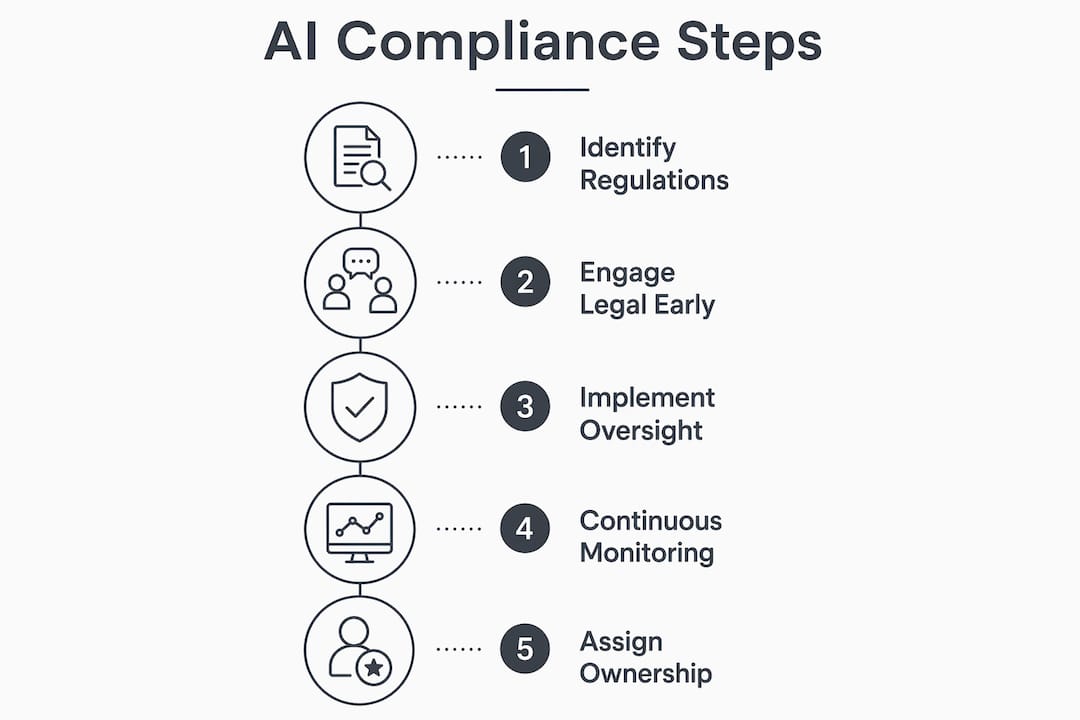
Pro Tip: Involve your legal department at the AI procurement stage, not after deployment. The role of legal in AI compliance is to identify provider-level obligations before contracts are signed, not to remediate them after a regulator inquiry.

The practical implication is that legal departments must engage early in the AI lifecycle and embed compliance guardrails such as granulated permissions, vendor vetting, and continuous monitoring from the start. Waiting until a system is live to assess regulatory fit is the single most common source of avoidable exposure.
How does AI ethics compliance connect to risk management?
Ethical AI is distinct from compliance. Compliance sets the legal floor. Ethics builds the trust that sits above it. A firm can satisfy every EU AI Act obligation and still deploy a system that produces biased credit decisions or opaque automated outcomes that erode customer confidence. What is AI ethics compliance, in practical terms? It is the commitment to fairness, transparency, accountability, and human oversight that goes beyond what any regulation currently mandates.
Risk management is the operational bridge between these two layers. Compliance guardrails define what you must not do. Risk frameworks define what you should not do, even when the law permits it. The two work together when compliance teams map AI risk exposure across the same dimensions they use for credit, operational, and conduct risk: probability, severity, and blast radius. A model that affects lending decisions for thousands of customers carries a different risk profile than an internal scheduling tool, and your governance posture should reflect that difference.
Core principles that anchor both compliance and ethical AI governance include:
- Fairness: AI outputs must not systematically disadvantage protected groups.
- Transparency: Firms must be able to explain how an AI system reached a decision.
- Accountability: A named individual or function must own each AI system's governance.
- Human oversight: Automated decisions must have a defined escalation path to a human reviewer.
Organizations that conflate ethics and compliance risk defaulting to minimum legal standards and missing the trust-building work that regulators and customers increasingly expect. The FCA's Consumer Duty, for example, requires firms to demonstrate good outcomes for customers. A technically compliant AI system that produces poor outcomes still fails that test.
Pro Tip: Embed ethics by design at the model selection stage. Require vendors to provide fairness metrics, explainability documentation, and bias test results before procurement approval. This converts an abstract principle into a concrete procurement criterion.
What are the common challenges in AI compliance programs?
Low organizational confidence is the baseline problem. The fact that fewer than 25% of IT leaders feel confident in AI governance reflects a structural gap, not a knowledge gap. Most firms have policies. Few have the operational infrastructure to enforce them consistently across every AI deployment.
The most common pitfalls compliance teams encounter follow a predictable pattern:
- Conflating ethics and compliance. Treating them as identical leads to minimum-effort strategies. Ethics requires ongoing investment in fairness and transparency that compliance checklists do not capture.
- Underestimating employment AI notice requirements. Employment-AI notice regulation requires a per-tool file with bias audits, jurisdiction-specific notices, and deployment dates, all producible within 48 hours of a regulator request. Most firms are not operationally ready for that timeline.
- Ignoring the deployer-to-provider risk. Firms that modify vendor AI systems without reviewing their contracts may unknowingly assume provider-level obligations under the EU AI Act.
- Delegating governance entirely to IT. General Counsel who delegate AI governance solely to IT or operations assume significant legal risk. Senior legal accountability must remain central to the governance structure.
- Building complex policies that staff cannot follow. Most compliance failures result from staff unawareness or misapplication of policies, not from technical failures. Simple, practical guardrails outperform dense documentation every time.
Cross-functional collaboration is not optional. Compliance, legal, IT, operations, and business units each hold a piece of the AI governance picture. A compliance program that operates in isolation from the teams actually deploying AI will always be reactive and always be late.
Pro Tip: Run a tabletop exercise simulating a regulator request for your employment-AI notice file. If your team cannot produce the required documentation within 48 hours, that is your highest-priority remediation item.
What practical steps should compliance professionals take for AI governance?
In-house legal and compliance teams must maintain five foundational artifacts to achieve compliance readiness by Q3 2026. Each artifact addresses a specific regulatory obligation and doubles as audit evidence.
- AI inventory: A live register of every AI tool in use, mapped to data flows, business function, and risk classification. This is the foundation for every other artifact.
- Vendor diligence template: A standardized questionnaire covering AI-specific contractual clauses, including indemnification for model errors, data handling obligations, and notification requirements if the vendor modifies the underlying model.
- Employment-AI notice and audit posture: A per-tool file containing bias audit results, jurisdiction-specific employee notices, and deployment dates. This file must be producible within 48 hours of a regulator request.
- EU AI Act gap analysis: A structured assessment of each AI system against Article 26 deployer obligations, identifying gaps in log retention, human oversight, and employee notification.
- Formal AI governance program: A written program aligned with professional conduct standards, assigning ownership, defining escalation paths, and specifying review cadences.
Data governance is legally more significant than the AI systems themselves. An AI inventory that does not map data flows is incomplete. Regulators examining an AI deployment will look at the data pipeline before they look at the model.
Continuous monitoring closes the loop. Compliance is not a point-in-time assessment. AI systems drift, vendors update models, and regulatory requirements change. A governance program without a defined monitoring cadence and incident-reporting mechanism will fall out of date within months of deployment.
Pro Tip: Assign a named owner to each AI system in your inventory. Ownership without a name is ownership without accountability. When a regulator asks who is responsible for a specific deployment, the answer must be a person, not a department.
Key Takeaways
Effective AI governance requires compliance professionals to combine regulatory precision, cross-functional ownership, and continuous monitoring into a single, defensible program.
| Point | Details |
|---|---|
| Deployer obligations are real | EU AI Act Article 26 requires six-month log retention, human oversight, and employee notification for all deployers. |
| Ethics exceeds compliance | Meeting legal minimums is not enough. Fairness, transparency, and accountability require active investment beyond regulatory checklists. |
| Five artifacts define readiness | AI inventory, vendor diligence template, employment-AI notice file, EU AI Act gap analysis, and a formal governance program are the baseline for 2026. |
| Simple guardrails outperform complex policies | Most compliance failures stem from staff unawareness, not technical errors. Practical, easy-to-follow controls reduce exposure more than dense documentation. |
| Legal accountability cannot be delegated | General Counsel must retain central ownership of AI governance. Delegating entirely to IT creates structural legal risk. |
Compliance as a competitive signal, not a cost center
The framing I see most often in regulated industries is that compliance is a tax on AI deployment. That framing is wrong, and it is getting more expensive to hold. Regulators are not waiting for firms to self-certify good behavior. The FCA's Consumer Duty, the EU AI Act's deployer obligations, and the emerging US state-level patchwork all point in the same direction: demonstrate oversight or face the consequences.
What I find more interesting is the competitive dimension. Firms that build defensible AI governance programs now are building an asset, not just avoiding a liability. When a regulator asks for your employment-AI notice file within 48 hours, the firm that produces it cleanly has a different conversation than the firm that cannot. That difference shows up in supervisory relationships, in client due diligence, and eventually in the cost of regulatory capital.
The hardest shift is cultural, not technical. Compliance professionals who wait for legal to hand them a policy and then enforce it will always be behind. The ones who sit in AI procurement meetings, review vendor contracts before signature, and own the AI inventory as a live document are the ones building programs that actually hold up. That transition from reactive to proactive is the defining professional challenge of this decade for anyone in this field.
— Eleye
How Aetherpulse supports AI governance in regulated firms
Regulated financial services firms face a specific version of the AI governance problem: regulators expect demonstrable oversight, but most governance tooling either touches production systems or cannot produce audit-ready evidence on demand.
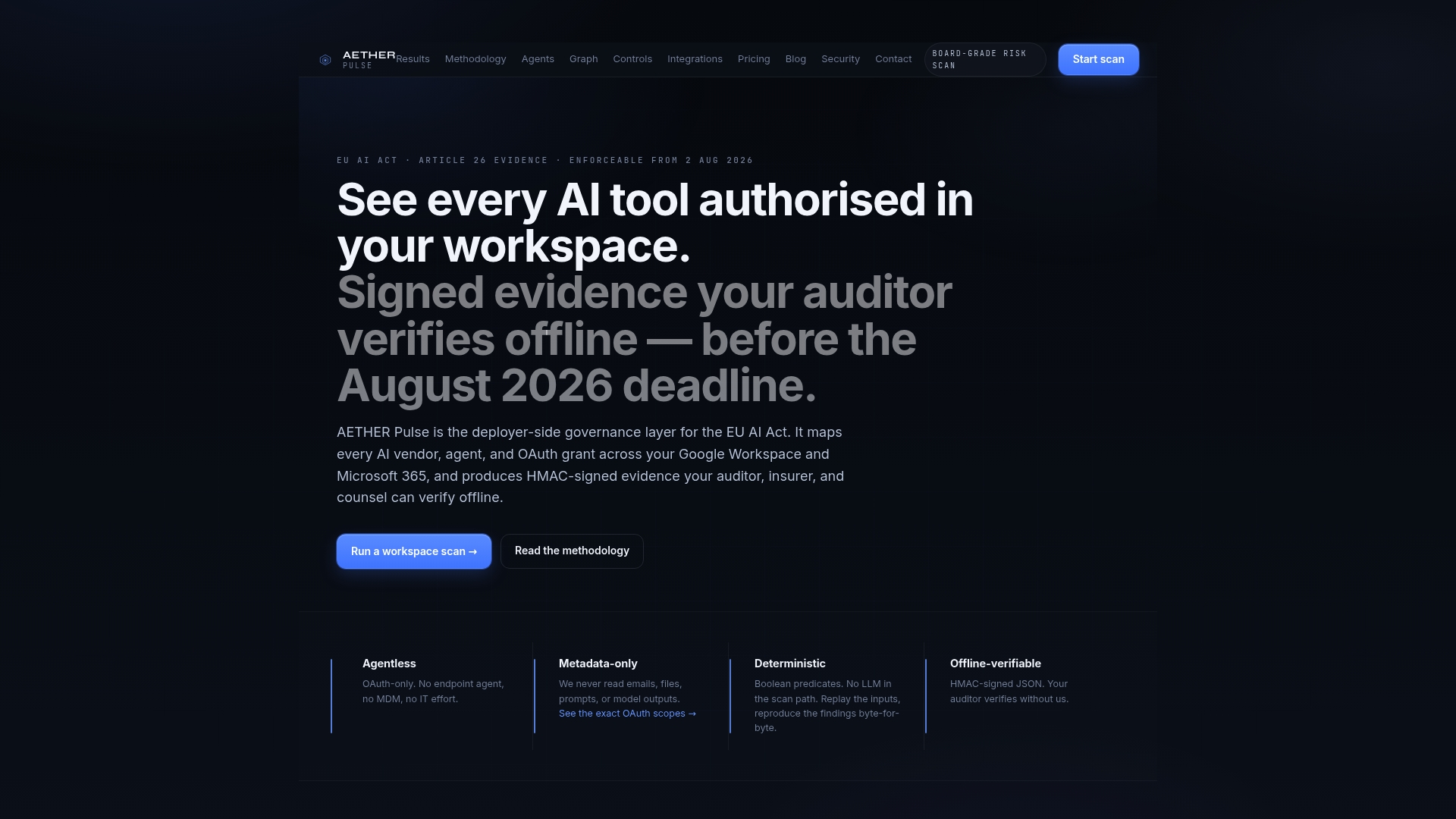
Aetherpulse addresses this directly. The platform connects via OAuth metadata only, touching no customer data, and builds an inventory and identity graph of every AI agent in your organization. It surfaces risk concentration, including financial blast-radius exposure, and generates tamper-evident, cryptographically signed evidence packs using HMAC-SHA256. Those packs are designed to be presented to auditors, regulators, and internal risk functions without additional preparation. For compliance professionals managing EU AI Act Article 26 obligations, FCA Consumer Duty requirements, and ICO AI code of practice alignment, Aetherpulse provides the audit-readiness layer that most firms currently lack.
FAQ
What is the role of compliance in AI deployment?
Compliance in AI deployment is the function of ensuring that AI systems meet legal, regulatory, and ethical standards throughout their lifecycle. It covers procurement controls, ongoing monitoring, audit evidence, and incident reporting.
What are the core deployer obligations under the EU AI Act?
EU AI Act deployers must retain logs for at least six months, implement human oversight mechanisms, and notify employees when AI systems affect their work. Firms that substantially modify or rebrand AI systems may also assume provider-level obligations.
How does AI ethics compliance differ from legal compliance?
Legal compliance sets the minimum standard a firm must meet to avoid regulatory action. AI ethics compliance addresses fairness, transparency, and accountability beyond what regulations currently require, building trust with customers and regulators alike.
What are the biggest challenges in AI compliance programs?
The most common challenges include low organizational confidence in governance, underestimating employment-AI notice requirements, conflating ethics with compliance, and delegating legal accountability entirely to IT rather than retaining it at the senior legal level.
What five artifacts define AI compliance readiness in 2026?
The five foundational artifacts are an AI inventory, a vendor diligence template, an employment-AI notice and audit posture, an EU AI Act gap analysis, and a formal written AI governance program. All five must be producible on short notice for regulator review.
Recommended
Working on Article 26 readiness, deployer-side governance evidence, or AI agent risk at a regulated firm? We'd value 15 minutes of your perspective.
Start a conversation