Second Line AI Oversight Procedures: 2026 Guide
Second Line AI Oversight Procedures: 2026 Guide

Second line AI oversight procedures are defined as the systematic governance, monitoring, and control functions that an independent risk function applies to AI systems operated by the first line of defense. In regulated financial services, this layer sits between front-line AI deployment and third-line internal audit, and it carries direct accountability to regulators including the FCA, SEC, and FINRA. Over 90% of banks have now incorporated AI risk into their second-line oversight frameworks. That figure signals a structural shift: AI governance is no longer optional or ad hoc. It is a core second-line responsibility, governed by frameworks such as ISO 31000 and increasingly shaped by the EU AI Act Article 26.
What are the key components of second line AI oversight procedures?
Effective second line AI oversight begins with a documented policy framework that defines control objectives, ownership, and testing cadence for every AI system in production. Without that foundation, monitoring activities lack authority and audit trails lack coherence. The second line does not build or operate AI models. It sets the rules, tests the controls, and reports the results.
Second line responsibilities include maintaining an AI inventory, mapping each system to applicable regulations, designing and testing controls, and reporting risk findings to the board at least annually. That scope is broader than most compliance teams initially expect. A firm deploying ten AI models across credit, fraud, and customer service faces ten distinct regulatory mapping exercises, each requiring documented evidence.
Four foundational prerequisites must be in place before oversight procedures can operate reliably:
- AI inventory and identity graph. Every model, agent, and automated decision process must be cataloged with owner, purpose, data inputs, and regulatory classification.
- Policy framework with executable controls. Policies must translate into testable control statements, not static documents stored in a shared drive.
- Role clarity between first and second line. 56% of executives report that first-line teams lead responsible AI efforts without second-line integration. That gap creates accountability failures that regulators will identify during examination.
- Integration with enterprise risk management (ERM) platforms. AI risk must feed into the same risk register used for operational, credit, and reputational risk.
| Component | Second line responsibility |
|---|---|
| AI inventory | Maintain catalog of all models and agents in production |
| Regulatory mapping | Map each AI system to FCA, SEC, EU AI Act, and ICO requirements |
| Control design and testing | Define, test, and document controls for each AI risk domain |
| Board reporting | Produce periodic risk reports with findings and remediation status |
Pro Tip: Build your AI inventory before writing a single policy. You cannot govern what you have not counted. Start with a metadata-only scan to avoid touching production data.
How to implement escalation and override procedures within second line oversight
Override and escalation procedures are the operational core of second line AI governance. They define what happens when an AI system produces an output that a human operator rejects, and they create the evidence trail that regulators and auditors will examine.

A well-designed override procedure requires four elements working together. First, every override must be logged at the point of action, capturing the operator identity, timestamp, AI output, and the human decision that replaced it. Second, the log must include a structured reason code. A reason code taxonomy such as FACTUAL_ERROR, POLICY_CONFLICT, or REGULATORY_CONCERN enables root cause analysis across hundreds of override events. Without reason codes, override logs are noise rather than signal.
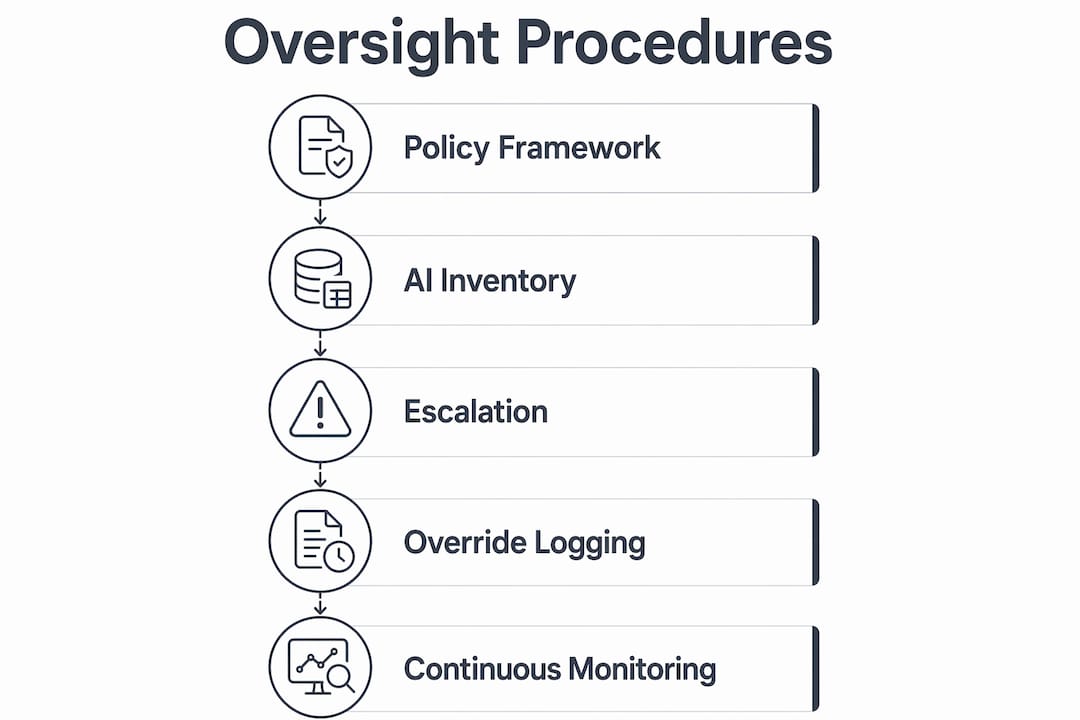
Third, escalation thresholds must be defined in writing and embedded in the workflow. Specific escalation triggers include mandatory incident reporting when overrides indicate potential safety concerns, and executive notification when three or more factual error overrides occur within a defined period. That specificity matters. Vague thresholds produce inconsistent escalation and create gaps that examiners will flag. Fourth, override records must be retained with tamper-evident controls and mapped to the relevant risk register entry.
A practical implementation sequence for escalation procedures runs as follows:
- Define override categories. Map each category to a reason code and assign a default severity level (low, medium, high, critical).
- Set escalation thresholds per category. Specify the volume or pattern of overrides that triggers each escalation level.
- Assign authority levels. Document who receives each escalation: team lead, risk officer, Chief Risk Officer, or board risk committee.
- Integrate with the incident response workflow. High-severity overrides must open an incident ticket in the firm's risk management system automatically.
- Define retention requirements. Override records must be retained for the period required by the applicable regulatory framework, with cryptographic integrity controls where regulators require tamper-evidence.
- Test the procedure quarterly. Run tabletop exercises using synthetic override scenarios to verify that escalation paths function as documented.
Pro Tip: Assign reason code governance to a named individual in the second line. Reason code taxonomies drift over time as new AI use cases emerge. Quarterly taxonomy reviews prevent the catalog from becoming obsolete.
How does machine-enabled governance improve continuous AI monitoring?
Machine-enabled governance embeds policy logic directly into code, enabling continuous assurance across the AI lifecycle rather than periodic manual review. This is the most significant structural shift in second-line AI governance practice. It moves the second line from a reactive audit function to a real-time control layer.
The practical difference is measurable. A manual review cycle that runs quarterly will miss model drift that develops over six weeks. A machine-enabled monitoring layer that checks governance indicators daily will surface the same drift within hours of its first appearance.
Continuous monitoring for second-line oversight covers four domains:
- Model drift detection. Statistical tests run against live model outputs to identify performance degradation relative to validated baselines.
- Policy violation alerting. Automated checks compare AI outputs against defined policy rules and flag violations in near real time.
- Override rate tracking. Supervisory agents measure override frequency by model, use case, and operator to identify systemic issues before they become incidents.
- Regulatory mapping currency. Automated checks verify that each AI system's regulatory mapping remains current as regulations change.
| Monitoring domain | Governance indicator | Alert trigger |
|---|---|---|
| Model drift | Performance delta vs. baseline | Exceeds defined threshold |
| Policy violations | Output rule breach count | Any breach in high-risk systems |
| Override rate | Overrides per 1,000 decisions | Rate exceeds control limit |
| Regulatory mapping | Mapping last-reviewed date | Exceeds review cadence |
Implementing continuous monitoring requires supervisory agents that measure governance indicators including model drift, override rates, and policy deviations in near real time. Human oversight shifts from data collection to judgment and escalation. That is the correct allocation of second-line capacity.
What are the most common pitfalls in second line AI oversight?
The most damaging failure mode in second-line AI governance is the persistence of manual, paper-based processes. Manual oversight cannot scale with the speed and complexity of autonomous AI systems. A compliance team reviewing spreadsheet logs monthly will always be behind the risk curve. The solution is not more reviewers. It is automated controls that surface exceptions for human judgment.
Siloed risk data is the second major failure mode. Fragmented AI risk data across multiple teams creates blind spots and prevents coordinated governance. A firm where the model risk team, the data privacy team, and the operational risk team each maintain separate AI inventories will produce three inconsistent views of the same risk. Regulators examining those records will identify the inconsistency immediately.
Three additional pitfalls appear consistently in second-line oversight programs:
- Accountability gaps between first and second line. When first-line teams own responsible AI without second-line challenge, governance becomes self-certification. The second line must have independent authority to test, challenge, and escalate.
- Inadequate override documentation. Logging the fact of an override without capturing reason codes and context produces records that cannot support root cause analysis or regulatory examination.
- Absence of executive ownership. AI governance programs without a named executive sponsor lose priority when operational pressures increase. The Chief Risk Officer or a designated AI Risk Officer must hold formal accountability.
"The second line must evolve into a machine-enabled governance capability providing continuous assurance rather than reactive oversight. Firms that treat AI governance as a periodic review exercise will find themselves structurally unable to meet the expectations of the FCA, the EU AI Act, and the ICO's developing code of practice."
Integrating AI risk into the firm's ERM platform resolves most of these issues at once. A single risk register that captures AI, operational, and reputational risk gives the board a coherent view and gives the second line a defensible audit trail.
Key Takeaways
Effective second line AI oversight requires an integrated combination of structured escalation protocols, machine-enabled continuous monitoring, and a unified ERM framework to meet regulatory expectations in 2026.
| Point | Details |
|---|---|
| Build the AI inventory first | Catalog every model and agent before designing controls or writing policy. |
| Embed reason codes in override logs | Structured taxonomies like FACTUAL_ERROR enable root cause analysis and governance tuning. |
| Automate monitoring, not just reporting | Machine-enabled governance detects model drift and policy violations in near real time. |
| Integrate AI risk into ERM | Siloed AI risk data creates blind spots that regulators will identify during examination. |
| Assign named executive ownership | AI governance programs without a sponsor lose priority under operational pressure. |
The accountability gap is the real problem
The technical components of second-line AI oversight are well understood at this point. Policy frameworks, control taxonomies, escalation thresholds, and monitoring dashboards all have established design patterns. What I have seen fail repeatedly is not the tooling. It is the accountability structure underneath it.
When first-line teams own AI governance without genuine second-line challenge, the oversight function becomes a formality. The 56% of executives who report that first-line teams lead responsible AI efforts are describing a structural problem, not a capability one. The second line exists precisely to provide independent challenge. If it is not exercising that challenge, it is not functioning as designed.
The shift toward machine-enabled governance is the right direction, but it requires the second line to accept a different role. Compliance professionals who have spent careers reviewing documents and signing off on checklists will need to develop comfort with automated control outputs, alert triage, and governance-as-code concepts. That is a genuine skills transition, not a minor process update.
The firms I find most credible in this space are the ones that have separated the question of what the AI does from the question of who is accountable when it goes wrong. Those are two different governance problems. The second line owns the second one entirely.
— Eleye
Aetherpulse: purpose-built for second line AI governance
Regulated firms need a governance layer that produces defensible evidence without inserting itself into production systems. Aetherpulse connects via OAuth metadata only, builds an AI agent inventory and identity graph, and generates cryptographically signed (HMAC-SHA256) evidence packs on demand.
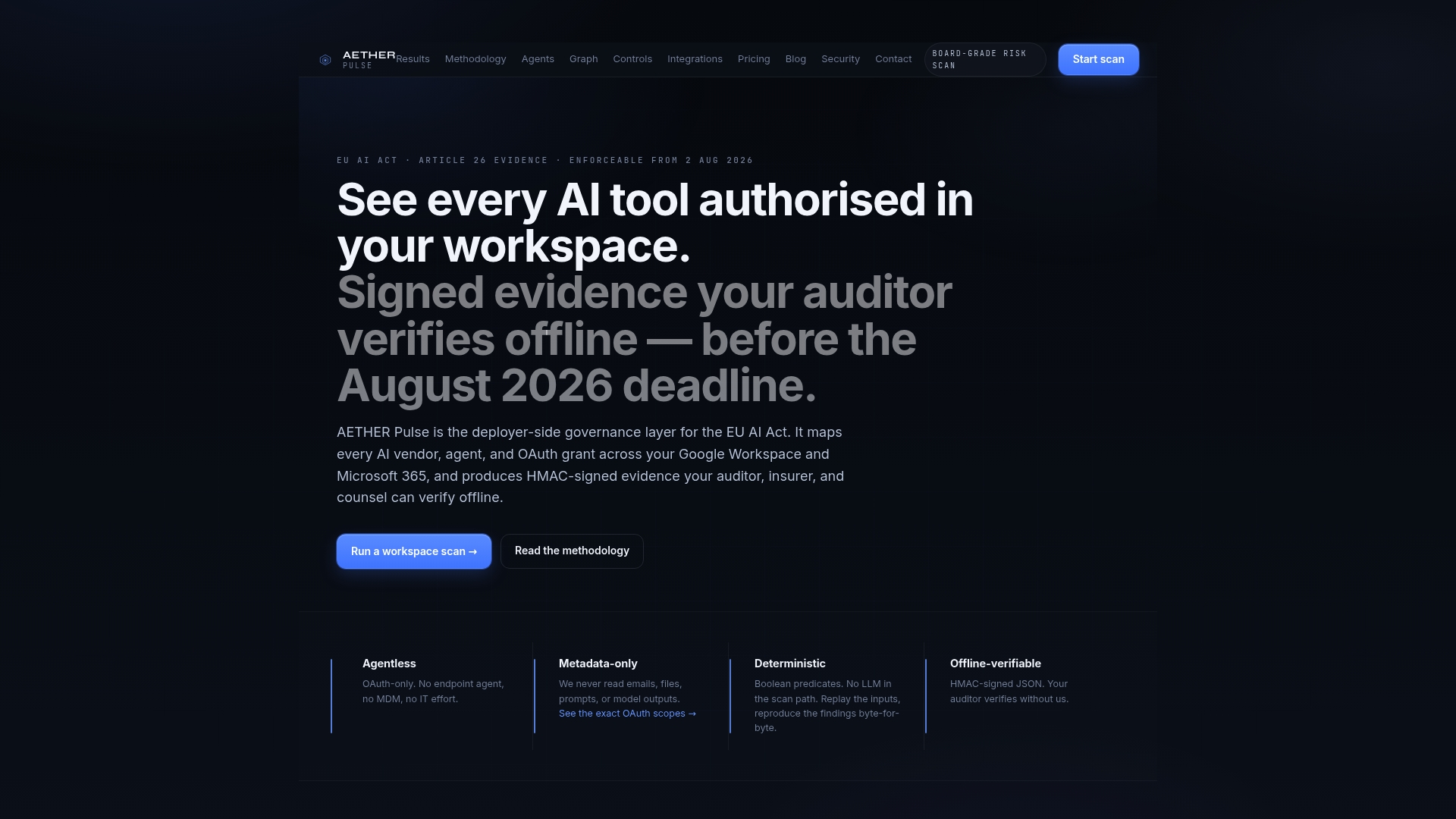
The platform maps directly to FCA Consumer Duty, SYSC requirements, EU AI Act Article 26, and the ICO's developing code of practice on automated decision-making. It surfaces risk concentration and financial blast-radius exposure without touching customer data. For second-line teams that need audit-ready evidence without a lengthy deployment program, Aetherpulse delivers visibility from day one.
FAQ
What is second line AI oversight in financial services?
Second line AI oversight is the independent governance function that monitors, tests, and challenges AI systems operated by the first line of defense. It sits between front-line deployment and internal audit, with direct accountability to regulators including the FCA and SEC.
What regulations govern second line AI oversight procedures?
Key frameworks include EU AI Act Article 26, FCA Consumer Duty and SYSC requirements, the ICO's code of practice on automated decision-making, and ISO 31000 for enterprise risk management. Over 90% of banks have incorporated AI risk into their second-line frameworks to meet these standards.
How should override records be structured for audit purposes?
Override records must capture the operator identity, timestamp, AI output, human decision, and a structured reason code from a defined taxonomy. Tamper-evident retention controls are required where regulators mandate defensible audit evidence.
What is machine-enabled governance in the context of AI oversight?
Machine-enabled governance embeds policy logic as executable code rather than static documents, enabling continuous monitoring of model drift, override rates, and policy violations in near real time. It shifts human oversight capacity from data collection to judgment and escalation.
How does AI risk integrate with enterprise risk management?
AI risk should feed into the same risk register used for operational, credit, and reputational risk. Firms that maintain separate AI risk inventories create fragmented data that produces inconsistent governance views and creates examination vulnerabilities.
Recommended
Working on Article 26 readiness, deployer-side governance evidence, or AI agent risk at a regulated firm? We'd value 15 minutes of your perspective.
Start a conversation