Operationalise AI Governance for Fast Deployment
Operationalise AI Governance for Fast Deployment

AI governance operationalization is defined as the process of embedding enforceable controls, audit mechanisms, and oversight structures directly into AI deployment architecture before systems go live. For governance and compliance leaders in regulated financial firms, the urgency is acute: organizations deploy AI agents 3–5 times faster than governance infrastructure can support, and only 21% have mature AI governance in place. That gap is not a planning failure. It is a structural one, and closing it requires a deliberate method to operationalize AI governance frameworks at deployment speed. The standard industry term for this discipline is AI governance operationalization. The phrase "fast deployment" signals the constraint: governance must ship with the model, not six months after it.
What does operationalising AI governance fast deployment require?
Rapid AI governance operationalization rests on three prerequisites: a formal mandate, a live inventory, and tooling that produces defensible evidence without slowing production. Without all three, governance remains a paper exercise. The EU AI Act Article 26, FCA Consumer Duty, and SYSC requirements each demand documented oversight of automated decision-making. Firms that cannot produce that documentation on demand face regulatory exposure, not just audit findings.
Governance mandate and committee
The governance mandate is a board-approved charter that assigns decision rights, defines risk appetite for AI systems, and names an accountable executive. Without executive sponsorship, governance committees lack the authority to block or modify deployments. The charter should specify which AI use cases require full review, which qualify for a fast-track approval, and what constitutes a material change triggering re-review.
AI system inventory and risk registry
A live inventory of all AI agents, models, and automated decision systems is the foundation of any governance program. The registry should capture each system's data inputs, decision outputs, affected customer populations, and regulatory classification under frameworks like ISO 42001 and the EU AI Act. Risk concentration, including financial blast-radius exposure, must be quantified so the committee can prioritize review effort.

Tooling requirements
| Governance Function | Required Capability | Implementation Benefit |
|---|---|---|
| Agent inventory | OAuth metadata ingestion, identity graph | No production access required |
| Audit evidence | Cryptographic signing, tamper-evident logs | Defensible in regulatory review |
| Risk monitoring | Real-time alerts, blast-radius scoring | Proactive, not reactive oversight |
| Policy enforcement | Automated controls, rule-based access | Removes manual bottleneck |
| Compliance mapping | Framework hooks (EU AI Act, FCA, ICO) | Reduces bespoke legal analysis |
How to implement a 90-day sprint to build a defensible AI governance foundation
A 90-day sprint cycle advances AI governance from zero to a foundation that satisfies regulatory and board scrutiny. The sprint divides into three phases: Establish, Instrument, and Operate. Each phase produces shippable artifacts, meaning the governance program delivers evidence at every 30-day checkpoint, not only at the end.
-
Days 1–30: Establish. Draft and ratify the governance charter. Appoint the AI governance committee with named decision rights. Complete the first-pass AI system inventory and populate the risk registry. Deliverables: signed charter, committee terms of reference, and a prioritized risk register covering all production AI systems.
-
Days 31–60: Instrument. Define audit cadence and assign runbook owners for each risk tier. Deploy technical controls for data access, model versioning, and decision logging. Map each control to the relevant regulatory requirement, whether EU AI Act Article 26, FCA Consumer Duty, or the ICO's code of practice on automated decision-making. Deliverables: audit schedule, runbooks, and a control-to-regulation traceability matrix.
-
Days 61–90: Operate. Activate the ethics review framework and set enforcement metrics. Run the first full governance cycle: committee review, automated monitoring check, and evidence pack generation. Conduct a structured handover to the ongoing operating model. Deliverables: first evidence pack, enforcement dashboard, and a post-sprint gap analysis for the board.
Pro Tip: Treat each 30-day deliverable as a "shippable" governance artifact. A signed charter on day 30 is more valuable than a perfect charter on day 91. Regulators reward demonstrated progress, not planned completeness.
Governance debt accumulates risk like technical debt, growing costlier to remediate over time. The 90-day sprint prevents that accumulation by forcing the program into a live operating loop from the first week.
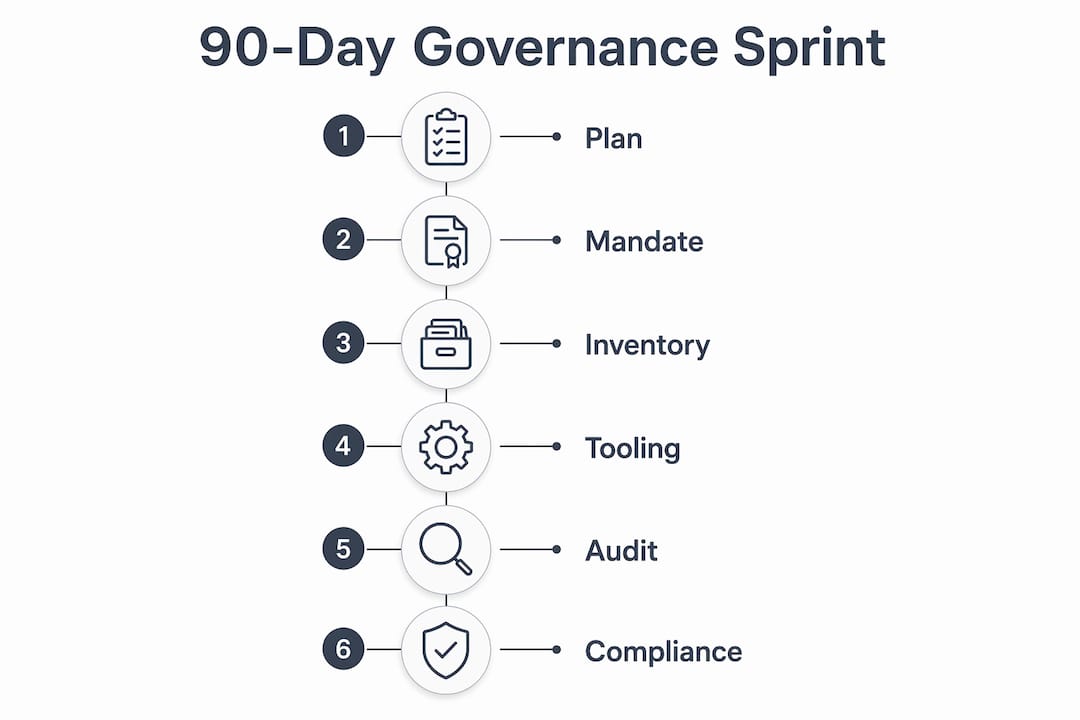
What are best practices for embedding governance controls into AI infrastructure?
Governance built into metadata layers enables automated inventory, provenance tracking, and audit without inspecting sensitive data. This is the architectural principle that separates fast, defensible governance from slow, brittle governance. The six-layer governance stack makes this concrete.
| Governance Layer | Core Function | Sprint Benefit |
|---|---|---|
| Inventory | Agent discovery, identity graph | Immediate visibility, no production access |
| Data foundation | Lineage tracking, data classification | Audit-ready provenance from day one |
| Security and access | Role-based controls, OAuth enforcement | Eliminates unauthorized model access |
| Model assurance | Version control, drift detection | Catches silent model changes |
| Human oversight | Escalation triggers, review queues | Keeps humans in the loop at scale |
| Compliance and audit | Evidence packs, framework mapping | Regulator-ready output on demand |
The six-layer stack installs through six two-week sprints, each ending with acceptance criteria signed before work begins. Each sprint costs approximately $10,000. That pricing structure makes governance budgeting predictable and ties expenditure directly to delivered controls.
The key discipline is sprint gating. No sprint begins until the previous sprint's acceptance criteria are signed off by the governance committee. This prevents the common failure mode where layers are declared "done" before they are actually enforced. Automated controls transform governance from a review bottleneck into a performance lever that scales with AI deployment volume.
Pro Tip: Write acceptance criteria as executable tests, not prose descriptions. "The audit log captures 100% of model decisions within 500ms" is testable. "The audit log is comprehensive" is not. Testable criteria prevent governance theater.
How do you maintain governance speed without compromising compliance?
Governance that lacks enforcement authority fails because teams bypass slow processes. The failure mode is predictable: a governance committee with no power to block deployments becomes an advisory body that AI teams learn to route around. Speed and rigor are not opposites. They become opposites only when governance is designed as a sequential gate rather than a parallel control layer.
The following practices prevent that breakdown:
- Tiered review authority. Classify AI systems by risk level. Low-risk systems receive automated fast-track approval. High-risk systems, particularly those making credit, insurance, or fraud decisions, require full committee review with documented rationale.
- Fail-closed architecture. Temporal asymmetry between millisecond AI decisions and slow governance reviews creates accountability gaps. Fail-closed designs prevent unnoticed governance drift by defaulting to a safe state when monitoring signals are absent or ambiguous.
- Automated human oversight triggers. Define threshold conditions that automatically escalate a decision to human review. This keeps humans in the loop without requiring manual monitoring of every transaction.
- Enforcement dashboards. Make governance metrics visible to the board and the risk function. Track review cycle time, control exception rates, and evidence pack completeness. Invisible governance is ungoverned governance.
Governance speed is an ethical variable, not just an operational one. When AI systems make decisions in milliseconds and governance reviews take weeks, the accountability gap is not a process inefficiency. It is a compliance liability that regulators will treat as a material control failure.
Successful governance combines meaningful authority with tiered automated reviews that balance speed and risk. The firms that get this right treat governance as part of the deployment pipeline, not a checkpoint after it.
Key Takeaways
Operationalizing AI governance requires embedding enforceable controls, a live inventory, and cryptographically signed audit evidence into deployment architecture before AI systems go live, not after.
| Point | Details |
|---|---|
| Governance gap is structural | Only 21% of organizations have mature AI governance; the rest face growing regulatory exposure. |
| 90-day sprint delivers results | Three phased sprints produce shippable governance artifacts that satisfy board and regulatory scrutiny. |
| Six-layer stack embeds controls | Installing governance layer by layer through two-week sprints makes controls testable and enforceable. |
| Tiered reviews prevent bypass | Classifying AI systems by risk level allows fast-track approvals for low-risk systems and full review for high-risk ones. |
| Fail-closed design closes gaps | Temporal asymmetry between AI decision speed and review speed requires architectural defaults, not manual monitoring. |
The governance speed problem is harder than it looks
The firms I see struggle most with AI governance are not the ones that ignore it. They are the ones that treat it as a documentation project. They produce a governance policy, file it with the board, and assume the work is done. Six months later, they have twelve new AI agents in production and a governance register that reflects none of them.
The uncomfortable truth is that governance operationalization requires the same discipline as software delivery. You need a backlog, sprint cadence, acceptance criteria, and a team with authority to say no. Most compliance functions are not structured that way. They are structured to advise, not to enforce.
The 90-day sprint model works precisely because it forces that structural change early. By day 30, you have a committee with named decision rights. By day 60, you have controls mapped to regulations. By day 90, you have an evidence pack you can hand to an auditor. That progression builds institutional muscle memory. It also builds credibility with the board, which is the resource governance leaders need most.
The other insight I would press on: governance integrated into infrastructure is not a technical luxury. For firms operating under FCA Consumer Duty or EU AI Act Article 26, it is the only architecture that produces defensible evidence at the speed regulators now expect. A read-only, metadata-only layer that generates HMAC-SHA256 signed evidence packs without touching customer data is not an edge case. It is the minimum viable governance posture for a regulated financial firm in 2026.
— Eleye
Aetherpulse: governance that ships with your AI deployment
Governance and compliance leaders in regulated financial firms need more than a policy framework. They need a platform that produces audit-ready evidence without inserting itself into production systems.
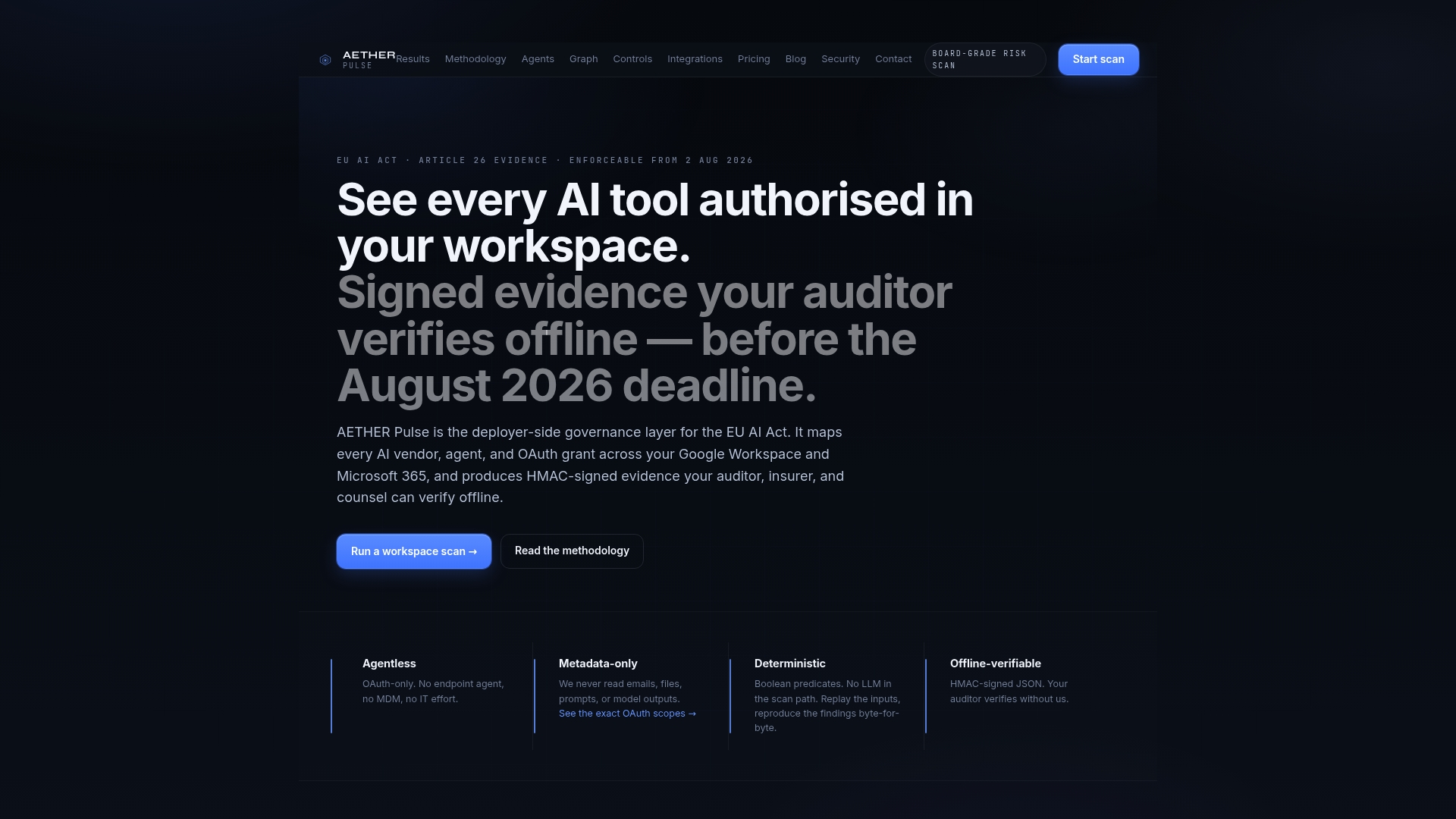
Aetherpulse connects via OAuth metadata only, builds a live identity graph of your AI agents, and generates tamper-evident, HMAC-SHA256 signed evidence packs on demand. The platform maps controls directly to EU AI Act Article 26, FCA Consumer Duty, SYSC requirements, and the ICO's code of practice on automated decision-making. Risk concentration and financial blast-radius exposure surface in real time, so your governance committee acts on live data, not quarterly reports. For firms that need to implement AI governance quickly and prove oversight to regulators, Aetherpulse is built for exactly that operating environment.
FAQ
What does it mean to operationalize AI governance?
Operationalizing AI governance means embedding enforceable controls, audit mechanisms, and oversight structures into AI deployment architecture before systems go live. It moves governance from a policy document to a live operating loop with automated monitoring and defensible evidence.
How quickly can a financial firm implement AI governance?
A structured 90-day sprint can take a firm from no formal governance to a defensible foundation that satisfies board and regulatory scrutiny. The sprint divides into three 30-day phases: Establish, Instrument, and Operate.
Why does AI governance need to be fast to deploy?
Organizations deploy AI agents 3–5 times faster than governance infrastructure can support. Slow governance creates accountability gaps that regulators treat as material control failures, particularly under frameworks like the EU AI Act and FCA Consumer Duty.
What is the six-layer AI governance stack?
The six-layer stack covers inventory, data foundation, security and access, model assurance, human oversight, and compliance and audit. Each layer installs through a two-week sprint with signed acceptance criteria, producing executable controls embedded in system architecture.
How does a fail-closed architecture support AI governance?
A fail-closed architecture defaults AI systems to a safe state when governance monitoring signals are absent or ambiguous. This prevents unnoticed governance drift caused by the temporal asymmetry between millisecond AI decisions and slower human review cycles.
Recommended
Working on Article 26 readiness, deployer-side governance evidence, or AI agent risk at a regulated firm? We'd value 15 minutes of your perspective.
Start a conversation