AI Regulatory Reporting Requirements 2026: Finance Guide
AI Regulatory Reporting Requirements 2026: Finance Guide

AI regulatory reporting requirements for 2026 are defined by a convergence of international frameworks and state-level laws, each mandating specific documentation, auditability, and transparency obligations for financial institutions. The EU AI Act, Colorado's AI Act (SB 24-205), SOX, COSO 2026 guidance, and PCAOB AS 1105 collectively set the compliance baseline that auditors and regulators now expect. Compliance and risk professionals in regulated financial sectors face a firm deadline structure: some enforcement windows have extended, but transparency obligations are non-negotiable starting december 2, 2026. This guide details every critical mandate and the practical steps your team must take to achieve audit readiness.
1. What are the key operational logging and audit trail requirements for AI systems in 2026?
Operational log retention is the foundation of AI audit readiness in 2026. Retention mandates vary by framework: SOX requires at least 366 days of operational logs, the EU AI Act mandates a minimum of 6 months for high-risk AI systems, and audit work papers must be retained for 7 years. Each retention period serves a distinct audit function, and failing to meet any one of them creates a gap that regulators will find.
The technical standard for log integrity is equally specific. Tamper-evident, HMAC-SHA256 signed audit evidence is the accepted method for meeting forensic integrity demands under PCAOB AS 1105 and the EU AI Act. Unsigned logs fail regulatory scrutiny because auditors are trained to identify altered or non-forensic evidence. A log that cannot prove it was not modified after the fact is not a defensible audit artifact.

Regulators also specify minimum data schema requirements. Compliant audit trails must capture at least 12 defined fields, including timestamps, agent identifiers, decision outputs, input data references, and override events. Financial sector frameworks including PCI DSS, HIPAA, and FFIEC each add sector-specific field requirements on top of this baseline.
Key log features required across frameworks:
- Cryptographic signing at the point of generation, not retroactively
- Immutable storage with access controls and write-once architecture
- Timestamping synchronized to a trusted time source
- Chain-of-custody metadata for every log entry
- Automated alerting for log gaps or integrity failures
Pro Tip: Run a log integrity spot-check quarterly, not just at audit time. Regulators increasingly request rolling evidence, and gaps discovered mid-year are harder to remediate than gaps found in advance.
2. How regional regulations shape AI reporting obligations for financial institutions
The geographic scope of AI reporting obligations in 2026 is broader than most compliance teams anticipated two years ago. The EU AI Act extended compliance deadlines for high-risk AI systems to december 2, 2027, and august 2, 2028, under the Digital Omnibus package amendments. The extension grants firms more time to build internal governance structures. However, watermarking of AI-generated content and core transparency obligations remain mandatory starting december 2, 2026, with no grace period.
Colorado's AI Act (SB 24-205) is the most stringent U.S. state-level AI regulation effective in 2026. It requires impact assessments, consumer disclosures, and appeals mechanisms for high-risk AI systems deployed in finance and employment. Colorado's law is not a federal mandate, but it sets a de facto national standard for firms operating across state lines, because the compliance floor it establishes is the highest in the country.
The absence of a unified federal U.S. AI law means financial institutions must map compliance across overlapping sector-specific guidance from the SEC, OCC, CFPB, and FFIEC. Each regulator interprets AI oversight through its own existing authority. That fragmentation creates coordination risk, particularly for firms that operate in multiple states and jurisdictions simultaneously.
Regional obligations compliance teams must track:
- EU AI Act Article 26 operator obligations, including oversight and shutdown capability
- Colorado SB 24-205 impact assessments and consumer-facing disclosures
- SEC enforcement focus on AI-related internal controls and disclosures
- FCA Consumer Duty requirements for AI-driven customer outcomes in the UK
- ICO code of practice on automated decision-making for UK-regulated firms
SME relief provisions exist under the EU AI Act, reducing some conformity assessment burdens for smaller operators. Financial institutions above the SME threshold receive no such relief and must meet the full documentation and oversight standard.
3. What documentation and transparency measures organizations must implement
Mandatory documentation under 2026 AI regulatory frameworks includes system cards, model cards, risk assessments, and conformity assessments for every high-risk AI system. System cards must capture use cases, known limitations, failure modes, and testing results in a format that auditors can evaluate without requiring technical expertise. Regulators treat missing or incomplete documentation the same way they treat missing financial records.
The transparency obligations extend beyond internal documentation. Machine-readable watermarking for AI-generated content becomes mandatory under the EU AI Act in december 2026. Disclosure mechanisms must notify affected stakeholders, including customers and regulators, when AI systems make or materially influence consequential decisions. These disclosures must be accessible, not buried in terms-of-service language.
Operator training and monitoring protocols are a distinct documentation requirement. Firms must demonstrate that staff responsible for AI systems can identify anomalous behavior, trigger overrides, and initiate shutdowns. That capability must be documented, tested, and evidenced, not simply asserted in a policy document.
Required documentation steps for 2026 compliance:
- Complete a system card for every AI system classified as high-risk under applicable frameworks.
- Conduct a risk assessment and, where required, a third-party conformity assessment before deployment.
- Implement machine-readable watermarking for all AI-generated content by december 2, 2026.
- Establish written disclosure procedures for affected users and regulators.
- Document operator training programs with evidence of completion and competency testing.
- Create incident reporting workflows that specify escalation paths, timelines, and notification obligations.
- Schedule periodic model re-evaluation at defined intervals, with results recorded and retained.
Pro Tip: Treat your system card as a living document, not a one-time filing. Regulators expect it to reflect the current state of the model, including any retraining, fine-tuning, or deployment scope changes.
4. Practical steps compliance teams can take to meet AI reporting standards
Governance-by-design is the most effective framework for meeting 2026 AI reporting standards. This means embedding risk classification, policy enforcement, and audit logging into the AI deployment process before systems go live, not after. Retrofitting governance controls onto deployed AI systems is significantly more expensive and produces weaker audit evidence than building them in from the start.
COSO 2026 guidance on generative AI and the SEC's dedicated SOX enforcement group have both intensified scrutiny on AI audit trails and internal controls in financial sectors. That intensification means compliance teams can no longer treat AI governance as a technology problem delegated to IT. Risk and compliance functions must own the control framework, with IT providing implementation support.
Cross-jurisdictional compliance mapping is a practical necessity for firms operating under both EU and U.S. obligations. Build a single control matrix that maps each regulatory requirement to a specific control, owner, and evidence artifact. This approach eliminates duplicate work and makes it possible to demonstrate compliance to multiple regulators from a single evidence set.
Practical steps for audit readiness:
- Classify every AI system by risk tier using EU AI Act and Colorado SB 24-205 criteria before the end of Q1 2026.
- Deploy cryptographically signed logging at the infrastructure level, not the application level, to prevent tampering.
- Assign a named compliance owner to each high-risk AI system with documented accountability.
- Establish a regulatory monitoring process that captures updates from the EU, SEC, FCA, and state-level bodies on a monthly cadence.
- Conduct a pre-audit evidence review at least 90 days before any scheduled regulatory examination.
- Maintain a cross-jurisdictional control matrix updated whenever a new regulatory requirement is published.
5. How AI reporting requirements integrate with SOX and COSO frameworks
AI-specific reporting requirements and existing financial compliance frameworks share more common ground than most compliance teams realize. SOX Section 302 and 404 controls already require management to assess the effectiveness of internal controls over financial reporting. AI systems that influence financial outputs fall squarely within that scope, meaning AI governance controls are not additive to SOX compliance. They are part of it.
COSO's internal control framework provides the structural model for integrating AI controls. The five COSO components, including control environment, risk assessment, control activities, information and communication, and monitoring, map directly onto AI governance requirements. A firm that has already implemented COSO-aligned controls has the architecture to absorb AI-specific requirements without building a parallel framework.
The retention and documentation standards across frameworks align more than they conflict. SOX requires 366 days of operational logs. The EU AI Act requires 6 months for high-risk AI. Audit work papers require 7 years. A single retention policy set at the longest applicable period satisfies all three simultaneously. That harmonization reduces storage complexity and eliminates the risk of inadvertently deleting records that one framework still requires.
Auditor training is the integration point that firms most often overlook. PCAOB AS 1105 governs how auditors evaluate audit evidence, and the 2026 amendments signal that regulators expect auditors to assess AI-generated evidence with the same rigor applied to financial records. Internal audit teams need training on cryptographic log verification, model card review, and AI risk assessment methodology to perform credible AI-related audit procedures.
Key Takeaways
Meeting AI regulatory reporting requirements in 2026 requires cryptographically signed audit logs, jurisdiction-specific documentation, and governance controls embedded before AI systems go live.
| Point | Details |
|---|---|
| Log retention varies by framework | SOX requires 366 days, EU AI Act requires 6 months for high-risk AI, and audit work papers require 7 years. |
| HMAC-SHA256 signing is mandatory | Unsigned logs fail forensic scrutiny under PCAOB AS 1105 and the EU AI Act. |
| Transparency obligations start december 2026 | AI content watermarking and disclosure requirements are firm under the EU AI Act, regardless of deadline extensions. |
| Colorado SB 24-205 sets the U.S. floor | Effective february 2026, it requires impact assessments and consumer disclosures for high-risk AI in finance. |
| Governance-by-design reduces audit risk | Embedding controls before deployment produces stronger evidence than retrofitting them after the fact. |
The compliance gap that no one is talking about
The conversation in financial compliance circles focuses almost entirely on which frameworks apply and when. That is the wrong question to lead with. The more pressing question is whether your firm can actually produce defensible evidence on demand, not just in theory.
I have watched compliance teams spend months mapping regulatory requirements to control frameworks, producing beautifully structured gap analyses, and then discover at audit time that their logging infrastructure cannot generate a tamper-evident evidence pack. The documentation existed. The logs did not hold up. That is a failure of implementation, not a failure of understanding.
The EU AI Act amendments represent a genuine trade-off: more time to build governance structures for high-risk systems, but no flexibility on transparency. Regulators are signaling clearly that auditability is the non-negotiable core. Everything else is a timeline negotiation.
My view is that compliance professionals in financial services need to shift their primary metric from "are we mapped to the regulation" to "can we produce signed, provenance-tracked evidence within 24 hours of a regulator request." That shift changes what you build, what you buy, and what you prioritize. Firms that make that shift now will not be scrambling in december 2026 when the transparency obligations land.
The evolving role of the compliance professional in AI governance is not to become a data scientist. It is to own the evidence chain. That means understanding what cryptographic signing means for audit integrity, what a system card must contain, and what "ongoing monitoring" requires operationally. Those are compliance skills, not engineering skills.
— Eleye
Aetherpulse: AI governance evidence for regulated firms
Regulated financial institutions deploying AI agents face a specific problem: regulators expect defensible audit evidence, and most governance tooling either accesses sensitive data or cannot produce cryptographically signed artifacts that hold up under scrutiny.
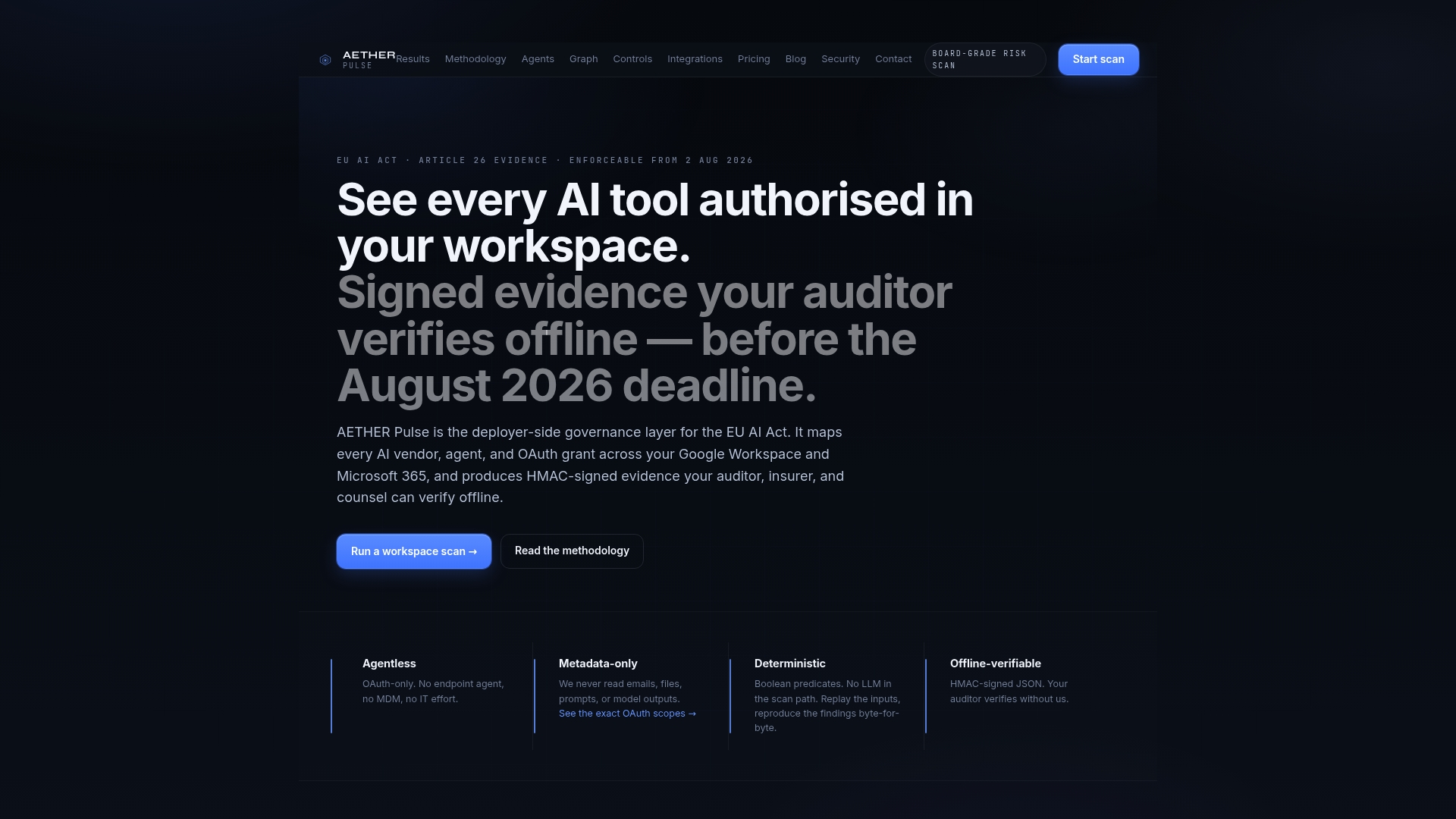
Aetherpulse is built for exactly this gap. It connects via OAuth metadata only, touching no customer data, and generates tamper-evident, HMAC-SHA256 signed evidence packs on demand. The platform builds an inventory and identity graph of your AI agents, surfaces risk concentration including financial blast-radius exposure, and produces provenance-tracked documentation aligned with EU AI Act Article 26, FCA Consumer Duty, and SYSC requirements. If your team needs audit-ready AI governance without inserting new tooling into production systems, Aetherpulse is the place to start.
FAQ
What are the core AI regulatory reporting requirements for 2026?
The core requirements include tamper-evident operational logging, system and model card documentation, risk and conformity assessments for high-risk AI, and transparency disclosures to affected stakeholders. Retention periods range from 6 months under the EU AI Act to 7 years for audit work papers.
When does the EU AI Act transparency obligation take effect?
The EU AI Act's transparency obligations, including machine-readable watermarking of AI-generated content, take effect december 2, 2026. Enforcement deadlines for high-risk AI systems were extended to 2027 and 2028, but the transparency provisions were not delayed.
Does Colorado's AI Act apply to financial institutions outside Colorado?
Colorado SB 24-205 applies to any firm deploying high-risk AI systems that affect Colorado residents, regardless of where the firm is headquartered. Financial institutions with customers in Colorado must comply with its impact assessment and consumer disclosure requirements effective february 2026.
What makes an audit log cryptographically compliant under PCAOB AS 1105?
A compliant log must be signed using HMAC-SHA256 at the point of generation, stored in a write-once architecture, and include chain-of-custody metadata. Logs that can be altered after creation fail forensic integrity standards and will not satisfy PCAOB or EU AI Act audit requirements.
How do AI reporting standards align with existing SOX controls?
AI governance controls fall within SOX Section 302 and 404 scope when AI systems influence financial reporting outputs. COSO's five-component framework maps directly onto AI governance requirements, allowing firms to integrate AI-specific controls into existing internal control structures rather than building a separate framework.
Recommended
Working on Article 26 readiness, deployer-side governance evidence, or AI agent risk at a regulated firm? We'd value 15 minutes of your perspective.
Start a conversation