AI Oversight in Regulated Financial Services: 2026 Guide
AI Oversight in Regulated Financial Services: 2026 Guide

U.S. AI oversight in regulated financial services operates through a layered patchwork of existing federal frameworks, agency-specific guidance, and state legislation rather than a single unified federal law. The GAO confirmed that federal regulators primarily rely on existing statutes, risk-based examinations, and guidance documents such as the model risk management framework SR 26-2 to govern AI use across banks, credit unions, and other regulated entities. Key agencies in this architecture include the Office of the Comptroller of the Currency (OCC), the Federal Reserve, the Consumer Financial Protection Bureau (CFPB), the Federal Housing Finance Agency (FHFA), the National Credit Union Administration (NCUA), and the Federal Trade Commission (FTC), each operating within its own statutory mandate.
The oversight picture has notable gaps. The NCUA, for instance, lacks detailed AI-focused model risk management guidance and the authority to examine third-party technology providers, leaving credit unions exposed to risks that other banking regulators can address more directly. Meanwhile, the Financial Stability Board (FSB) and the International Organization of Securities Commissions (IOSCO) are shaping international norms that U.S. firms with cross-border operations must track alongside domestic requirements.
Key structural features of the current framework:
- No unified federal AI statute governs financial services; SR 26-2 remains the primary model risk management reference.
- The Federal Reserve, OCC, and FDIC recently amended model risk management guidance to exclude generative and agentic AI, signaling a shift toward flexible governance.
- NCUA's model risk management guidance is limited in scope and does not cover the full range of AI models credit unions deploy.
- CFPB has issued specific guidance on AI use in credit decisions, including requirements for adverse action notices.
- FHFA oversees AI use at Fannie Mae and Freddie Mac, with a focus on fair lending and model validation.
- FTC applies consumer protection statutes to AI-driven practices, including deceptive or unfair automated decisions.
- FSB and IOSCO provide international supervisory frameworks that inform U.S. regulatory expectations for globally active firms.
1. How federal agencies structure AI oversight in financial services
The federal regulatory architecture for AI governance in banking and financial services is not a single coherent system. It is a set of overlapping mandates, each agency applying its existing authority to AI-related risks within its supervised population.
The Federal Reserve has spent nearly a decade engaging with banks on AI deployment. Its supervisory approach emphasizes safety and soundness, with examiners monitoring AI use through existing risk management frameworks. Critically, the Fed, together with the OCC and FDIC, recently amended model risk management guidance to clarify that it does not apply to generative or agentic AI, narrowing the scope to traditional models and basic AI applications. The rationale: prior supervisory practice had stretched SR 26-2 beyond its original purpose, and rapidly evolving AI capabilities require a different governance approach. Going forward, the Fed expects other risk management and governance practices to fill that space.
The OCC takes a risk-based approach to AI supervision across national banks and federal savings associations. Its Semiannual Risk Perspective has flagged AI-related operational and compliance risks, particularly around model governance, third-party dependencies, and cybersecurity exposure. The OCC's guidance on third-party risk management is directly relevant to banks procuring AI services from technology vendors.

The CFPB has been among the more active agencies on AI-specific guidance. It has issued guidance on credit denials by lenders using AI, requiring that adverse action notices provide specific, accurate reasons rather than generic explanations. This directly affects any institution using algorithmic credit decisioning. The CFPB also applies the Equal Credit Opportunity Act and the Fair Housing Act to AI-driven lending, meaning that disparate impact from a model is a compliance exposure regardless of intent.
The FHFA oversees AI governance at Fannie Mae and Freddie Mac, with particular attention to model validation, fair lending compliance, and the integrity of automated underwriting systems. Its inspector general has examined AI-related risks in the context of the enterprises' model inventories and third-party vendor relationships.
The NCUA presents the most visible gap in the federal framework. As the GAO documented, NCUA's model risk management guidance is limited in scope and detail, and the agency lacks statutory authority to examine technology service providers that credit unions increasingly rely on for AI-driven services. GAO reiterated its 2015 recommendation that Congress consider granting NCUA this examination authority. As of early 2026, Congress had not acted. NCUA launched an AI resources page in march 2026, but that page does not substitute for detailed model risk management guidance covering a broad range of AI models. Compliance professionals advising credit unions should treat this gap as an active risk, not a resolved one.
The FTC applies Section 5 of the FTC Act and other consumer protection statutes to AI-driven practices across financial services, including deceptive or unfair automated decisions. Its enforcement posture signals that AI outputs affecting consumers carry the same legal exposure as any other business practice.
The FSB and IOSCO operate at the international level but directly shape U.S. regulatory expectations. The FSB's Standing Committee on Supervisory and Regulatory Cooperation, currently chaired by Federal Reserve Vice Chair for Supervision Michelle Bowman, is developing a report on sound practices for AI adoption, use, and innovation. IOSCO has released a supervisory toolkit for capital market regulators endorsing risk-based, proportionate oversight and practical governance tools for AI. U.S. firms with international operations cannot treat these bodies as irrelevant to their domestic compliance programs.
Key agency roles at a glance:
- Federal Reserve: Safety and soundness supervision; amended MRM guidance excluding generative/agentic AI; FSB coordination.
- OCC: Risk-based AI supervision for national banks; third-party risk management guidance.
- CFPB: AI-specific guidance on credit decisions; adverse action notice requirements; fair lending enforcement.
- FHFA: Model validation and fair lending oversight at GSEs; third-party vendor risk.
- NCUA: Limited MRM guidance; no authority to examine third-party technology providers.
- FTC: Consumer protection enforcement against deceptive or unfair AI-driven practices.
- FSB/IOSCO: International supervisory frameworks informing U.S. expectations for cross-border firms.
Pro Tip: When mapping your institution's AI governance obligations, build a matrix that assigns each AI use case to the relevant agency's primary framework. A credit decisioning model at a national bank sits at the intersection of OCC model risk guidance, CFPB adverse action requirements, and fair lending statutes simultaneously. Treating these as separate compliance workstreams rather than a unified obligation is where gaps form.
2. How state AI legislation is reshaping financial services compliance
State-level AI regulation is accelerating, and the compliance implications for financial services firms are real and immediate. Unlike the federal framework, which relies on technology-neutral application of existing statutes, several states have enacted or proposed AI-specific legislation that directly intersects with financial services operations.
State AI laws vary considerably, creating a patchwork that compliance functions must navigate across jurisdictions. Some states apply unfair and deceptive acts and practices (UDAP) statutes to AI-driven consumer interactions, meaning that an automated decision that misleads or harms a consumer can trigger state enforcement independent of any federal action. Others have enacted laws requiring disclosure when AI is used in consequential decisions, including credit, insurance, and employment.

The practical compliance challenge is regulatory arbitrage risk. A firm operating in multiple states faces the possibility that an AI deployment compliant with federal standards and one state's rules may nonetheless violate another state's requirements. This is not a theoretical concern. States like Colorado, Illinois, and California have each moved on AI-related legislation affecting financial services, and their requirements differ in scope, covered entities, and enforcement mechanisms.
For compliance functions managing multi-jurisdictional obligations, the priority is building a state-by-state inventory of AI-relevant laws and mapping each to the firm's AI use cases. That inventory needs to be dynamic, not a one-time exercise, because state legislative activity is ongoing. Several states have bills pending that would impose new requirements on automated decision-making in lending, insurance, and consumer financial products.
Key state-level considerations for financial services compliance:
- UDAP statutes in multiple states apply to AI-driven consumer interactions, creating enforcement exposure independent of federal oversight.
- Disclosure requirements for AI use in consequential decisions vary by state, with some requiring plain-language explanations and others mandating human review options.
- Anti-discrimination laws at the state level may impose stricter standards than federal fair lending statutes for AI-driven credit decisions.
- State attorneys general have enforcement authority over consumer protection violations involving AI, and several have signaled active interest in this area.
- Multi-state compliance programs need a living inventory of state AI laws, updated as legislation advances.
The absence of federal preemption means state requirements stack on top of federal obligations rather than replacing them. For a firm deploying AI in credit decisioning, that means simultaneously satisfying CFPB adverse action guidance, OCC model risk expectations, and potentially three or four different state disclosure or anti-discrimination requirements. Compliance architecture that treats federal and state obligations as separate tracks will produce gaps.
3. What model risk management means for AI systems today
Model risk management, as codified in SR 26-2, was designed for traditional quantitative models: statistical tools with defined inputs, outputs, and validation methodologies. AI systems, particularly generative and agentic AI, do not fit cleanly into that framework. The gap between what SR 26-2 covers and what modern AI deployments require is one of the most consequential compliance challenges in financial services right now.
The Federal Reserve's recent amendment to model risk management guidance addresses this directly by narrowing the scope of SR 26-2 to traditional models and basic AI applications. Generative and agentic AI are explicitly excluded, with the expectation that other governance practices will govern their use. This is not a relaxation of oversight. It is an acknowledgment that applying a static model validation framework to a system that learns, adapts, and takes autonomous actions in production is technically inadequate.
For compliance and risk professionals, the practical implication is that agentic AI systems require governance approaches that SR 26-2 was never designed to provide. Traditional model validation asks: does this model produce accurate outputs under defined conditions? Agentic AI governance asks: what actions can this system take, under what conditions, with what blast-radius exposure, and who is accountable when it acts outside expected parameters?
Emerging MRM adaptations for AI include:
- Runtime policy enforcement: Defining and enforcing behavioral constraints on AI agents in real time, not just at model validation.
- Governance-semantic telemetry: Capturing what AI agents are doing, why, and with what downstream effects, in a form that is auditable and defensible.
- Capability-centric inventories: Treating AI as a dynamic capability rather than a static asset, with continuous monitoring of what each agent can access and affect.
- Blast-radius mapping: Quantifying the financial and operational exposure if an AI agent acts erroneously or outside its authorized scope.
- Third-party model governance: Applying validation and monitoring standards to vendor-provided AI, not just internally developed models.
The NCUA's MRM gap is particularly acute here. Credit unions relying on third-party AI services for lending, fraud detection, or member service have no regulatory backstop requiring those providers to meet model risk standards. The NCUA cannot examine those providers directly, and its own guidance does not give credit unions sufficient direction on how to manage the risk. Compliance professionals at credit unions should treat third-party AI vendor contracts as a primary governance control point, building in audit rights, performance monitoring requirements, and incident notification obligations.
Pro Tip: For agentic AI deployments, build a capability register that documents not just what each agent does, but what systems it can access, what actions it can initiate, and what the maximum financial exposure is if it operates outside its intended scope. Regulators are increasingly asking for this kind of documentation, and firms that cannot produce it quickly are at a disadvantage in examinations.
4. What governance frameworks are financial firms actually adopting?
The governance frameworks gaining traction in regulated financial services share a common architecture: they treat AI as a dynamic operational capability requiring continuous oversight, not a static tool requiring periodic validation. This shift reflects both the technical reality of modern AI systems and the direction of regulatory expectations from bodies including IOSCO and the FSB.
IOSCO's supervisory toolkit for capital market regulators, released for international adoption, endorses risk-based, proportionate oversight and provides practical governance tools that U.S. firms can use as a reference architecture. The toolkit emphasizes transparency, auditability, and the ability to demonstrate that human oversight is meaningful rather than nominal. That last point matters: regulators are not satisfied by governance structures that place a human in the loop on paper while the AI operates with effective autonomy in practice.
Third-party and vendor management has emerged as a central governance pillar. Firms remain legally responsible for outsourced AI services, and regulators across jurisdictions have made clear that delegating AI functions to a vendor does not delegate the compliance obligation. Governance frameworks that treat vendor AI as outside the firm's risk perimeter are structurally deficient.
The most effective governance frameworks currently in use share several features:
- AI agent inventories: A complete, continuously updated register of every AI system in production, including vendor-provided tools, with ownership, use case, and risk classification.
- Transparency and explainability standards: Requirements that AI outputs affecting consumers or material business decisions can be explained in terms that satisfy both regulators and affected parties.
- Human oversight protocols: Defined escalation paths and review triggers that ensure human judgment is applied at consequential decision points, not just logged as a formality.
- Audit trail generation: Tamper-evident records of AI agent actions, decisions, and the data inputs that drove them, producible on demand for regulators and internal audit.
- Incident response integration: AI-specific incident classification and response procedures embedded in the firm's broader operational resilience framework.
The FSB's work on AI governance, led through its Standing Committee on Supervisory and Regulatory Cooperation, is expected to produce published findings on sound practices for AI adoption. U.S. firms should monitor that output closely, as it will inform Federal Reserve supervisory expectations for internationally active institutions.
Algorithmic governance in banking research confirms that regulatory legitimacy depends on enforceable, proportional oversight that aligns regulatory requirements with an AI system's actual impact on rights, prudential soundness, and systemic stability. Governance frameworks that are proportionate to risk, rather than uniformly applied regardless of use case, are both more defensible to regulators and more operationally sustainable for firms.
5. Research insights on oversight gaps and where governance is failing
The most significant oversight gaps in AI governance at financial institutions are not primarily technical. They are organizational and structural, and the research evidence on this point is consistent.
Shadow AI is the clearest example. Unauthorized AI deployment by employees, whether through consumer-grade tools used for work purposes or unapproved integrations with firm systems, undermines audit trails and regulatory transparency. A firm's formal AI governance program may be technically sound while a material portion of AI-driven activity occurs entirely outside its perimeter. Regulators examining a firm's AI controls cannot assess what they cannot see, and neither can the firm's own risk function.
Automation bias compounds the problem. Human involvement alone does not guarantee sound AI oversight. When humans consistently defer to AI outputs without independent verification, the oversight function degrades even when the formal structure appears intact. This is particularly acute in high-volume, time-pressured environments like trading, fraud detection, and credit processing, where the speed advantage of AI creates implicit pressure to accept its outputs without scrutiny.
Agentic AI systems introduce a third category of gap. Traditional governance tools were designed for models that produce outputs for human review. Agentic systems take actions, often in sequences, with real-world consequences that may be difficult or impossible to reverse. Runtime policy enforcement and governance-semantic telemetry are emerging as the appropriate technical responses, treating AI governance as an operational control rather than a periodic validation exercise.
Key research-identified gaps in current AI oversight practice:
- Shadow AI deployments operate outside formal governance perimeters, creating audit trail gaps that regulators cannot assess.
- Automation bias erodes the quality of human oversight even when oversight structures are formally in place.
- Third-party AI providers often operate with limited visibility into their systems' behavior, and firms lack contractual mechanisms to obtain the telemetry they need for governance.
- Agentic AI systems require real-time behavioral monitoring that most current governance frameworks do not provide.
- Model inventories at many firms are incomplete, particularly for vendor-provided and departmentally deployed AI tools.
The governance response to these gaps is moving toward agentless, read-only oversight layers that can surface AI agent activity across an organization without requiring invasive integration into production systems. Aetherpulse's approach, connecting through metadata via OAuth and producing cryptographically signed evidence packs using HMAC-SHA256, represents this architectural direction: governance visibility without touching customer data or inserting into production workflows. For regulated firms that need to demonstrate oversight to auditors and regulators, the ability to produce tamper-evident, provenance-tracked evidence on demand addresses a gap that traditional MRM tooling was never designed to fill.
Pro Tip: Conduct a shadow AI audit before your next regulatory examination. Survey business units on the AI tools they use, including consumer applications, browser extensions, and vendor-provided features embedded in existing software. The gap between what your formal AI inventory shows and what a business unit survey reveals is your shadow AI exposure.
6. How to integrate AI oversight into existing compliance frameworks
Integrating AI oversight into an existing compliance program is primarily an architecture problem, not a technology problem. The compliance function already has the structural components: policies, controls, monitoring, testing, and reporting. The challenge is extending those components to cover AI-specific risks without creating a parallel governance structure that operates independently of the firm's established risk management infrastructure.
The starting point is the AI use case inventory. Every AI system in production, including vendor-provided tools and departmentally deployed applications, needs to be cataloged with its use case, data inputs, decision outputs, and the regulatory frameworks that apply to it. Without that inventory, risk-tiering and control assignment are guesswork.
Once the inventory exists, the next step is mapping each use case to the applicable regulatory obligations. A credit decisioning model maps to CFPB adverse action guidance, OCC model risk expectations, and fair lending statutes. A fraud detection system maps to data privacy requirements, model risk standards, and potentially consumer protection rules if it affects account access. That mapping drives the control design: what validation is required, what monitoring is needed, what documentation must be maintained, and what escalation paths apply when the system behaves unexpectedly.
Practical integration steps for compliance functions:
- Extend the firm's existing model risk management policy to explicitly address AI systems, with differentiated requirements for traditional models, basic AI, and agentic AI.
- Embed AI-specific risk assessment criteria into the third-party vendor management program, including audit rights, performance monitoring, and incident notification requirements.
- Assign AI governance ownership within the first line of defense, with second-line oversight and independent validation by internal audit or a dedicated model risk function.
- Integrate AI incident classification into the firm's existing operational risk event taxonomy, so AI-related failures are captured, reported, and remediated through established channels.
- Build AI-specific examination readiness into the compliance testing calendar, including documentation reviews, control testing, and evidence production exercises.
The IOSCO supervisory toolkit and the Federal Reserve's evolving supervisory guidance both point toward governance frameworks that are proportionate to risk and demonstrably effective rather than formally complete but operationally hollow. Compliance programs that can show regulators a clear line from AI use case to control to evidence are better positioned than those that can only produce policy documents.
7. How AI oversight affects innovation and operational efficiency at financial institutions
AI oversight requirements do not uniformly constrain innovation. The evidence from institutions that have built mature governance frameworks suggests the opposite: clear governance structures reduce the friction of AI deployment by eliminating the ambiguity that slows internal approval processes and regulatory engagement.
The Federal Reserve's Vice Chair for Supervision has been explicit that supervisory guidance should not be a barrier to AI adoption. The amended model risk management guidance, which narrows SR 26-2 to traditional models and creates space for flexible governance of generative and agentic AI, reflects a deliberate policy choice to preserve the path for innovation while maintaining safety and soundness standards. Smaller banks, which may lack the resources of their larger peers, are specifically acknowledged in the Fed's supervisory approach as needing flexibility to implement AI consistent with their own structure and culture.
The operational efficiency case for AI in financial services is well-documented across use cases including automated trading, credit decisioning, fraud detection, customer service, and regulatory reporting. The governance overhead associated with these deployments is real but manageable when it is built into the deployment process rather than retrofitted after the fact. Firms that treat governance as a deployment prerequisite rather than a post-deployment audit find that the incremental cost is lower and the regulatory exposure is substantially reduced.
The tension between oversight and efficiency is most acute for agentic AI, where the speed and autonomy that create operational value are precisely the characteristics that make governance harder. Runtime policy enforcement and real-time telemetry address this tension by enabling oversight without interrupting the agent's operational cadence. The governance layer observes and records; it does not slow the system down.
For compliance and risk professionals, the practical message is that AI oversight and operational efficiency are not competing objectives. Governance frameworks that are well-designed, proportionate to risk, and integrated into deployment workflows support rather than impede the firm's AI program. The NCUA's oversight gaps at credit unions illustrate the inverse: inadequate governance creates the kind of unmanaged risk exposure that ultimately forces more disruptive regulatory intervention.
8. What regulatory changes are coming for AI in financial services
The regulatory trajectory for AI in U.S. financial services is toward greater specificity, not less. The current reliance on technology-neutral application of existing frameworks is a transitional posture, not a permanent one. Several developments in 2025 and 2026 signal where the regulatory environment is heading.
The FSB's report on sound practices for AI adoption, currently in development under Federal Reserve leadership, will set international benchmarks that U.S. regulators will reference in their domestic supervisory expectations. When that report is published for stakeholder comment, compliance functions should treat it as a preview of examination priorities, not just an international policy document.
At the federal level, the NCUA's model risk management guidance gap is the most likely near-term target for regulatory action. GAO's recommendation that NCUA update its guidance to cover a broader range of models, including AI models, has been formally accepted by the agency. The timeline for implementation is not publicly specified, but the direction is clear. Credit unions and their compliance advisors should begin building toward the more detailed MRM standards that updated guidance will require.
State legislative activity will continue to accelerate. The patchwork of state AI laws affecting financial services is expanding, and the absence of federal preemption means each new state law adds to the compliance burden for multi-state operators. Federal legislation that establishes a floor for AI governance in financial services, potentially preempting more restrictive state requirements, remains a possibility but has not advanced in the current Congress.
Key regulatory developments to monitor:
- FSB report on AI sound practices: expected to set international benchmarks influencing U.S. supervisory expectations.
- NCUA MRM guidance update: formally recommended by GAO; direction is toward broader model coverage and greater detail.
- Federal Reserve third-party risk management guidance: the Fed has signaled it is working to update and simplify this guidance to reflect current and future risk.
- State AI legislation: ongoing legislative activity in multiple states affecting financial services AI use cases.
- IOSCO supervisory toolkit adoption: U.S. capital market participants should track how SEC and CFTC incorporate IOSCO recommendations into their supervisory approaches.
- Potential federal AI legislation: no current bill has advanced, but the policy pressure for a unified federal framework is building.
The firms best positioned for this regulatory evolution are those that have built governance infrastructure capable of adapting to new requirements without wholesale redesign. Proportionate, evidence-based oversight frameworks, grounded in the kind of tamper-evident audit trails that regulators are increasingly demanding, will be more durable than compliance programs built around the specific requirements of any single current guidance document.
Aetherpulse: audit-ready AI governance for regulated firms
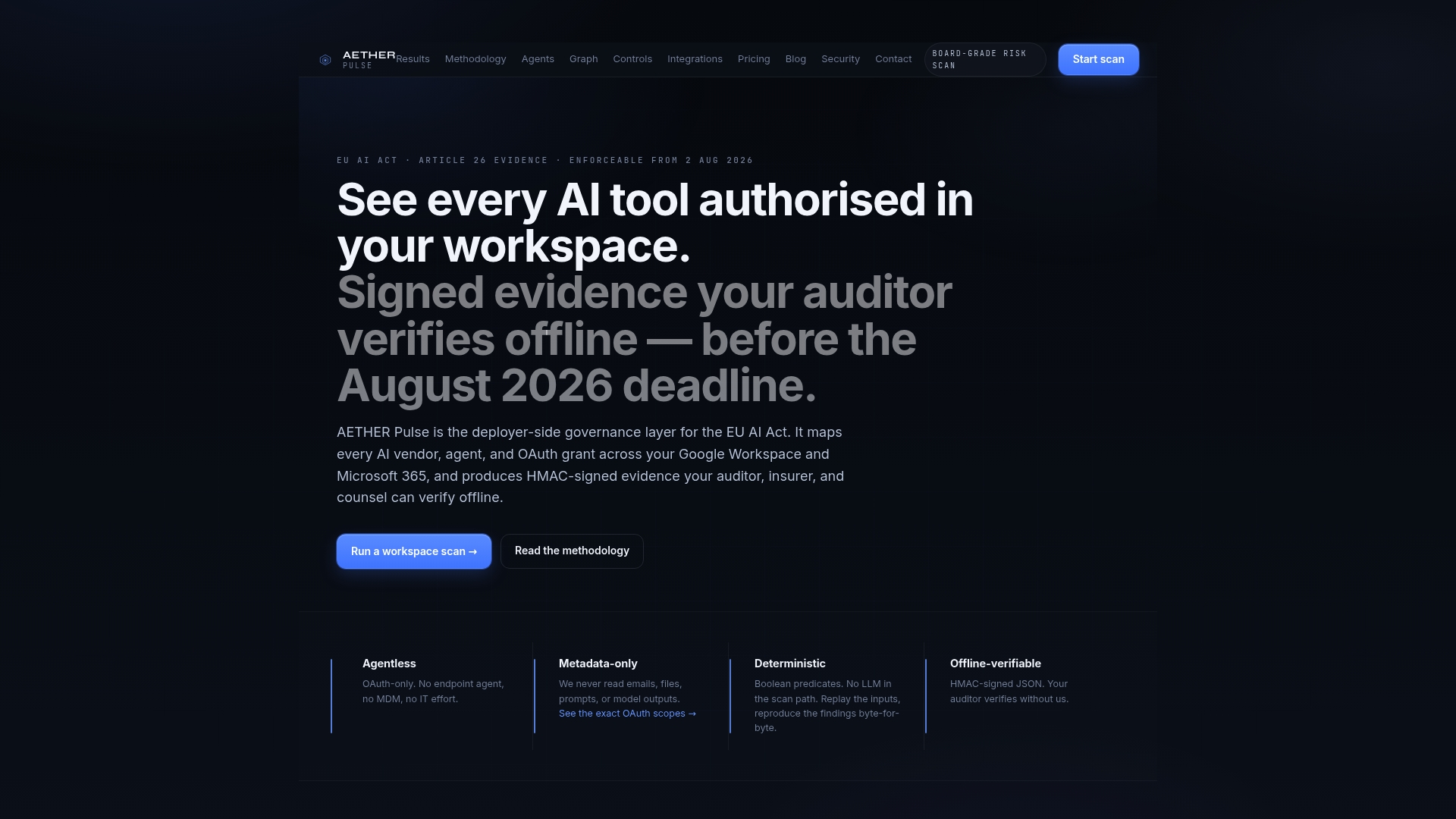
Regulated financial institutions face a specific problem: regulators expect demonstrable oversight of AI agent activity, but most governance tooling either requires invasive integration into production systems or cannot produce the kind of defensible audit evidence that examiners actually want to see.
Aetherpulse addresses this directly. The platform connects through OAuth metadata only, touching no customer data, and builds a complete inventory and identity graph of an organization's AI agents. It surfaces risk concentration, including financial blast-radius exposure, and generates cryptographically signed evidence packs using HMAC-SHA256 that firms can present to auditors, regulators, and internal risk functions on demand.
For compliance and risk professionals managing AI governance obligations across multiple regulatory frameworks, Aetherpulse provides the agentless visibility layer that traditional MRM tooling was never designed to deliver.
Key Takeaways
U.S. AI oversight in regulated financial services relies on a layered framework of existing federal statutes, agency-specific guidance, and evolving state legislation, with no unified federal AI law in place as of 2026.
| Point | Details |
|---|---|
| No unified federal AI law | Oversight relies on SR 26-2, agency-specific guidance, and existing statutes applied to AI use cases. |
| NCUA governance gap | NCUA lacks detailed AI-focused MRM guidance and cannot examine third-party technology providers. |
| Agentic AI excluded from SR 26-2 | The Fed, OCC, and FDIC amended MRM guidance to exclude generative and agentic AI, requiring new governance approaches. |
| Shadow AI undermines audit trails | Unauthorized AI deployments by employees create gaps in regulatory transparency that formal governance programs cannot address. |
| Third-party responsibility stays with the firm | Firms remain legally responsible for outsourced AI services regardless of vendor contractual arrangements. |
Recommended
Working on Article 26 readiness, deployer-side governance evidence, or AI agent risk at a regulated firm? We'd value 15 minutes of your perspective.
Start a conversation