The CRO's Role in AI Model Governance Starts With Ownership
The CRO's Role in AI Model Governance Starts With Ownership

The core answer to "what is the CRO's role in AI model governance" is this: the chief risk officer owns the risk taxonomy, sets executive risk appetite for AI deployments, and produces audit-ready evidence that controls actually work. That ownership cannot sit with the CIO alone, and it cannot live in a spreadsheet nobody updates.
A working checklist for the next quarter looks like this:
- Build a model inventory and apply impact tiering before anything else.
- Mandate test, evaluation, validation, and verification (TEVV) plus red-teaming for high-risk models.
- Require continuous monitoring with defined incident playbooks.
- Enforce vendor contracts that name shared-responsibility boundaries.
- Prepare regulator-ready evidence aligned to the NIST AI RMF and the EU AI Act.
Pro Tip: Firms that can produce audit evidence on demand, rather than assembling it after an examiner asks, consistently shorten review cycles. Tools like AETHER Pulse exist specifically to generate that evidence without touching production data.
Key Takeaways
AI model governance succeeds when the CRO owns risk taxonomy and pause authority, inventory and tiering exist before deployment, and evidence generation runs continuously rather than reactively.
| Point | Details |
|---|---|
| CRO owns risk appetite | The CRO, not the IT team alone, sets risk taxonomy and holds pause authority over unsafe models. |
| Inventory comes first | Build a model inventory with provenance, access mode, and data lineage before writing policy. |
| Tier by reversibility | Grade models by irreversibility of harm, financial exposure, and regulatory sensitivity. |
| Monitoring must be continuous | Track drift, bias, and performance KPIs with alerting thresholds tied to risk appetite. |
| Aetherpulse supports audit readiness | Aetherpulse generates metadata-only, tamper-evident evidence packs mapped to EU AI Act Article 26 and FCA requirements. |
Table of Contents
- What Ownership Looks Like: CRO Responsibilities and Where Authority Sits
- Core Building Blocks: Inventory, Tiering, and Documentation
- Lifecycle Controls: Pre-Deployment Testing, Red-Teaming, and Continuous Monitoring
- Regulatory Alignment: Preparing for NIST and EU AI Act Audits
- What to Require From Vendors and Governance Tools
- A 90 to 180 Day Rollout for AI Model Governance
- Making Governance Audit-Ready Without Touching Sensitive Data
- Common CRO Mistakes and the Fixes That Actually Reduce Risk
- Get Audit-Ready Evidence Without Adding Data Risk
- Sources
What Ownership Looks Like: CRO Responsibilities and Where Authority Sits
Ownership without specificity is just a slogan. The CRO's job in AI model governance breaks into five concrete responsibilities:
- Defining the risk taxonomy that classifies every AI system by function and exposure.
- Writing and enforcing the acceptable-use policy for model deployment.
- Setting escalation thresholds that trigger review before a model reaches production.
- Owning audit evidence, not delegating its existence to engineering.
- Reporting model risk posture to the board on a fixed cadence.
Mapping these duties onto the Three Lines of Defense model helps prevent the fragmentation that examiners flag most often. The business line that deploys a model is the first line. Risk and compliance, sitting in the second line, validate and monitor. Internal audit forms the third. When CIO and CRO responsibilities blur, accountability disappears into the gap between them, and joint accountability structures tend to close that gap faster than informal coordination.
Pro Tip: Establish a standing quarterly review between the CIO and CRO covering every production model. This single habit catches drift in ownership before it becomes an examination finding.
Core Building Blocks: Inventory, Tiering, and Documentation
You cannot govern what you cannot see. The first structural control is a model inventory that captures more than a name and a business owner. Each entry needs provenance, stated purpose, the underlying foundation model, access mode, and data lineage back to source systems.
Risk tiering comes next. RSM's guidance on AI governance for CROs recommends grading systems by reversibility of harm, financial exposure, and regulatory sensitivity. A chatbot answering FAQs sits in a different tier than a model driving credit decisions, and your thresholds should reflect that gap explicitly, not implicitly.
A workable inventory template includes:
| Field | Why It Matters |
|---|---|
| Model purpose | Establishes scope and intended use boundary |
| Foundation model / version | Tracks provenance and change history |
| Access mode | Confirms whether the system reads, writes, or acts autonomously |
| Data lineage | Shows what data trained or feeds the model |
| Last TEVV date | Confirms testing currency |
Documentation needs versioning discipline that survives staff turnover and regulator requests alike, aligning to both the NIST AI RMF and EU AI Act expectations.
Pro Tip: Capture inventory metadata only, without touching underlying customer data. An agentless approach gives the risk office full visibility while keeping data access risk at zero.
Lifecycle Controls: Pre-Deployment Testing, Red-Teaming, and Continuous Monitoring
TEVV, short for test, evaluation, validation, and verification, is the pre-deployment gate every medium and high-risk model must pass before production. NIST's Generative AI Profile treats pre-deployment testing and provenance capture as primary risk controls, not optional extras, and the CRO's job is to require that evidence rather than assume engineering produced it.

Red-teaming scales with risk tier. A low-risk internal tool might need lightweight adversarial checks; a model touching credit or claims decisions needs structured, documented attacks against its failure modes. The International AI Safety Report notes that model evaluations and red-teaming are increasingly embedded in oversight structures, though disclosure and measurement consistency still lag behind adoption.
Once deployed, monitoring becomes continuous, not periodic. The risk office should require:
- Drift detection against baseline accuracy metrics.
- Bias metrics segmented by protected characteristics.
- Performance KPIs tied to defined thresholds.
- Telemetry with alerting when thresholds breach.
Analysts recommend CROs treat AI as a socio-technical system and preserve the authority to pause or cease deployment the moment a model demonstrates unacceptable bias or unreliability, per Berkeley's GPAI profile. That pause authority belongs explicitly to the CRO, documented in the risk appetite statement, not implied.
Regulatory Alignment: Preparing for NIST and EU AI Act Audits
Supervisors ask for specific artifacts, and mapping your controls to named frameworks in advance saves weeks during an exam. The NIST AI RMF's four functions, GOVERN, MAP, MEASURE, and MANAGE, correspond directly to documented roles, risk identification, monitoring metrics, and remediation records. The EU AI Act layers on similar demands for high-risk systems, with Article 26 focused on deployer obligations.
An audit evidence checklist should include:
- Full inventory exports with timestamps.
- TEVV and red-team reports tied to each model version.
- Monitoring logs showing drift and bias metrics over time.
- Incident post-mortems with root-cause analysis.
- Role assignment and approval records showing who signed off on deployment.
Supervisors respond well to three trust signals: documented Three Lines roles, a fixed board reporting cadence, and tamper-evident evidence packs that cannot be edited after the fact. Firms that lack these often remediate by retrofitting a risk register around existing models rather than building one from scratch, which is slower but workable.
Pro Tip: Ask your governance tooling to generate exportable, timestamped evidence on demand. If producing an audit package takes more than a day, your evidence process is the finding, not the models.
What to Require From Vendors and Governance Tools
Third-party models introduce shared-responsibility risk that many contracts still leave undefined. Before signing, run vendors through an evaluation checklist:
- Tamper-evident logging that a vendor cannot quietly alter after delivery.
- Metadata-only integration that avoids moving customer data through vendor infrastructure.
- Provenance capture covering training data and model lineage.
- Support for TEVV evidence in a format your risk office can actually ingest.
- Role-based access control and audit export features.
Contractually, insist on incident reporting service levels, independent evaluation rights, and audit access that survives contract renewal negotiations. Sentient Concepts' work on governance for banking and finance deployments reinforces that independent evaluation rights are becoming a baseline expectation, not a premium add-on.
Vendor claims deserve scrutiny before signature: request safety-case summaries, ask for reproducible test artifacts rather than marketing decks, and confirm the vendor can supply evidence in a format your risk office can drop directly into ERM tooling.
Pro Tip: Require vendors to deliver evidence packs in a structured, ingestible format from day one. Retrofitting that requirement after deployment is far harder than writing it into the contract.
A 90 to 180 Day Rollout for AI Model Governance
- Days 1 to 90: Run an inventory sweep on the highest-impact models, draft the risk taxonomy, and launch a standing CIO-CRO review.
- Days 90 to 180: Finalize TEVV policy for high-risk models, establish a continuous monitoring baseline, and update vendor contracts with the clauses above.
Resourcing matters as much as sequencing:
- Hire or upskill at least one model validation specialist inside the second line.
- Decide early which validation work stays internal versus goes to independent reviewers.
- Prioritize budget toward monitoring infrastructure over one-time assessments.
Watch for two common failure modes during rollout: teams treating the inventory as a one-time project instead of a living record, and monitoring thresholds set so loosely they never trigger an alert.
Making Governance Audit-Ready Without Touching Sensitive Data
The hardest part of AI governance for regulated firms is proving oversight without expanding data access risk. Agentless evidence solves that by connecting through metadata only, inventorying models and their access patterns without ever reading the underlying customer records those models process. Evidence packs generated this way carry cryptographic signing, typically HMAC-SHA256, so a supervisor can confirm the record has not been altered since generation.
A practical evidence checklist teams or vendors should supply on request:
- Timestamped inventory snapshots.
- TEVV artifacts tied to specific model versions.
- Monitoring logs with clear provenance back to source systems.
- Incident records showing detection, escalation, and resolution.
One recurring pattern across firms that adopt this approach: audit cycles that once took weeks of manual evidence assembly shrink substantially because the evidence already exists in exportable form, with no PII exposure risk during collection.
Pro Tip: Structure board packages so every piece of evidence links directly to a line in the risk appetite statement. A board member should be able to trace a monitoring metric straight to the risk threshold it supports without asking a follow-up question.
Common CRO Mistakes and the Fixes That Actually Reduce Risk
A common mistake is fragmented ownership. Another frequent issue is treating IT as the sole owner of a function that carries board-level risk implications. Third is mistaking paperwork volume for evidence quality, and fourth is ignoring shadow AI entirely.
The fixes are unglamorous: codify ownership in writing, tier by reversibility of harm rather than novelty of the technology, and instrument detection for unsanctioned tools before an examiner finds them first.
Pro Tip: The fastest risk reduction usually comes from instrumenting shadow AI detection before writing a single new policy page.
Get Audit-Ready Evidence Without Adding Data Risk
Aetherpulse gives CROs something most governance tooling cannot: full model visibility without a single byte of customer data changing hands. Where many platforms require deep integration into production systems to build an inventory, Aetherpulse connects through metadata only, mapping every AI agent, its access mode, and its financial blast-radius exposure without ever touching the data those agents process.
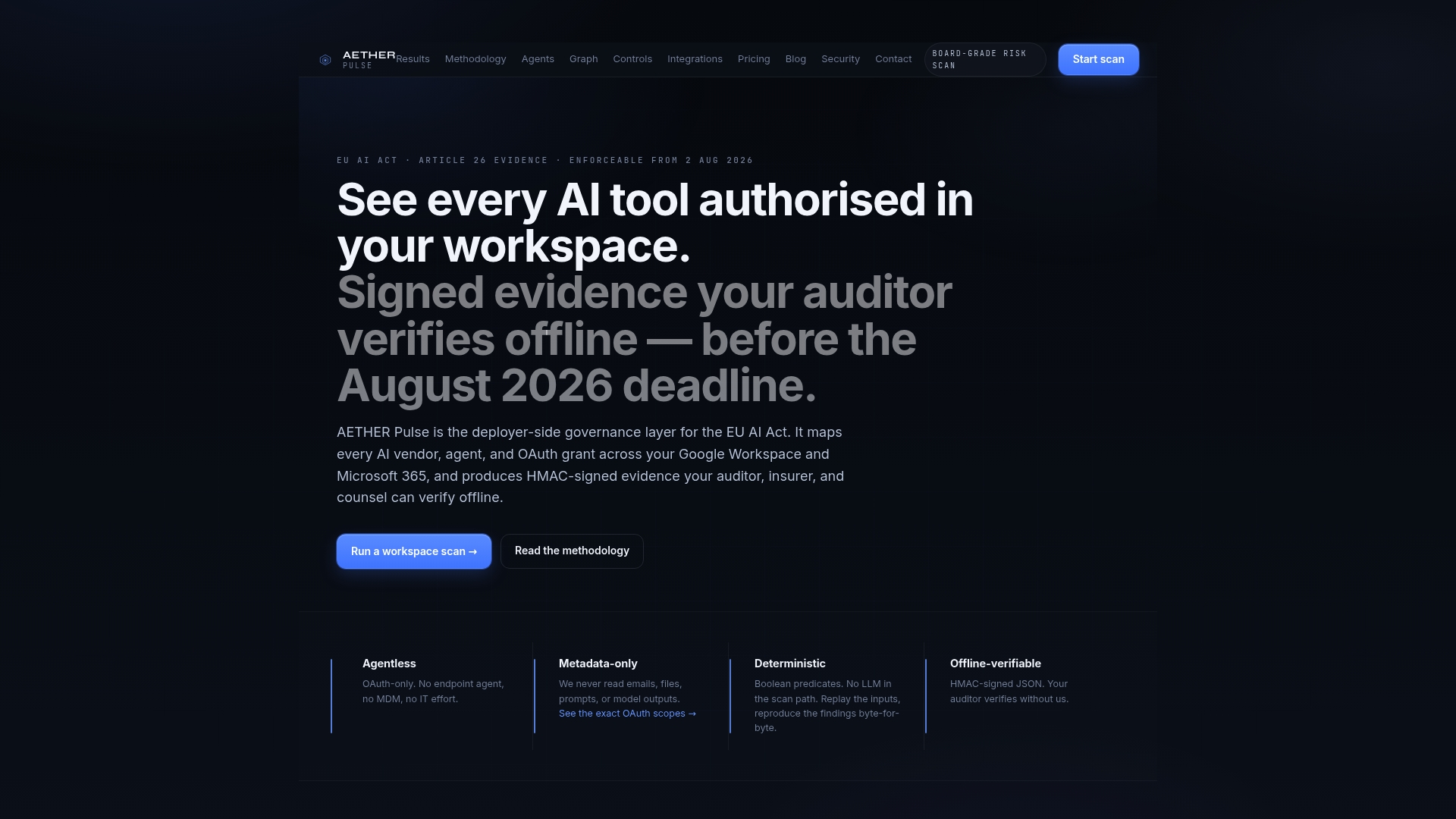
The platform produces tamper-evident, cryptographically signed evidence packs built for exactly the audit asks covered above: inventory exports, provenance records, and regulator-ready documentation aligned to EU AI Act Article 26, FCA SYSC, Consumer Duty, and the ICO's developing guidance on automated decision-making. For a risk office trying to close the gap between "we have a policy" and "we can prove it," that read-only layer removes the data-access tradeoff entirely. Review the pricing and plan details or explore the product overview to see how a demo would map onto your current model inventory.
Sources
Deepen your evidence mapping with these sources, and share them directly with compliance and audit teams building parallel documentation:
This article is general information, not a substitute for advice from a qualified financial advisor. Consult a qualified financial professional about your own circumstances before acting on anything here.
Recommended
- Building an AI Governance Operating Model for Regulated Financial Services - AETHER Pulse
- The Difference Between AI Governance and AI Oversight, and Why It Matters for Compliance - AETHER Pulse
- What Good AI Governance Actually Looks Like in a Regulated Financial Services Firm - AETHER Pulse
- AI Model Inventory Management Steps for Audit Readiness
Working on Article 26 readiness, deployer-side governance evidence, or AI agent risk at a regulated firm? We'd value 15 minutes of your perspective.
Start a conversation