AI Explainability Requirements for Compliance Officers
AI Explainability Requirements for Compliance Officers

AI explainability requirements for compliance officers are defined as the obligation to demonstrate, document, and defend how AI systems reach decisions that affect regulated outcomes. The EU AI Act sets a hard deadline of august 2, 2026 for transparency obligations under Article 50 to take effect. Compliance officers in European and UK financial firms must now treat explainability not as a technical footnote but as a frontline governance requirement. The industry term for this discipline is explainable AI (XAI), and it covers everything from human-readable decision accounts to immutable audit trails and third-party model assessments.
1. What are the top explainability criteria compliance officers must verify?
Explainability compliance starts with human-readable decision accounts. Any AI system affecting credit scoring, insurance underwriting, or hiring decisions must produce an explanation a non-technical reviewer can evaluate. Regulators and auditors do not accept "the model said so" as a sufficient answer.
Documentation depth is the second criterion. Compliance officers must confirm that model cards, data lineage records, and preprocessing details exist and are current. A model card without version history is not audit-ready. Data lineage must trace inputs from source to output, with no gaps.

Third-party assessments are mandatory for the most complex models. Models exceeding 1 million parameters require independent explainability reviews under Article 14 of the EU AI Act. That threshold catches most large language models and many credit-scoring engines deployed in regulated finance.
Continuous monitoring and version control round out the core criteria. A model that was explainable at deployment may drift over time. Compliance officers must verify that monitoring alerts are validated, that changes are logged, and that the audit trail is immutable.
- Human-readable decision accounts for all high-risk AI outputs
- Model cards with version history and data lineage
- Independent third-party assessments for models above 1 million parameters
- Continuous monitoring with validated alert workflows
- Immutable version control capturing every model change
Pro Tip: Run a quarterly explainability spot-check: pull three recent AI decisions, request the human-readable explanation for each, and verify the explanation matches the documented model logic. If they diverge, you have a gap before the auditor does.
2. How to integrate AI explainability into existing governance frameworks
The most efficient path to AI transparency compliance runs through your existing model risk management framework, not around it. Updating current risk policies to include AI-specific risks such as bias, drift, and explainability is faster and more defensible than building a parallel governance structure. Regulators expect to see AI risks mapped to your stated risk appetite, not siloed in a separate AI policy document.
Practical integration follows a clear sequence:
- Inventory all AI systems currently in production, including vendor-supplied models embedded in third-party platforms. You cannot govern what you have not cataloged.
- Map each system to a risk tier based on the decisions it influences. Credit decisions and customer-facing outputs sit at the top tier and require the deepest explainability controls.
- Assign human oversight roles for each tier. Article 14 of the EU AI Act requires meaningful human oversight, which means a named individual with authority to override, not just a passive reviewer.
- Embed explainability checkpoints into your existing model approval workflow. Add a sign-off step that confirms human-readable explanations exist before any model goes live.
- Document review decisions and alert validations. Every time a monitoring alert fires, the response must be logged. Auditors look for evidence that humans acted on signals, not just that signals existed.
Pro Tip: Attach your AI explainability checklist directly to your existing model change-control form. This creates a single paper trail and prevents explainability sign-off from being treated as optional.
3. What technical and operational challenges compliance officers face
Black-box AI models are the central challenge. Neural networks and gradient-boosted ensembles produce outputs that resist straightforward explanation. Post-hoc interpretation methods exist, but they introduce their own uncertainty. An explanation generated after the fact is not the same as a model that was built to be transparent.
The audit risk is concrete. Firms relying on post-hoc neural network interpretation face a credibility gap when auditors ask how a decision was reached. Deterministic automation, where business rules are written in explicit, auditable logic, eliminates that gap. English-as-code automation tools encode decision logic in plain language that auditors can read directly. This approach trades some model performance for full auditability, a trade that regulators increasingly expect regulated firms to make.
Vendor risk is the second major operational challenge. Many financial firms deploy AI through third-party providers who treat their models as proprietary. Vendor contracts must require on-demand feature-attribution evidence, audit rights, and clear allocation of compliance responsibility. Without those provisions, a firm cannot meet its own explainability obligations when the model sits outside its walls.
Key challenges to address before the august 2026 deadline:
- Black-box models that cannot produce human-readable explanations without post-hoc approximation
- Vendor agreements that lack audit rights or feature-attribution evidence clauses
- Disclosure language that is technically accurate but inaccessible to end users
- Monitoring systems that log alerts but do not record human responses
- Model documentation that exists at deployment but is not updated after changes
4. Operational best practices and tools for AI explainability compliance
ISO/IEC TS 6254:2025 is the most relevant technical standard for compliance officers building an explainability program. The standard addresses multi-stakeholder explainability objectives, recognizing that regulators, auditors, developers, and end-users each need different types of explanation. A regulator needs to see decision logic and governance controls. An end-user needs a plain-language account of why a decision was made about them.
The standard endorses three main technical approaches: LIME (Local Interpretable Model-agnostic Explanations), SHAP (SHapley Additive exPlanations), and interpretable models built for transparency from the start. SHAP values show the contribution of each input feature to a specific output. LIME approximates a complex model's behavior locally around a single prediction. Interpretable models, such as decision trees or logistic regression, produce explanations as a natural output rather than a post-hoc add-on.
| Approach | Best for | Audit strength |
|---|---|---|
| SHAP values | Feature attribution in complex models | High: quantified per-feature contribution |
| LIME | Local explanation of individual decisions | Medium: approximation, not exact logic |
| Interpretable models | Credit scoring, rule-based decisions | Highest: explanation is the model itself |
| English-as-code automation | Compliance workflow decisions | Highest: logic is human-readable by design |
Compliance teams also need operational infrastructure. Standardized reporting protocols, real-time monitoring dashboards, and compliance checklists tied to specific regulatory articles give auditors a clear view of the program. Training compliance staff to recognize explainability as a business risk, not a data science task, is the governance shift that makes the rest of it work.
5. What immediate actions to take before the August 2, 2026 deadline
The august 2, 2026 deadline under Article 50 is not a soft target. Transparency disclosures must be noticeable, accessible, and presented at the point of AI interaction, not buried in terms and conditions. Compliance officers who have not yet audited their customer-facing AI interfaces are already behind.
- Identify every AI system subject to Article 50 transparency rules. This includes chatbots, automated decision tools, and any system that generates synthetic content or interacts with customers without human mediation.
- Audit customer-facing interfaces for disclosure quality. The disclosure must appear at first interaction, use plain language, and meet accessibility standards. A footnote in a privacy policy does not satisfy the requirement.
- Update onboarding and publication workflows to embed disclosure steps. Compliance sign-off should be required before any AI-powered customer interface goes live or is materially changed.
- Coordinate with vendors to assign compliance responsibility. Where a third-party model powers a customer interaction, the contract must specify who owns the disclosure obligation and how evidence will be produced on request.
- Prioritize remediation of the highest-risk gaps first. Credit decision systems, customer-facing chatbots, and automated underwriting tools carry the greatest regulatory exposure. Fix those before addressing lower-risk internal tools.
Explainability as a frontline business risk means that gaps in disclosure or documentation are not just compliance failures. They are reputational and financial exposures that boards and senior management will be asked to account for.
Key takeaways
AI explainability compliance requires immutable audit trails, stakeholder-specific documentation, and vendor contracts with explicit audit rights, all in place before the august 2, 2026 EU AI Act deadline.
| Point | Details |
|---|---|
| August 2026 deadline is fixed | Article 50 transparency obligations apply from august 2, 2026 with no grace period for financial firms. |
| Third-party assessments are mandatory | Models with more than 1 million parameters require independent explainability reviews under Article 14. |
| Governance integration beats isolation | Embed AI explainability into existing model risk frameworks rather than creating a separate AI policy. |
| Vendor contracts must include audit rights | Require feature-attribution evidence and audit access clauses before signing any AI vendor agreement. |
| Disclosure quality is a legal standard | Article 50 disclosures must appear at first user interaction in plain, accessible language. |
The compliance officer's real challenge is governance, not technology
The firms that will struggle most with explainability are not the ones running the most complex models. They are the ones that treated AI governance as a technology project rather than a compliance function. I have seen this pattern repeatedly: a data science team deploys a model, writes documentation that satisfies internal review, and then compliance inherits a system it cannot fully explain to an auditor. The documentation exists, but it was written for engineers, not regulators.
The shift that actually works is treating every AI deployment decision as a governance event from the start. That means compliance officers sit in model approval meetings, not just model review meetings after the fact. It means vendor diligence happens before procurement, not after a contract is signed. And it means the audit trail is built into the deployment process, not reconstructed when a regulator asks for it.
The August 2026 deadline is useful pressure. But the firms that will be genuinely audit-ready are the ones that stopped asking "does this model work?" and started asking "can we explain this model to a regulator at 9 AM on a Monday morning?" Those are different questions, and the second one changes how you build, buy, and govern AI.
— Eleye
Aetherpulse: audit-ready AI governance for regulated firms
Compliance officers managing AI explainability obligations need more than a checklist. They need a system that produces defensible evidence on demand.
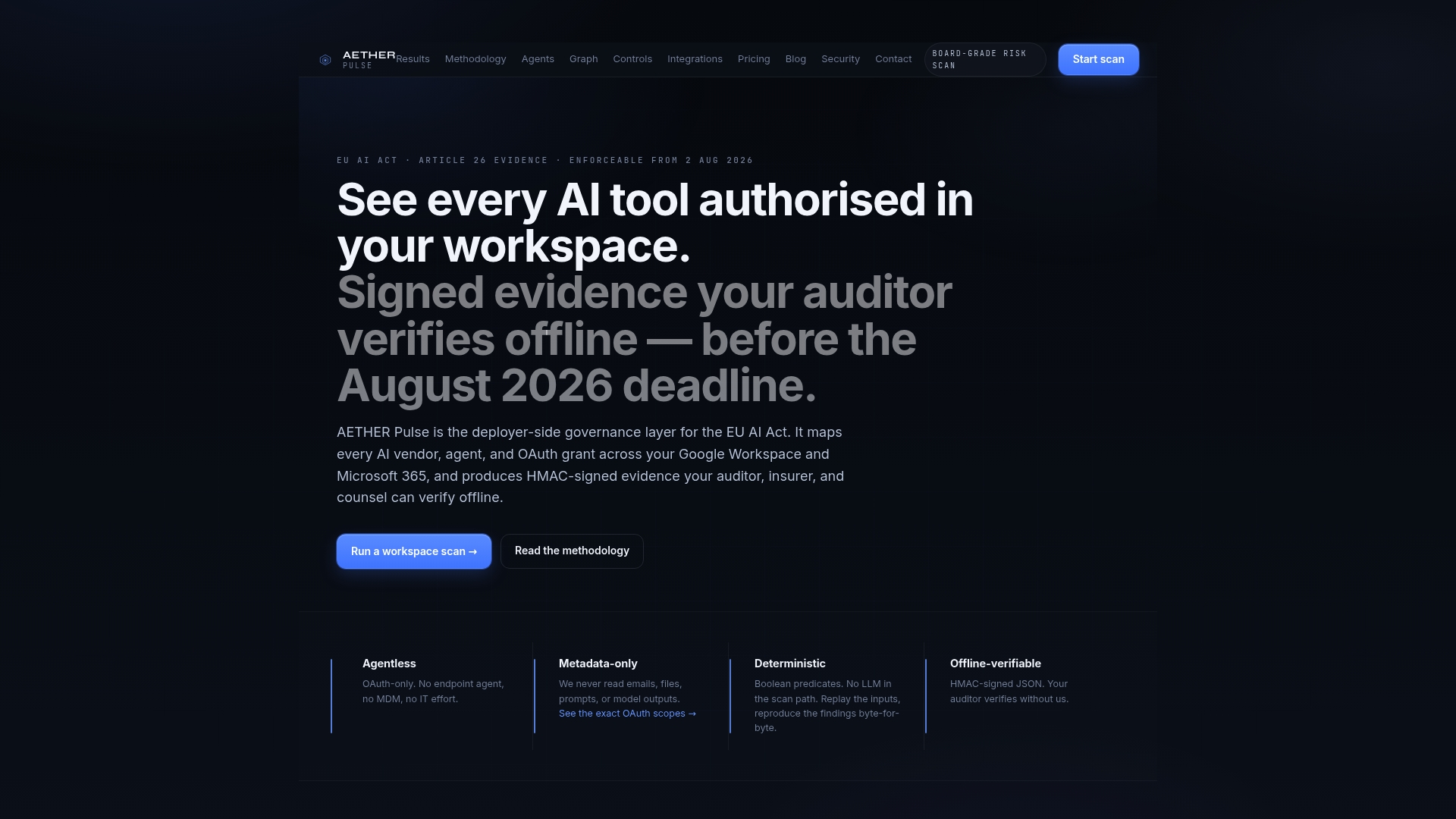
Aetherpulse is built specifically for regulated financial firms in the UK and EU. It connects through OAuth metadata only, touching no customer data, and generates cryptographically signed (HMAC-SHA256) evidence packs that auditors and regulators can verify. The platform builds an inventory of all AI agents in your organization, surfaces risk concentration, and tracks data lineage without inserting itself into production systems. For compliance officers facing the August 2026 EU AI Act deadline, Aetherpulse provides the audit-ready documentation layer that most governance programs are still missing.
FAQ
What does Article 50 of the EU AI Act require?
Article 50 requires that AI systems interacting with users disclose their AI nature clearly and accessibly at the point of first interaction. Disclosures must not be buried in terms and conditions or layered menus.
Which AI models require third-party explainability assessments?
Models with more than 1 million parameters require independent third-party assessments under Article 14 of the EU AI Act. This threshold captures most large language models and complex credit-scoring engines.
How does ISO/IEC TS 6254:2025 help compliance officers?
ISO/IEC TS 6254:2025 defines multi-stakeholder explainability objectives and endorses technical approaches including SHAP, LIME, and interpretable models. It gives compliance teams a recognized standard to reference in audit documentation.
What should vendor contracts include for AI explainability?
Vendor contracts must require on-demand feature-attribution evidence, explicit audit rights, and clear allocation of compliance responsibility. Without these provisions, a firm cannot meet its own explainability obligations for third-party models.
What is the difference between SHAP and LIME for compliance purposes?
SHAP provides quantified, per-feature attribution for individual decisions and carries the strongest audit credibility. LIME approximates model behavior locally and is useful for explanation but is not a substitute for model-level transparency.
Recommended
Working on Article 26 readiness, deployer-side governance evidence, or AI agent risk at a regulated firm? We'd value 15 minutes of your perspective.
Start a conversation